First issued in 2015, the UN’s Sustainable Development Goals (SDGs) provide clear guidance on lifting millions of people around the world out of poverty and mitigating the impact of climate change. Ranging from reducing hunger to improving education to raising incomes and boosting economic growth, the 17 goals include 169 specific sustainability targets to be met by 2030. At present, however, progress toward just 12% of these targets is on track and, in the case of more than 30%, it has either stalled or reversed, according to the UN.
Nowhere is the need to close these gaps greater than in Africa. And there is no better way to close them than by boosting investment in the continent’s agriculture sector. According to our analysis, between 30% and 50% of overall SDG targets—starting with SDG 1 (“no poverty”) and SDG 2 (“zero hunger”)—could be met through improvements in the continent’s agrifood systems. Yet Africa’s agriculture sector currently receives only 4% of all investment in the continent, and just 3% of global development funding.
This article examines why African agriculture is so critical to global sustainable development, the amount and kinds of investment needed, and the investment strategies that can help close the gap in the current development funding landscape.
Why African Agriculture Matters
Agriculture and its related food systems are the backbone of African economies. They provide livelihoods for 70% of the population—mostly women—and contribute around 30% to the continent’s GDP.
Yet this vital sector remains underfunded and underoptimized. Over the past ten years, for example, cereal production across sub-Saharan Africa has increased by 37%, according to the UN’s Food and Agriculture Organization, largely owing to the cultivation of more land. Yet cereal yields per hectare remain approximately 60% below the world average. That’s in part because, by and large, the continent’s farms use fewer inputs and are far less mechanized than those elsewhere. And just 5% of its farmland is irrigated, almost two-thirds less than farms in other parts of the world.
The sector’s underperformance has made Africa heavily reliant on food imports. Between 2015 and 2017, the continent spent an average of $27.3 billion annually on imported cereals. Without intervention, this figure could rise to $110 billion by 2030.
Global Benefits
Despite these challenges, African agriculture can be a powerful lever for change. Closing the current productivity gap will be crucial to feeding a population expected to double by 2050, while also contributing to the resilience of global food systems to price shocks and supply chain disruptions.
Thus, increasing investments in African agriculture represents a major opportunity not just for Africa but for the world. Agricultural investment is two to four times more effective at raising incomes than investments in other sectors. And given that 250 million Africans currently work in agriculture, investing in the sector will foster inclusive growth, safeguard livelihoods, and build resilience. These investments promise not only strong returns for the continent but also attractive opportunities for foreign investors and businesses.
In addition to the economic benefits, sustainable farming practices can protect communities from climate shocks, bolster long-term food security, and reduce pressure on forests. With African land offering great potential as carbon sinks, increasing yields on existing farmland is essential to preventing deforestation and advancing global climate goals. Taken together, improvements in the continent’s agriculture sector can have a profound effect on global development. (See “Closing the Development Gap.”)
What Is Needed?
Despite its potential to close so many significant gaps in the UN’s development goals, African agriculture remains severely underfunded. And given the current financing landscape, its funding could decline even more.
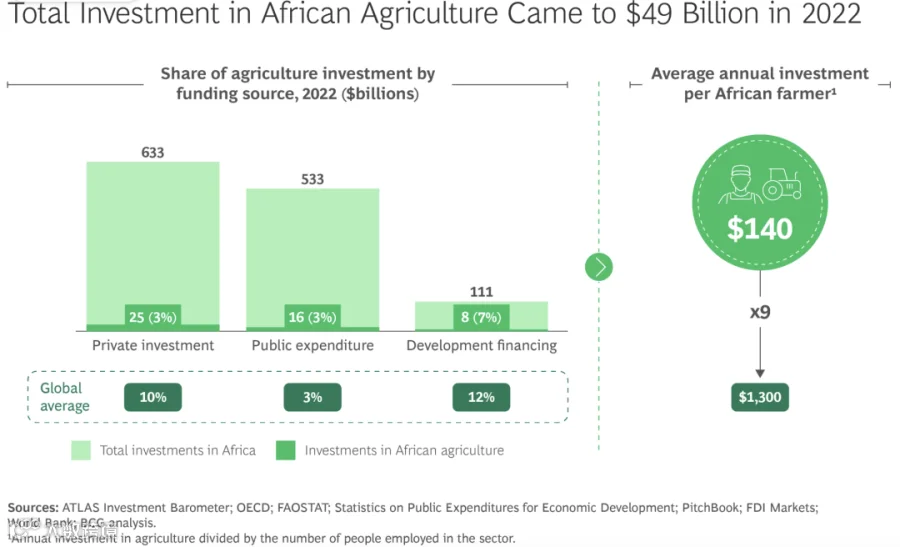
Total investment in Africa’s agriculture sector in 2022 came to $49 billion across public, private, and development financing, according to the ATLAS Investment Barometer. (See the exhibit below.) That’s approximately $140 per African farmer per year, whereas farmers globally receive an average of $1,300 a year. The share of funding for African farmers is less than 3% of total global development funds and less than 4% of total investments in Africa from all sources combined.
The funding gap cuts across all investment sources. Public expenditure in African agriculture amounted to $16 billion in 2022, equivalent to about 3% of total public spending in the continent, and far from meeting the African Union’s Comprehensive Africa Agriculture Development Program target of at least 10% of public expenditures directed to agriculture. In fact, just two African countries—Malawi and Ethiopia—consistently dedicated at least 10% of their government budgets to agriculture between 2008 and 2022.
Similarly, only 7% of development financing in Africa in 2022 went to agriculture, well below the global average of 12%. Investment from private sources in the sector—primarily commercial lending by banks, but also foreign direct investment and private equity and venture capital—represented just 3% of total private funding in 2022—considerably less than the average 10% of private-sector spending invested in the sector globally.
Clearly, the current level of funding isn’t enough. According to the Africa Food Systems Forum, the continent needs a total of $200 billion in investment if it is to create a fully sustainable agrifood system and help reach the UN’s development targets. Yet with shifting geopolitical priorities and tightening development budgets, a critical question remains: Where will this funding come from?
To help bridge the gap, each group of funders must focus on targeted, high-impact priorities that can unlock further investment and accelerate agricultural transformation.
Development Agencies. Given the effectiveness of agricultural funding in achieving development goals, these agencies can play a key role by maintaining their support. Investing in agriculture remains one of the most effective levers for achieving broader development goals, from poverty reduction to climate resilience. These funders can also focus on catalytic investments—such as risk-sharing mechanisms and blended-finance solutions—that can attract and unlock further funding from both public and private sources.
Public Funders. African governments can play a major role in helping to close the funding gap. As with development financing, these public sources should prioritize spending directed at enabling the opportunities and conditions needed for private investment. This includes areas such as critical infrastructure that will open up the possibility of further private funding. And they should promote investment-friendly policies and reduce bureaucratic obstacles to agricultural development.
Private Sector. Private companies and financial institutions already contribute half of all investment in African agriculture. Now they must double down on investing in the sector, pursuing growth opportunities in agriculture and related areas like energy, water, and technology, as well as developing innovative financing mechanisms and promoting local entrepreneurship. In this effort, private investors should operate in conjunction with local and national governments, boosting accountability across both spheres and improving the chances of success.
In June 2024, the Paris Peace Forum created the Agricultural Transitions Lab for African Solutions (ATLAS) to advocate for increased investment, align priorities, and promote transparency and accountability in African agrifood systems. More than 35 organizations across the public, private, and development sectors are now part of this initiative.
During the January 2024 meeting of the World Economic Forum in Davos, Switzerland, ATLAS launched the 2x30 Challenge, calling on funders to work together to double the current $49 billion in investment in African agriculture by 2030. The ATLAS Investment Barometer tracks funding progress across all types of investments, improving transparency into and accountability for investments made in the continent’s agriculture sector.
The evidence is clear: increasing investments in African agriculture would reap benefits for both Africa and the world. Boosting agricultural output would not just increase the food available on the continent, but also drive growth, protect jobs, and secure livelihoods for 250 million agricultural workers, while building climate resilience across the agricultural value chain.
More investment would also strengthen global food security by reducing Africa’s reliance on imported food, reduce the likelihood of disruptions such as conflicts and pandemics, and limit the social and environmental impact of climate change, including the mass displacement of peoples.
Finally, it would offer investors opportunities not just to help achieve global development goals at scale, but to benefit financially at the same time. In short, boosting investment in African agriculture is a triple win for everybody.
Source:Boston Consulting Group
自贸港经贸发展研究院于香港九龙成立,作为综合型智库咨询机构,研究院汇集专业博士与行业资深顾问,在国内外拥有丰富的行业技术积累和区域发展经验。以政府和企业为核心,长期致力于国内外产业提升、地方经济发展、专项规划策划、城乡发展咨询、存量资产盘活、谋划优质项目、企业双向出海、全球战略落地与实施等。紧密围绕区域高质量发展,充分利用国际资源优势,提供解决方案和全过程支持。
点击跳转→自贸港经贸发展研究院 | 简介