

December
Global Market Insights
01
Early Steps Back
Through Suez
CMA CGM has taken a significant step toward normalizing Red Sea operations by announcing a return to the Suez Canal on three services. The most notable is the INDAMEX service, which has resumed a full loop connecting India and Pakistan with the US East Coast. In addition, CMA CGM has rerouted the backhaul legs of its MEX (Ocean Alliance MED2) and FAL1 (OA NEU4) services via Suez, cutting one week from roundtrip times.
Other carriers are moving more cautiously. Maersk completed its first Suez Canal transit in December with the Maersk Sebarok on the MECL1 service linking the Middle East and US East Coast, but the move was not announced in advance, indicating that large-scale redeployment is not yet imminent. Such unannounced transits allow carriers to test conditions but can create challenges for shippers and ports if cargo arrives earlier than expected (Journal of Commerce, Dec 2025).
Meanwhile, Yang Ming has said a return to regular Red Sea sailings is under consideration but will be gradual and coordinated with alliance partners, ONE & HMM. The carrier stressed that crew safety, cargo security and schedule reliability remain paramount, and warned that even after a reopening, full network and supply chain stability could take several months (Loadstar, Dec 2025).
02
China Launches $113 Billion
Free-trade Experiment
on Hainan Island
China launched the Hainan Free Trade Port on December 18, 2025, turning the southern island into a duty-free customs zone to attract foreign investment and boost trade. Goods with at least 30% local value-added can enter the Mainland of China tariff-free, and foreign companies will gain broader access to selected service sectors. The initiative aims to position Hainan as a regional logistics and trading hub similar to Hong Kong and supports China’s bid to join the Comprehensive and Progressive Agreement for Trans-Pacific Partnership (CPTPP)—a major trade pact among Pacific Rim economies that promotes high standards for market access, investment, and trade rules (Reuters, Dec 2025).
03
Thailand–Cambodia
Border Clashes Disrupt
Land Logistics
Since early December 2025, renewed military clashes along the Thailand–Cambodia border—particularly at Poipet—have involved small arms, artillery, rocket exchanges, and airstrikes, leading to border closures, civilian displacement, and halted land transport (Reuters, Dec 2025). These developments have significantly disrupted cross-border logistics, increased supply chain risks, and raised operational safety concerns, forcing businesses to adapt their transport strategies and bear higher costs.
04
Panama Port Deal
Hits Geopolitical Roadblock
In mid-December 2025, the planned $22.8 billion acquisition of Panama Canal ports by BlackRock and MSC reached an impasse. China has reportedly demanded that state-owned carrier COSCO receive a controlling stake in the transaction, a condition that has stalled the deal (The Wall Street Journal, Dec 2025). The uncertainty surrounding port ownership could affect port operations, capacity allocation, and shipping network planning along Asia–Americas trade lanes. This development highlights how geopolitical factors can directly impact critical port assets and global shipping strategies, underscoring the importance of logistics operators closely monitoring ownership changes at key maritime hubs.
December
Port Updates
Slovenia – Port of Koper
Koper is currently moderately congested, with vessel waiting times over 3 days and high terminal utilisation. Import and export dwell times have extended due to yard pressure and rail infrastructure works.
China – Ningbo-Zhoushan Port
In December 2025, Ningbo‑Zhoushan Port achieved a historic milestone, with annual container throughput exceeding 40 million TEUs for the first time, confirming its status as one of the world’s busiest container hubs (Global Times, Dec 2025).
Bangladesh – Chittagong Port
The port is experiencing a 7-day average vessel waiting time of approximately 1.5–2 days despite high yard density. However, feeder and transshipment services have experienced delays due to regional congestion and peak-season volumes.
Malaysia – Port Klang
The port maintained normal operations with a 7-day average vessel waiting time of around 2 days. Late November berth congestion and high yard utilisation (90%+) caused 2–3 day delays, mainly affecting feeder and smaller vessels.
Pakistan – Karachi Port & Port Qasim
Following the recent end of the goods transport strike, both Karachi Port and Port Qasim are experiencing heavy congestion, with vehicles taking up to 8–10 hours to pick up empty containers and return full container loads. Operations are further constrained by time restrictions at Karachi Port (11 PM–6 AM daily), making container movements to terminals more challenging.
January
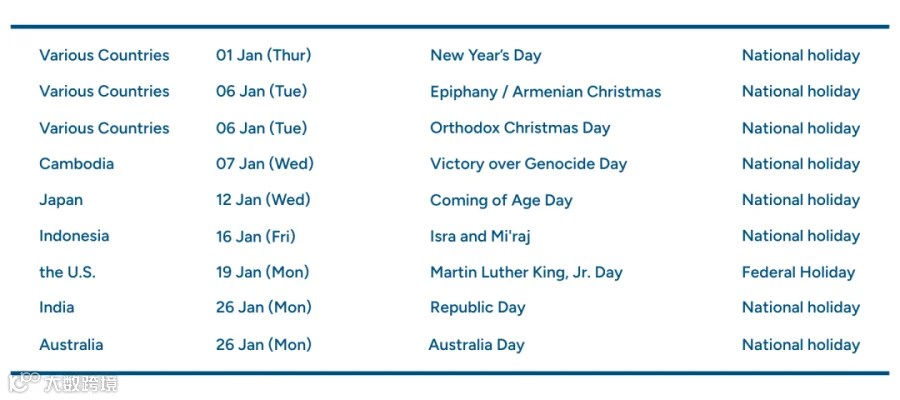
January Holidays
December
MOOV Highlights