

January
Global Market Insights
01
Shipping Lines Return to
Red Sea–Suez Corridor
CMA CGM has resumed several services through the Suez Canal and the Red Sea, reconnecting European and Asian ports after two years of rerouting around Africa due to security risks. Shortly thereafter, on January 15, 2026, Maersk officially restarted its MECL service, with the vessel Cornelia Maersk, via the Suez Canal and the Red Sea, re-establishing its East–West corridor as part of a phased return strategy. Maersk Detroit departed North Charleston on 10 January 2026 as the first eastbound sailing to use the Trans-Suez route, with all subsequent sailings following this routing (Maersk.com, January 2026). These moves follow successful trial transits by CMA CGM and Maersk from December 2025 through early January 2026, which demonstrated improved stability in the region.
Impact: The partial reopening is expected to shorten transit times and reduce costs on Asia–Europe trade lanes, strengthening supply chain efficiency. However, carriers continue to monitor security and insurance conditions before fully normalizing operations (Reuters, January 2026).
02
Road Carrier Strike
Hits Gdańsk Baltic Hub
A drivers‘ strike took place in early January near the Baltic Hub Container Terminal, impacting access roads around Kontenerowa and Sucharskiego streets. The blockade began on 7 January, preventing vehicles from entering or exiting the terminal and temporarily halting landside operations, including trucks already inside the facility. The protest was organised by road carriers in response to newly introduced terminal policies and additional charges, including a planned PLN 65 entry fee during peak daytime hours. Initial negotiations did not result in an immediate resolution, and the disruption affected terminal flows and hinterland connectivity.
Following further discussions on 8 January 2026, representatives of road carriers, Baltic Hub, and the Port of Gdańsk Authority reached a joint declaration. The agreement sets a framework for continued negotiations covering operational efficiency, capacity management, systemic improvements, and clear procedures for exceptional situations. Conditions to end the protest were also agreed, allowing roads to be unblocked and port operations to resume (Baltichub.com, January 2026).
Impact: Operations have since normalised and any resulting backlogs are being recovered, but the event highlights ongoing sensitivity around terminal access, cost structures, and landside capacity at key European gateways.
03
Bangladesh –
General Election 2026
Bangladesh is scheduled to hold its general election on 12 February 2026, including parliamentary elections for the Jatiya Sangsad and a constitutional referendum. The vote follows ongoing political uncertainty since 2024 and may influence short-term economic and operational stability (Reuters; Dhaka Tribune, January 2026).
Impact: During the election period, disruptions to domestic transport, labour availability, customs clearance, and inland logistics may occur. MOOV will proactively monitor conditions across our customers’ supply chains to provide impact assessments and recommendations to support informed planning and risk mitigation.
04
Spring Festival 2026
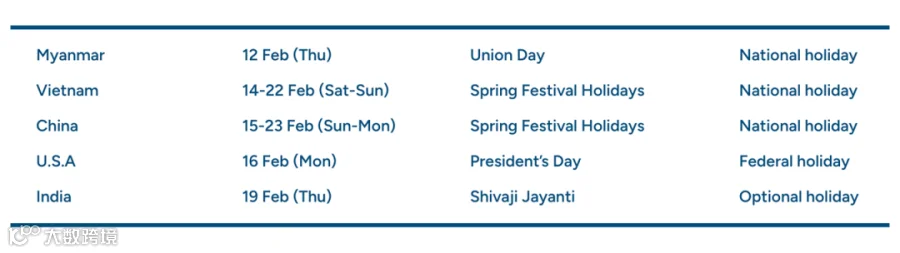
The Spring Festival in China and Vietnam falls in mid-February 2026, with the main public holiday period lasting approximately one week, although operational disruption typically extends 2–4 weeks before and after the festival. During this period, factories, warehouses, and logistics service providers reduce operations or shut down entirely as workers travel home. This commonly results in production slowdowns, labour shortages, port congestion, equipment imbalances, and delays in customs clearance and inland transportation.
Pre-holiday shipping demand usually surges as shippers move cargo ahead of closures, followed by capacity constraints and slower recovery once operations resume, particularly in southern China and northern Vietnam manufacturing hubs.
Impact: MOOV coordinates closely with customers to advance or defer orders as required, supported by early supplier visibility, proactive warehouse capacity planning, and clear communication of port operating hours to minimise supply chain disruption.
05
Ramadan 2026
Ramadan 2026 is expected to run from mid-February (approximately 18–19 February) to mid-March 2026 (around 19–21 March, subject to local moon sightings). Across Asia Pacific markets with significant Muslim populations, including Indonesia, Malaysia, Bangladesh, and Pakistan, Ramadan typically results in reduced working hours and labour availability. This can lead to slower customs clearance, constrained port operations, and extended transit and delivery timelines.
In parallel, demand for food and consumer goods—particularly refrigerated cargo—generally increases. Port Klang has already experienced operational pressure, with reefer transshipment volumes impacted by higher imports of chilled and frozen food products.
Impact: Eid follows the conclusion of Ramadan, with the Eid holiday commencing on Wednesday, 18 March. Regular business activities are expected to resume between 24–25 March, depending on location. During this period, MOOV works closely with customers to support effective planning and minimise disruption, with clear arrangements communicated in advance. Some disruption at regional ports may occur during the holiday period, and customers are encouraged to plan accordingly and engage early with their MOOV contacts for support.
January
Port Updates
Bangladesh – Chittagong Port
Chittagong Port operations remain stable, with vessels securing berths immediately upon arrival. Improved berth availability compared to previous years has reduced the average vessel turnaround time to approximately 2.5 days.
Belgium – Antwerp Port
At Antwerp, the 7-day average vessel waiting time is around 1.13 days. Yard utilisation remains high at terminals Q913 and Q869 across dry, reefer, and empty container stacks.
China – Ningbo Port
Ahead of the Chinese New Year, increased export volumes and vessel bunching have tightened berth availability. Some terminals are reporting vessel waiting times of approximately 2–3 days.
Germany – Port of Hamburg
Broader European port conditions also show ongoing congestion and schedule impacts, particularly at Port of Hamburg and other Northern Europe hubs, with residual effects from winter weather and backlog contributing to vessel line-ups and impacts on schedule reliability.
Malaysia – Port Klang
Port Klang continues to operate under relatively stable conditions in January, with manageable berth congestion. Average vessel waiting times remain around 1–2 days, although higher yard utilization has caused minor delays for feeder and intra-Asia services.
Netherlands – Rotterdam Port
At Rotterdam, the 7-day average vessel waiting time is approximately 1.69 days. Terminal operations remain under pressure, with intermittent delays linked to vessel bunching and regional network disruptions.
Sri Lanka – Colombo Port
Colombo Port reports a 7-day average vessel waiting time of approximately 1.08 days. Despite recent capacity enhancements, congestion persists, impacting vessel flow and overall operational efficiency.
February
February Holidays
January
MOOV Highlights