


“Time” in Chinese sentence structure
“Time when” will go either right before the subject or right after the subject. So, the sentence structure will become:
Subject + Time when + Verb + Object
or
Time when + Subject + Verb + Object
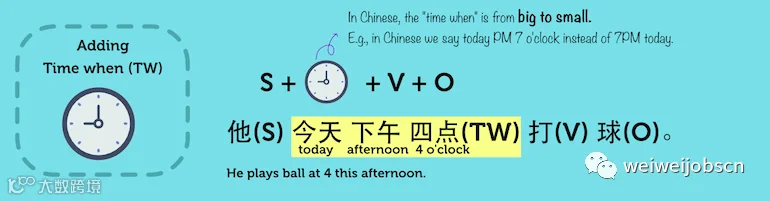

Let’s use the same example from above:
He plays ball at 4 this afternoon.
4 o’clock this afternoon is the “time when.” It can be placed either right before, or right after, the subject.
To apply the sentence structure Subject + Time when + Verb + Object,
the order will be:
He + today afternoon 4 o’clock + plays + ball.
他今天 下午 四点 打球
Tā jīntiān xiàwǔ sì diǎn dǎ qiú.
Note: If there is more detail about the time, they go from big to small in Chinese. For example, you have an appointment at 11:30 AM. There are two, time words, 11:30 and AM. As we just mentioned, the correct time words order is from big to small. AM has a bigger time range (12 hours) and 11:30 is a moment. So, the order in Chinese should be AM 11:30, which is 上午 十一点半 Shàngwǔ shíyī diǎn bàn. 上午 shàngwǔ means late morning, 十一点半 shíyī diǎn bàn means 11:30.
Let’s practice one more question, how do we say 7 PM this Friday?
First, find all of the time words:
7 o’clock
PM
This Friday
Second, arrange them from big to small:
This Friday (24 hour time frame)
PM (12 hour time frame)
7 o’clock (a moment)
Third,
This Friday 这个星期五 zhège xīngqīwǔ
PM 晚上 wǎnshàng
7 o’clock 七点 qī diǎn
这个星期五 晚上 七点 Zhège xīngqíwǔ wǎnshàng qī diǎn is the answer!