


1Storage requirements according to the type of sample to be analyzed
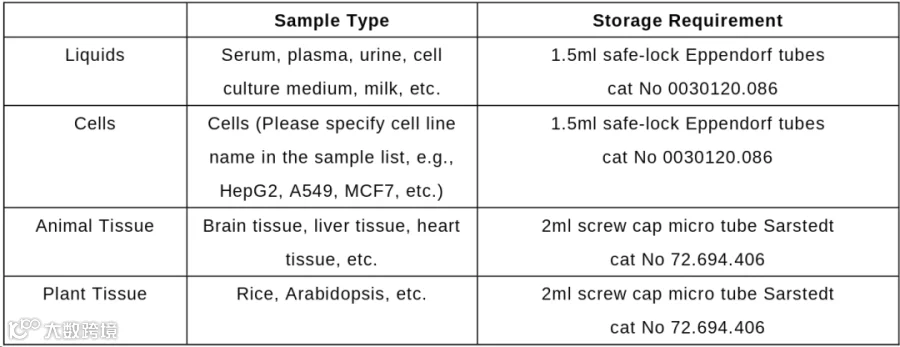
Notes:
1. There are different storage requirements depending on the sample types to be analyzed (please refer to the table above for details), which should be collected after consultation. Please label the sample with unique sample number on both the cap and side of the centrifuge tube.
2. If the client weigh and pack the samples with accurate mass/volume, please strictly follow the storage requirements for the corresponding sample types listed above and ensure that there is sufficient sample volume/mass.
2Determine the Analysis Content
Please visit the company website by clicking on the URL to understand the type of analysis products and services available: http:www.lipidall.com
3Collection and Pre-treatment
3.1 Volume/Mass
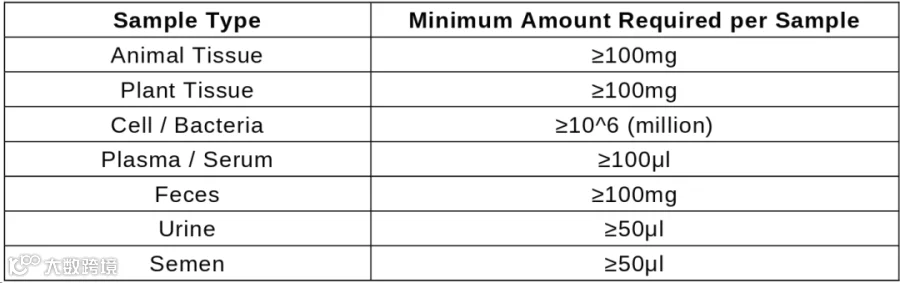
Notes:
1. The required volume/mass may vary depending on the number of types of analyses requested.
2. For precious samples, a smaller volume/mass may be permitted only after consultation with the appropriate company personnel.
3. If toxic samples are included, please provide the Material Safety Data Sheet (MSDS).
(Specific information can be confirmed with sales)
3.2 Quantity
The number of biological replicates depends on the size of inter-group differences relative to intra-group sample differences and the statistical analysis method used. It is recommended to have no less than 6 biological replicates. For multivariate analysis and modeling such as PLS-DA, association network analysis, and machine learning, no less than 20 biological replicates are suggested. The number of clinical samples mainly depends on the selection of the control group, and it is recommended to have no less than 30 cases per group. Increasing confounding factors also requires increasing the sample size.
3.3 Sample List
Please attach a printed copy of the sample list for our staff to check the samples upon arrival and send an electronic version to the sample reception team's email.
1 Liquids
1.1 Storage and Packaging Requirements
Liquid samples (serum, plasma, urine, cell culture medium, saliva, sputum, milk, etc.) should be stored in appropriate centrifuge tubes according to the required volume (it is strongly encouraged to use the centrifuge tubes recommended by our company).
Notes: For liquid samples, please freeze the liquid in a vertical position so that the frozen particles remain at the bottom of the tube, avoid thawing or leakage during transportation. It is important to ensure that there is sufficient dry ice during delivery so that the samples remained frozen throughout the delivery process.

1.2 Labeling
Use oil-based marker pens or label sticker to label the top and side of the tube with neat handwriting. Please ensure that the labels are legible.
Recommended labeling method: Letter-number combinations, such as A1, A2, B1, B2. Avoid overly lengthy labels or numbers.

Fig 2. Correct labeling example
1.3 Tighten the Cap and Arrange Samples in Order
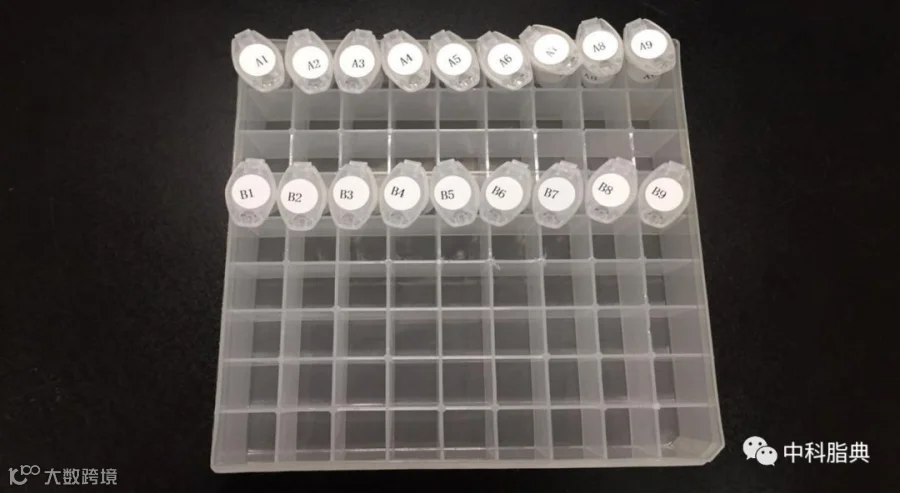 Fig 3. Correct sample ordering
1.4 Packaging
Freezer box should be tightly covered and secured with rubber band across both length and width of the box. Finally, the freezer box is placed in a sealed ziplock bag and submerged in dry ice.
Notes: Avoid using only rubber bands without sealed bags as these can become brittle in dry ice temperatures. It is recommended to wrap them in a sealed ziplock bag and secure with tape.
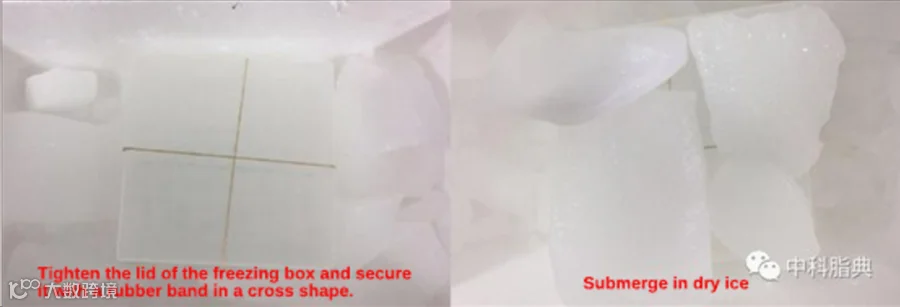
Fig 4. Packaging diagram
Notes: If sending serum (plasma) by centrifuge tube, please tighten the lid of the centrifuge tube and ensure that the serum (plasma) sample in the centrifuge tube is frozen prior to packing and delivery.
2Solids
2.1 Storage and Packaging Requirements
Solid samples include animal tissue, plant tissue, feces, etc. Animal tissue is recommended to be stored in specialized centrifuge tubes, and plant tissue can also be wrapped in tinfoil.
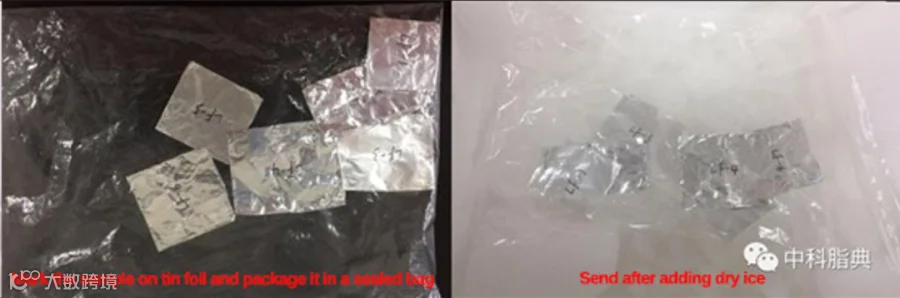
Fig 5. Correct packaging method
2.1.1 Centrifuge Tube Packaging for Samples
(Same as for Liquid Samples)
2.2 Tinfoil Packaging for Samples
Package the samples in tinfoil, label the samples then place them individually in a sealed Ziplock bag each with printed sample label (as labeling on tinfoil can easily rub off). Please attach a printed copy of the sample list for our staff to check the samples upon arrival and send an electronic version to the sample reception team's email.
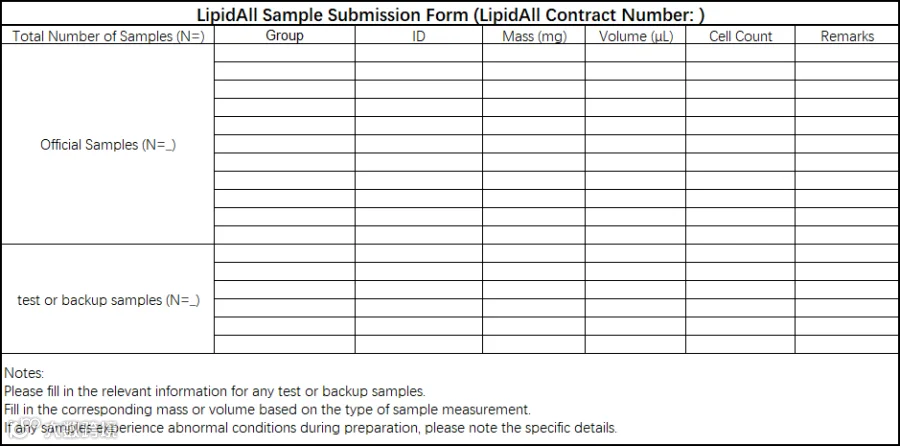
Fig 6. Electronic sample sheet
3Sample Transportation and Collection
All types of biological samples should be stored in a -80°C freezer or liquid nitrogen tank. During transportation, please use and ensure sufficient dry ice (it is recommended to calculate the evaporation rate at 5 kg/day in summer and 3 kg/day in winter, with an appropriate increase depending on distance and transportation duration).
For transportation under dry ice conditions, it is recommended to use SF Express and provide the express tracking number.
Please send complete sample information, such as sample number and weight, to the sample reception team's email. After receiving the samples, we will check whether the samples are complete and arrived frozen, and we will email the sample status to the client.
-
It is recommended to avoid delivering samples on weekends and public holidays.