

一、合作落地
2026年6月4日,美国能源部联合日本文部科学省(Ministry of Education, Culture, Sports, Science and Technology, MEXT)及日本经济产业省(Ministry of Economy, Trade and Industry, METI)在华盛顿正式宣布建战略合作:日本成为首个正式加入Genesis Mission的国家。“创世纪使命”正式实现了国际化扩张。
美日Genesis Mission战略合作建立在为期五年、总额达10亿美元的对等资金承诺基础之上,美国能源部与日本MEXT/METI各出资5亿美元(其后续拨付取决于各自国内的财政预算审批)。
关于此次合作,美国能源部(DOE)与日本文部科学省(MEXT)及经济产业省(METI)三方的代表,分别发言如下:
“This partnership brings together two of the world’s great scientific powers to accelerate discovery and unlock breakthroughs that will shape the future,” said DOE Under Secretary for Science and Genesis Mission Lead Dr. Darío Gil. “For generations, DOE’s National Laboratories have set the global standard for scientific excellence, delivering breakthroughs that transformed industries, advanced human knowledge, and strengthened prosperity around the world. By combining their unparalleled capabilities with Japan’s world-class scientific institutions, we are helping define how science will be conducted in the age of AI.”
“Under Japan’s Seventh Basic Plan for Science, Technology and Innovation, we are expanding investments in science and technology, recognizing AI and computing resources as essential to both research excellence and industrial competitiveness,” said Dr. Yasuyoshi Kakita, Vice-Minister for Policy Coordination, MEXT. “Through our ‘AI for Science’ strategy, MEXT is advancing bold and timely investments in these areas. In this context, the Japan–U.S. strategic partnership will significantly strengthen research capabilities in both countries. We will continue to deepen our cooperation with the United States in close coordination with the Ministry of Economy, Trade and Industry.”
“Japan and the United States have built a complementary partnership that leverages each other’s strengths and has driven innovation in advanced fields. We recognize that the development of next-generation computing requires close Japan–U.S. collaboration,” said Mr. Takehiko Matsuo, Vice Minister for International Affairs, METI. “Japan is strengthening its industrial base and expanding investments under the ‘Semiconductor and Digital Industry Strategy Initiatives’ and the ‘Budgetary Framework for Strengthening AI and Semiconductors’. Building on these efforts, and in coordination with MEXT, we will contribute as a trusted partner to the United States’ Genesis Mission in advancing next-generation computing and further deepen Japan–U.S. cooperation.”
需要明确的是,本次合作是美日2025年签署的科技繁荣协议为基础的,两份协议分别是President Donald J. Trump Drives Forward Billions in Investments from Japan、Memorandum of Cooperation
Regarding the Technology Prosperity Deal Between the Government of the United States of America and the Government of Japan,可以在美国白宫官方网站上获取。
二、合作架构
双方在合作意向书(Statement of Intent)中确立了由11个联合科学团队组成的协同网络,将重点攻克美国能源部此前确定的26项Genesis Mission国家科学与技术挑战中的11项(其中包含近期新增的一项数学专项挑战)。
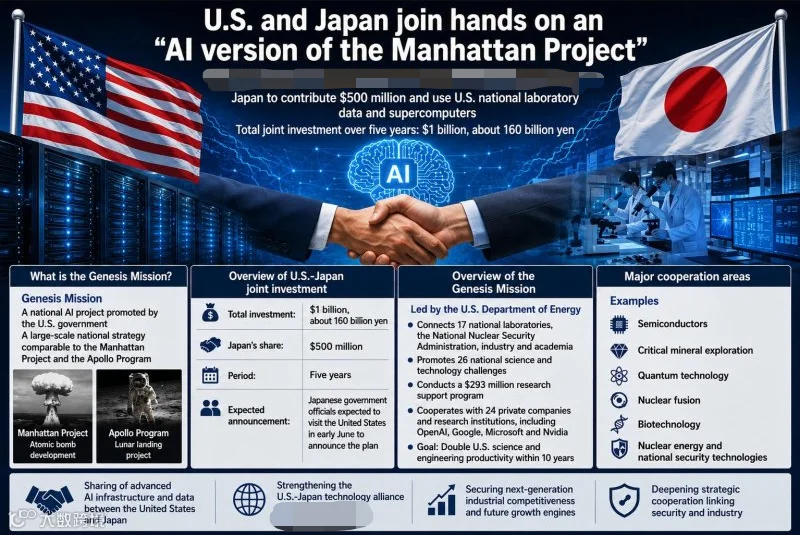
具体执行层面,该合作连接了12家美国能源部国家实验室、1个能源部科学办公室用户设施(Science Office User Facility),以及12家日本顶尖的研究机构。
基于调研有关报道,下表总结了双方的参与机构与大概分工:
|
|
|
|
|---|---|---|
| 美国能源部(DOE) |
|
|
| 日本文部科学省(MEXT) |
|
|
| 日本经济产业省(METI) |
|
|
| 日本物质材料研究机构(NIMS) |
|
|
| 日本质子加速器研究联合中心(J-PARC) |
|
|
三、算力协同
美日两国AI科学合作的技术支柱在于高性能计算(HPC)设施的对接以及面向科学的AI基础模型(AI for Science Foundation Model)的联合开发。探索始于2024年4月阿贡国家实验室(ANL)与日本理化学研究所(RIKEN)签署的“AI for Science”合作备忘录。主要内容包括:
-
• 未来的高性能计算与人工智能架构:定义并原型化下一代计算架构,优化于紧耦合建模、仿真和人工智能工作负载。 -
• 集成高性能计算系统与平台:开发和验证完整系统设计,无缝整合硬件、系统软件和设施。 -
• 人工智能驱动科学的共享软件生态系统:构建共享、开放且可互操作的软件栈,使人工智能能够实现科学的大规模发展。 -
• 科学应用旗舰人工智能及用例演示:通过共同选定的高价值科学应用展示影响,推动系统和软件需求。 -
• 通过人工智能驱动的实验室机器人实现实验室实验自动化:通过开发自主实验室工作流程,推动人工智能与物理科学的融合。 -
• 加速量子超级计算与集成:推动量子计算与人工智能超级计算的融合,实现公用事业规模的能力。
在此次签署的Genesis Mission合作框架下,双方研究团队将实现对“美国科学云”(American Science Cloud, AmSC)与日本“富岳”(Fugaku)超算系统的互跨访问与集成。AmSC作为安全、联邦化且针对科学优化的云环境,集成了DOE的计算节点与实验数据,而日本则通过将正在研发的下一代旗舰超算“富岳NEXT”(Fugaku NEXT,预计2030年左右投入运行)接入该体系。值得关注的是,日本在“富岳NEXT”的研发路线图上做出了颠覆性调整,打破了以往“纯国产”的硬件路径限制,转向“日本设计、英伟达赋能”(Japan-designed, NVIDIA-enabled)的模式。
四、重点合作领域的突破路径与技术实现
美日联合团队将10亿美元的投资焦点投向五个AI科学应用领域。
(一)聚变能源
橡树岭国家实验室(ORNL)与日本京都聚变工程公司(Kyoto Fusioneering)建立了深度合作关系,双方正在田纳西州联合建设包层(Breeding Blanket)测试设施,以补充京都聚变工程公司在日本的UNITY-1热循环测试平台。
(二)量子计算
橡树岭国家实验室与理化学研究所正在开展量子计算系统的协同攻关,主攻开发一种能够实现CPU-GPU-QPU(中央处理器-图形处理器-量子处理器)紧密耦合的系统级控制架构。
(三)材料科学
理化学研究所、东京大学、日本物质材料研究机构(NIMS)与美方国家实验室正联合开发由AI模型和多自由度机器人手臂完全接管的下一代自主化学/物理合成线,即“闭环自主实验室”(Closed-Loop Autonomous Laboratories)。
(四)气候建模
美日团队正在共同研发针对复杂水文水资源的AI实时预测系统,为核聚变反应堆、核电站及AI数据中心的冷却用水安全提供保障。
(五)合成生物设计工程化
美日两国的科学合作重点集中在“以AI算法重构基因设计与大分子定向降解技术”之上。美日联合的合成生物学团队通过部署AI分子搜索模型,成功在庞大的基因和蛋白质序列库中识别并预测全新的聚合物靶向酶家族,为废旧高分子材料的循环回用提供了突破性解决方案。
五、数据合作并不明朗
研读众多新闻后可以发现,美日双方在数据合作层面并没有达成良好共识,实际操作中面临严峻挑战。
美国能源部新闻中明确提到“合作将由11个联合科研团队(汇聚12个美国能源部国家实验室、1个美国能源部科学用户设施办公室以及12家日本顶尖研究机构),整合全球最前沿的科研设施、计算资源与顶尖科研人才,共同推动量子信息科学、聚变能、生物技术、先进材料、粒子物理以及自主实验室系统等领域的重大突破”(Under the partnership, eleven joint scientific teams will unite twelve DOE National Laboratories, one DOE Office of Science User Facility, and twelve leading Japanese research institutions—bringing together some of the world’s most advanced scientific facilities, computing resources, and research talent—to advance breakthroughs in quantum information science, fusion energy, biotechnology, advanced materials, particle physics, and autonomous laboratory systems.)。整合的资源中没有明确提及“数据”。
fedscoop.com的报道中指出:
活动期间,日本文部科学省政策协调副大臣柿田康义表示,关于如何处理和共享重要数据,相关讨论仍在进行中。双方签署的意向声明中包含一项条款,允许两国研究人员享有与本国研究人员同等的权限与审批。(Yasuyoshi Kakita, Japan’s vice-minister for policy coordination at MEXT, said there are still ongoing discussions to determine how to handle and share important data. The signed statement of intent includes a provision allowing researchers of each country the same permissions and approvals granted to domestic researchers.)
fedscoop.com认为,尽管相关工作已经启动,但仍存在一些不确定性,例如数据治理问题(While work has already begun, there are still uncertainties, such as data governance)。
结语
对于国内读者而言,我们需要看到这种战略合作的野心,也要注意到其内部在数据共享、安全审查等方面的深层矛盾。两国能否跨越数据主权与安全互信之间的鸿沟,仍是未知数。