


♥
Renting a Flat
In China
北漂 (běi piāo)
A Chinese migrant worker living and working in Beijing without a residence permit (户口hù kǒu). This is not the same as a foreigner living in Beijing.
Are you paying too much rent?
As a 北漂 (běi piāo), wholly priced out of the city’s property market, I feel despondent with the ever increasing rental costs in the city.
Rising rent in Beijing is just as inevitable as your nearby subway station being crowded at 8 am on a Monday morning. It's just a part of your life. These increasing costs largely reflect on-going price increases across other tier 1, tier 2 and tier 3 cities.
I still remember that four years ago, when I first moved to Beijing, I rented a two-bedroom flat (that means apartment for those unfamiliar with British English) near Wukesong subway station (line 1) for 3,500 RMB per month.
Later, in 2015, I moved to a more central location, along line 1 near Jianguomen subway station, and spent 2,000 RMB per month, for a single room while sharing the kitchen and bathroom with 4 other people.
Right now, I am living near Joy City in Chaoyang district (not far from Qingnianlu station on line 6). I’m renting a two-bedroom flat with a total floor space of 89 square metres, with the rent totalling 8000 RMB per month.
"Am I spending too much on my rent each month?"
This is the question I keep asking myself.
So, I decided to carry out some research into rental price trends for Beijing and compared these with other well-known major Chinese cities.
Freely available statistics on rental costs trends for China exists from 2012 up until May of last year (or October for Beijing).
The cities include Beijing, Shanghai, Guangzhou, Shenzhen and their respective rental costs (per square metre/ month) are 93.67 RMB, 76.39 RMB, 52.22 RMB, and 79.38 RMB.
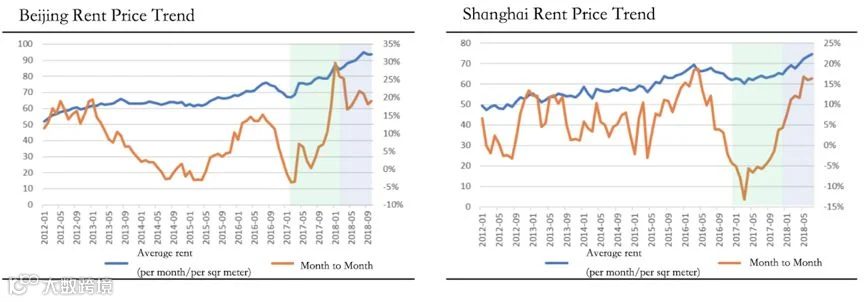
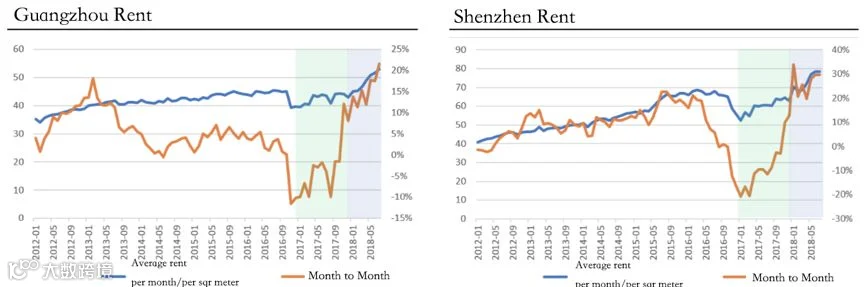
We can see from those charts that prices of the rent in the four biggest cities has increased a lot since the last quarter of 2017, although there was a surprise drop in the previous quarter of 2016, a particularly rare event in the Chinese rental market.
Another item of note is Beijing's, Shanghai's, Guangzhou's and Shenzhen's population control policy, introduced in 2017, stating that by the end of 2020, the population of four cities should be within 23 million, 25 million, 15.5 million, 14.8 million respectively.
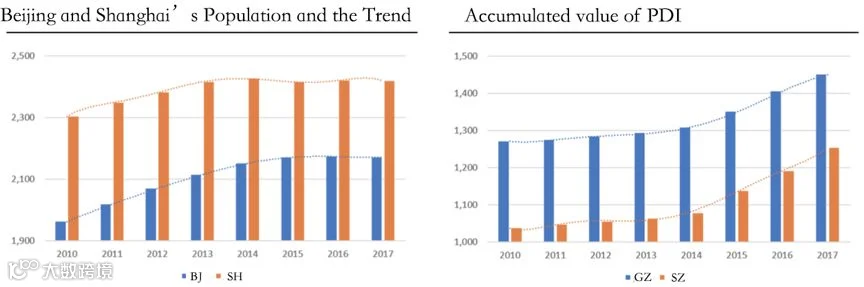
Since the cost of living in these big cities is pretty high, although perhaps lower than in your home country, many people with lower education and a lower income are either forced to live on the outskirts of the city in substandard flats, or live in nearby sleeper towns and face a punishing commute, or they end up moving to another cheaper city.
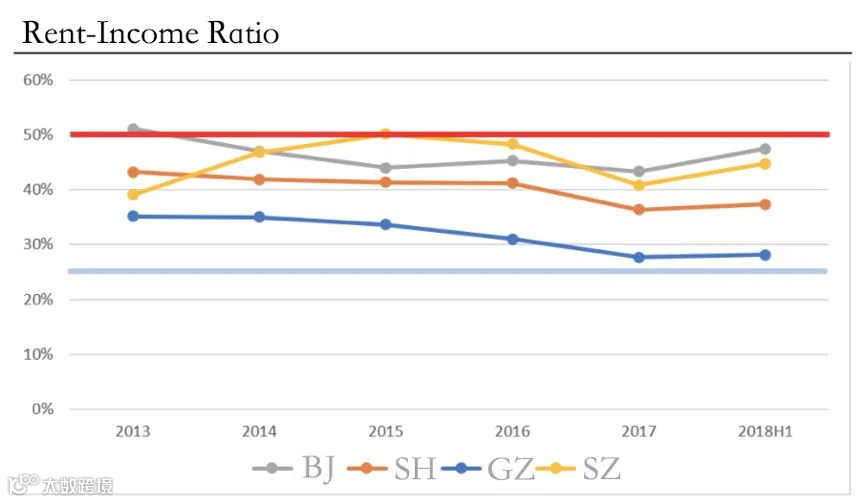
Above is a chart showing the proportion of one's monthly income spent on rent in each city. Guangzhou’s ratio is the lowest.
From my own personal experience of living and working in Guangzhou for almost one year, I know that salaries are not high, but the rent is quite cheap.
Finally, Beijing’s ratio is the highest, which is quite accurate considering that it's China's capital city and the home of the government.
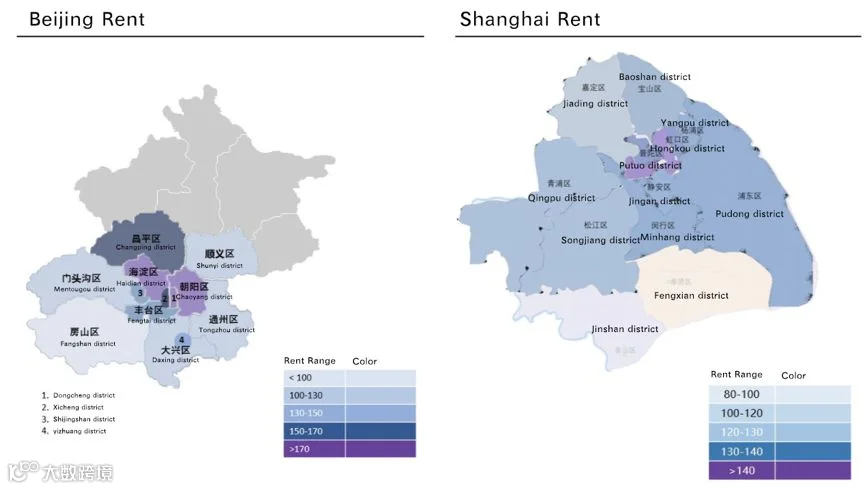
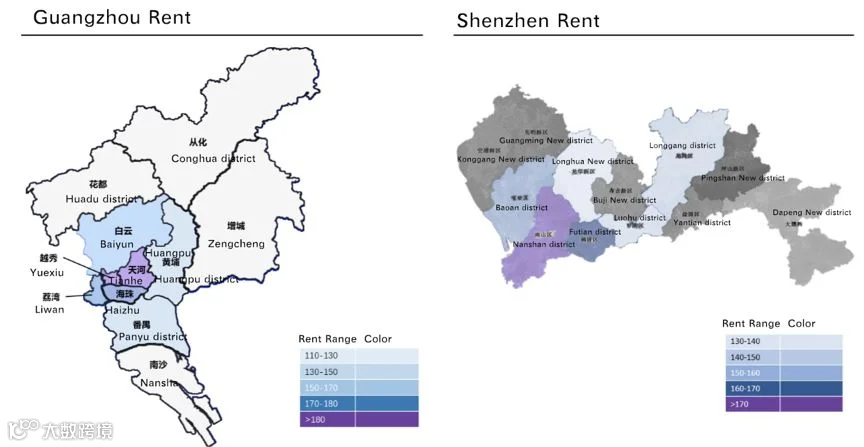
Now let’s separate the cost of living alone in a flat, and compare it with co-habiting with others (joint rent). Those living with others are more likely to have multiple bedrooms in their rented home.
Living alone (solo-rent) or living with others (joint-rent) – which option is cheaper for you?
Let’s look at the table below to compare the cost (per square metre) in different districts of major Chinese cities.
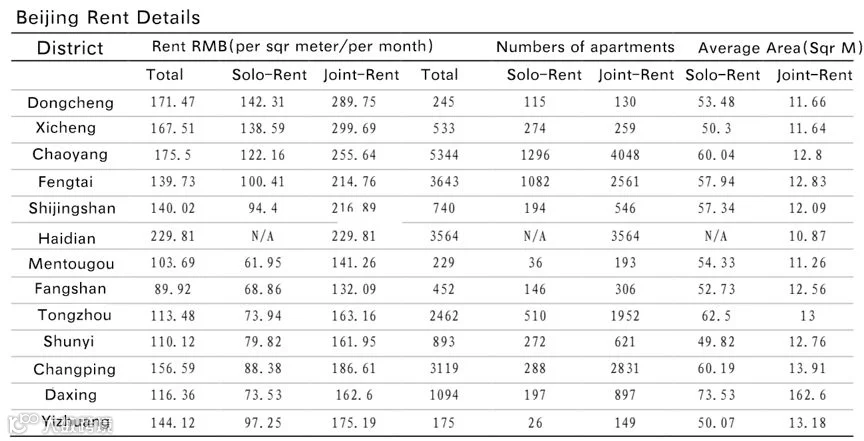
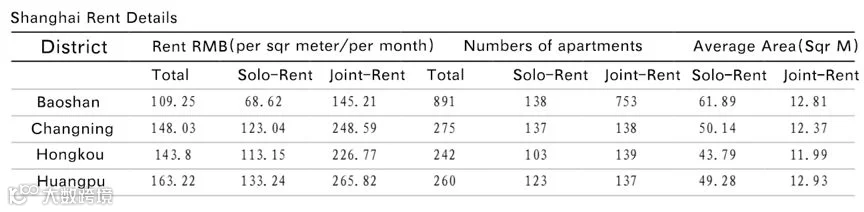
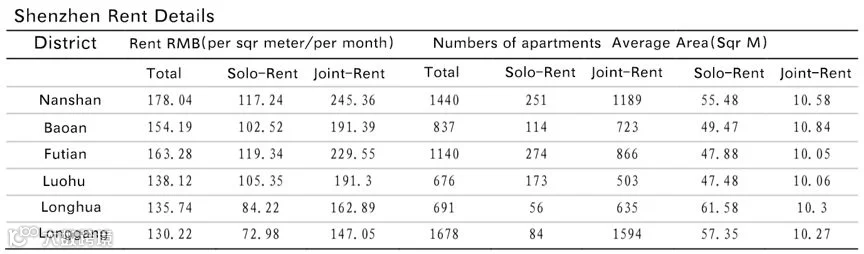
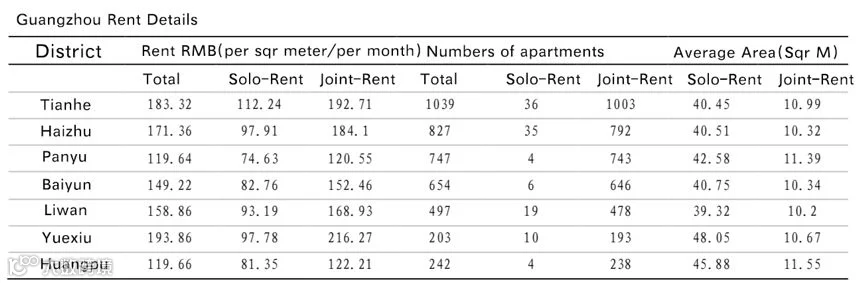
When considering all of this data, we can understand these points:
Firstly, 28% of all one-bedroom flats in Beijing are between 50-70 square meters, while two-bedrooms flats make up 47.72% of that amount.
Secondly, the majority of Shanghai’s one-bedroom flats measure between 50 to 150 square meters, while those smaller than 50, or larger than 150 square metres each make up 15% of Shanghai’s single bedroom properties.
Thirdly, in Guangzhou, one bed-room flats measuring 60 to 100 square metres make up nearly 50% of all existing residential homes available for rent.
Fourthly, in Shenzhen, one bed-room flats measuring 60-80 square meters’ account for one-third of all residential homes, while two-bedrooms and three-bedrooms account for about 86%.
Finally, at the end of 2017, there was a sharp increase in rental prices in Beijing, around a 30% increase. This occurred due to a huge fire in Daxing district, that started in an illegal building (one that was built without planning permission from the government). In a swift response, the government started to tear down thousands of ‘illegal’ buildings, forced many poor migrants out of the city as they lost their homes and livelihoods. Those who remained were forced to rent other properties in Beijing, and some of them moved to downtown areas – this mostly explains why the cost of rent increased sharply.
In conclusion, rents are highly likely to continue soaring in most Chinese cities, and it's up to us to ensure that we're not ripped off by housing agencies such as Lianjia or landlords.
As for me, I believe that I'm paying a fair price for my rent (for now).
How about you? Do you think that you're paying too much for your rent?
If you have any questions about housing,
feel free to contact us!
the end
W|MYPENGYOU

Publishing Interesting Stories about China