


据Mining.com网站报道,最早于2025年开始月球采矿的计划变得更加有吸引力。美国国家航空航天局(NASA)的一个团队发现,有证据表明,月球这个地球的天然卫星表面以下金属含量可能比以前认为的更高。
这个研究团队利用NASA的月球勘测轨道器(LRO)上的微型射频(Mini-RF)数据分析认为,月球表面以下某些金属比如铁和钛的含量比预测的要高。
此项发表在地球和行星科学通信(Journal Earth & Planetary Science Letters)的研究成果对目前最公认的月球成因理论提出了质疑。该文质疑火星大小的物体撞击地球引起上地壳大部分气化而形成月球的假想。
论文第一作者伊萨姆·希格(EssamHeggy)表示,“通过加深对月球表面以下金属实际含量的了解,科学家们能够更进一步聚焦月球成因、演化及其对地球适居性的影响。”
NASA声称,此项证据是科学家在月球北极地区冲击坑底部寻找冰时发现的。也就是说,在冲击坑口底部的细粒灰尘来自月球更深层,是流星撞击月球时冲击产生的。因此,这些灰尘能够代表月球更深层岩石成分。
研究人员发现,大的和深的冲击坑口的金属含量要比小和浅的坑口高。特别是在冲击坑直径在1-3英里时,介电常数或电性能随冲击坑规模而增加。但是,当冲击坑直径在3-12英里时,其电性保持稳定。
4月份,美国总统唐纳德·特朗普签署一项命令,鼓励美国公司商业性开发月球和其他天体资源。
该令将外层空间归类为一种“法律上和物理上的独特人类活动领域”而不是“全球公有地”,这为美国不受任何国际公约束缚而在月球采矿做了铺垫。
此项命令声称,“美国人有权在外太空从事商业性矿产资源的勘查、开发和利用”,并强调美国从来没有签署1979年月球公约。而月球公约规定,任何太空活动都必须遵守国际法。
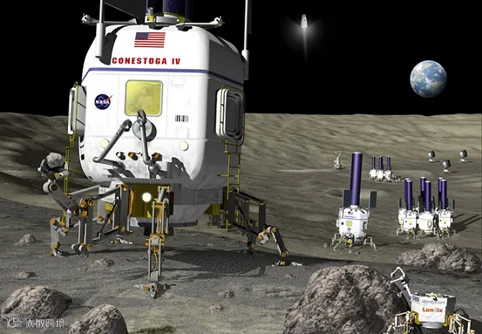
NASA正在筹建有轮子甚至支架的月球基地,以增加着陆区的安全性、设备冗余以及获得重大发现的几率。
俄罗斯联邦航天局(Roscosmos)迅速做出反应,谴责美国政府此举为殖民主义。
Roscosmos负责国际合作事务的副局长谢尔盖·萨维利耶夫(Sergey Saveliev)指出,“历史多次证明,当一个国家出于自身利益开始领土扩张时,任何人都知道这会带来什么。”
美国提出的月球采矿全球法律框架,即所谓“阿尔忒弥斯协定”(Artemis Accords)是NASA为寻求合作的最新举措。NASA计划未来10年在外星体建设人类基地和空间站。
为实现在月球、小行星甚至其他行星开采资源的目的,NASA已经同几项公共和私人计划进行了结盟。
2015年,美国国会通过了一项法案,公然允许美国公司和公民开采、销售和拥有任何太空物质。
该项法案中有一项重要的条款,声明并没有授权给企业和个人“对任何天体的主权,主权或独占权利,或者管辖权,以及所有权”。
1966年,美国、前苏联和其他国家共同签署的外层空间条约规定,国家不能在太空拥有领地。
特朗普一直重视美国对外太空的控制权,2019年成立了太空军,必要时发动太空战。
NASA此前制定了一项长期月球探索计划,包括在月球南极建立一个基地。
美国既不是第一个也不是唯一一个希望在月球采矿的国家。
俄罗斯近些年来一直计划重返月球,并可能在更远的外空旅行。2018年,Roscosmos制定了一项计划,准备未来20年在月球建设一个长期基地,而普京总统也宣称将很快实施火星探测计划。
卢森堡是首批计划在天体采矿的国家之一,为推进近地行星资源的勘查和商业利用,2018年该国成立了航天局(LSA)。
不过,与NASA不同,LSA并不执行研究或发射任务,其目的是促进航天工业经济项目负责人、投资者和其他伙伴之间的合作。
在新兴起的欧洲网络帮助下,科学家去年宣布了未来5年内在月球开采资源的计划。该项计划由欧洲航天局负责,与阿里安集团合作,打算开采无核能源,据说价值数万亿美元。
中国和印度也计划在月球开采氦-3资源。21世纪以来,中国探测器已经两次在月球着陆,后续还有更多的发射任务。
在加拿大,大多数计划来自私人部门。最引人注目的一项计划是来自安大略省北部的德尔申创新公司(Deltion Innovations)与月球快车公司(Moon Express)合作,这也是经政府允许在地球以外空间进行勘查的首家美洲私营企业。
太空合作计划包括小行星采矿、捕捉太空碎片以及在火星建设首个人类居住地,亿万富翁马斯克还提出了向火星发射无人飞行计划。
附英文原文
Plans to start mining the Moon as early as 2025 became more attractive this week after a US National Aeronautics and Space Administration (NASA) team found evidence that the Earth’s natural satellite may, underneath its surface, be richer in metals than previously thought.
Using data from the Miniature Radio Frequency (Mini-RF) instrument onboard NASA’s Lunar Reconnaissance Orbiter (LRO), a team of researchers came to the conclusion that the lunar subsurface contains higher concentration of certain metals, such as iron and titanium, than estimated.
EVIDENCE WAS DISCOVERED WHILE THE SCIENTISTS WERE LOOKING FOR ICE AT THE BOTTOM OF CRATERS IN THE LUNAR NORTH POLE REGION
The study, published in the journal Earth and Planetary Science Letters, contends the most popular theory surrounding the Moon’s origins. The hypothesis contends the satellite was formed when a Mars-sized object collided with Earth, vaporizing large portions of the Earth’s upper crust.
“By improving our understanding of how much metal the moon’s subsurface actually has, scientists can constrain the ambiguities about how it has formed, how it is evolving and how it is contributing to maintaining habitability on Earth,” lead study author Essam Heggy said in a statement.
The evidence was discovered while the scientists were looking for ice at the bottom of craters in the lunar north pole region, NASA said. It means that fine dust found at the base of those holes are parts of the deeper layers of the Moon, ejected during meteor impacts. As such, this dust represents the composition in deeper Moon layers.
The researchers found a pattern in which larger and deeper craters have higher metal concentrations than smaller and shallower ones. Specifically, in craters approximately 1 to 3 miles wide, the dielectric constant or electrical property increased along with crater size. However, the electrical property remained constant for craters between three to 12 miles wide.
Order to mine
US President Donald Trump signed an order in April encouraging citizens to mine the Moon and other celestial bodies with commercial purposes.
The directive classifies outer space as a “legally and physically unique domain of human activity” instead of a “global commons,” paving the way for mining the moon without any sort of international treaty.
“Americans should have the right to engage in commercial exploration, recovery, and use of resources in outer space,” the document states, noting that the US had never signed a 1979 accord known as the Moon Treaty. This agreement stipulates that any activities in space should conform to international law.
Russia’s space agency Roscosmos quickly condemned Trump’s move, likening it to colonialism.
“There have already been examples in history when one country decided to start seizing territories in its interest — everyone remembers what came of it,” Roscosmos’ deputy general director for international cooperation, Sergey Saveliev, said.
The proposed global legal framework for mining on the moon, called the Artemis Accords, would be the latest effort to attract allies to the National Space Agency’s (NASA) plan to place humans and space stations on the celestial body within the next decade.
It also lines-up with several public and private initiatives to fulfill the goal of extracting resources from asteroids, the moon and even other planets.
In 2015, the US Congress passed a bill explicitly allowing companies and citizens to mine, sell and own any space material.
That piece of legislation included a very important clause, stating that it did not grant “sovereignty or sovereign or exclusive rights or jurisdiction over, or the ownership of, any celestial body.”
The section ratified the Outer Space Treaty, signed in 1966 by the US, Russia, and a number of other countries, which states that nations can’t own territory in space.
Trump has taken a consistent interest in asserting American power beyond Earth, forming the Space Force within the US military last year to conduct space warfare.
The country’s space agency NASA had previously outlined its long-term approach to lunar exploration, which includes setting up a “base camp” on the moon’s south pole.
Trillion-dollar market
The US isn’t the first nor the only nation to jump on board the lunar mining train.
Russia has been pursuing plans in recent years to return to the moon, potentially travelling further into outer space.
Roscosmos revealed in 2018 plans to establish a long-term base on the moon over the next two decades, while President Vladimir Putin has vowed to launch a mission to Mars “very soon.”
Luxembourg, one of the first countries to set its eyes on the possibility of mining celestial bodies, created in 2018 a Space Agency (LSA) to boost exploration and commercial utilization of resources from Near Earth Objects.
Unlike NASA, LSA does not carry out research or launches. Its purpose is to accelerate collaborations between economic project leaders of the space sector, investors and other partners.
Thanks to the emerging European network, scientists announced last year plans to begin extracting resources from the moon in five years.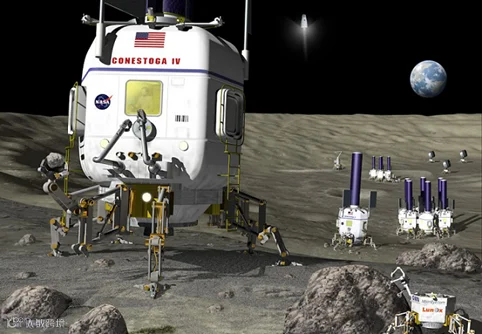 NASA is working on lunar bases that can travel on wheels, or even legs, increasing landing zone safety, provide equipment redundancy and improve the odds of making key discoveries. (Image courtesy of NASA.)
The mission, in charge of the European Space Agency in partnership with ArianeGroup, plans to extract waste-free nuclear energy thought to be worth trillions of dollars.
Both China and India have also floated ideas about extracting Helium-3 from the Earth’s natural satellite. Beijing has already landed on the moon twice in the 21st century, with more missions to follow.
In Canada, most initiatives have come from the private sector. One of the most touted was Northern Ontario-based Deltion Innovations partnership with Moon Express, the first American private space exploration firm to have been granted government permission to travel beyond Earth’s orbit.
Space ventures in the works include plans to mine asteroids, track space debris, build the first human settlement in Mars, and billionaire Elon Musk’s own plan for an unmanned mission to the red planet.
Geologists, as well as emerging companies, such as US-based Planetary Resources, a firm pioneering the space mining industry, believe asteroids are packed with iron ore, nickel and precious metals at much higher concentrations than those found on Earth, making up a market valued in the trillions.
信息来源:Mining.com

猜你喜欢:
1、传来好消息!中企拿下全球最大铁矿开发权!澳大利亚这下该着急了!
2、突发!个人账户收款被罚近300万!7月1日起,公转私、私转私的要小心了!大额现金管理文件正式发布!
3、惊呆了!世界级大金矿被发现 到处都是金子,澳大利亚了解一下
4、紫金17亿豪夺圭亚那金田,看看249吨大金矿
5、海南矿业筹划收购甘肃金徽矿业
6、无人驾驶技术,将颠覆式创新露天采矿行业
7、传紫金矿业38亿拿下中国最大铜矿项目控股权
相关业务需求即可致电下方相关责任人
| 吕国博士 | 董事长 | 1127203572@qq.com |
| 电话:13401184506 | 微信:suntrans-mining | |
| 孙玉梅 | 总经理 | 853495100@qq.com |
| 电话:13810694105 | 微信:853495100 | |
| 王宏业 | 矿业外语猎头 | 582934973@qq.com |
| 电话:18210692263 | 微信:suntrans222 | |
| 刘乾勇 | 英语翻译 | 1935014417@qq.com |
| 电话:13693672413 | 微信:13693672413 | |
| 范宝山 | 矿业咨询 | 1583289628@qq.com |
| 电话:13683660097 | 微信:suntrans_1543 | |
| 刘鑫 | 论文翻译 | 1749173384@qq.com |
| 电话:13683660873 | 微信:lvy_09260312 | |
| 史梦亚 | 地矿报告翻译 | 25342721235@qq.com |
| 电话:13683661813 | 微信:zyy-suntrans | |
| 陈志福 | 口译 | 2268356581@qq.com |
| 电话:13681439112 | 微信:miningtranslation | |
| 李冬梅 | 日、俄、韩翻译 | 3602237436@qq.com |
| 电话:15701297623 | 微信:suntrans_6787 | |
| 张学东 | 西、法、葡翻译 | 1529169438@qq.com |
| 电话:17310657953 | 微信:ha15313128283 | |
| 蔡恒 | 非地矿类及其他小语种 | 3073107861@qq.com |
| 电话:15210897852 | 微信:suntrans-1938 | |
| 钟凌峰 | 媒体合作 | 1985130191@qq.com |
| 电话:18511709317 | 微信:suntrans2014 | |
| 王洋 | 全职招聘 | 347562171@qq.com |
| 电话:13661190472 | 微信:13661190472 | |
阳光创译=国际矿业服务平台
打造中国地质矿业翻译领军品牌
阳光创译的核心定位已经由最初的“阳光创译=矿业翻译”——中国地质矿业翻译领军品牌逐渐延伸扩展成“阳光创译=中国国际矿业服务大平台”,涵盖矿业翻译、矿业会展、矿业咨询、矿业猎头、“一带一路”矿业商会、矿业媒体等国际矿业服务板块。
文章版权声明:本文来源 :牛博士矿业与金融观察,版权归原作者所有,本文不代表阳光创译立场,并对文中观点保持中立,仅供各位阅读者交流参考之目的。本号所转载内容没有任何商业宣传目的,仅供交流,如有侵权,请联系主编删除(主编微信:suntrans2008),另外图片版权归原作者所有,如有侵权请联系我们,我们将会立刻删除!给您带来的不便,尽请谅解!
商务合作:请加编辑微信suntrans2008(添加时请您标明“公众号商务合作”意向);联系电话:15313128281
图片版权声明:部分图片来源于网络,版权归原作者所有。如涉及侵权或者对版权有疑问,请联系邮件1943581358@qq.com,我们会尽快处理!