

大数跨境

Vitalik Buterin团队最新发文丨“隐私池”协议如何处理“隐私、去中心化、合规”的三角难题

Vitalik Buterin团队最新发文丨“隐私池”协议如何处理“隐私、去中心化、合规”的三角难题 界外科技
2024-09-25
1

Research Article


Blockchain privacy and regulatory compliance: Towards a practical equilibrium

区块链隐私和监管合规:迈向实际平衡


Vitalik Buterina, Jacob Illumb, Matthias Nadlerc, Fabian Schärc, Ameen Soleimanid


Ethereum Foundation, Switzerland

Chainalysis, USA

University of Basel, Switzerland

Privacy Pools, USA


区块链固有的透明度虽然有利于验证和信任,但也带来了重大的隐私问题。公有区块链上的传统交易是永久可见的,损害了用户隐私。这种可见性是一把双刃剑,它提供了透明度,但作为代价,却暴露了个人数据。
近日,Blockchain: Research and Applications 2024年第1期上线了以太坊创始人Vitalik Buterin以及巴塞尔大学Fabian Schär等学者合著研究论文“Blockchain privacy and regulatory compliance: Towards a practical equilibrium”.
Vitalik Buterin等人提出的名为隐私池(Privacy Pools)的新协议为区块链隐私和监管合规这两个看似矛盾的目标提供了一个潜在的解决方案。该协议在遵守监管标准的同时增强了区块链交易的隐私保护。这种基于智能合约的新协议使用户能够在不暴露其整个交易史的情况下证明其交易的特定属性,同时保证其隐私和透明度。
隐私池协议引入了一种新颖的方法,允许用户发布零知识证明,从而证实他们的资金是否与合法或非法来源有关,且并未披露他们的整个交易史。这种方法包括在预定义的关联集中证明成员资格,并与监管框架保持一致,从而将合规与不合规交易区分开来。
这篇文章的通讯作者Fabian Schär教授表示:“这项研究为调和区块链隐私和监管合规这两个看似矛盾的目标提供了一种很有前途的方法。”。“通过使用户在不披露其整个交易史的情况下证明合规性,隐私池可以为隐私保护机制更完善且更具包容性的区块链生态系统铺平道路。”
隐私池协议为在满足监管要求的同时维护区块链交易中的隐私这一长期的挑战提供了一个务实的解决方案。这一创新不仅增强了用户隐私,还增强了区块链技术的完整性和可信度。它表明,隐私和监管合规可以共存,为数字时代更安全、更私人化的金融交易铺平了道路。

文章图选


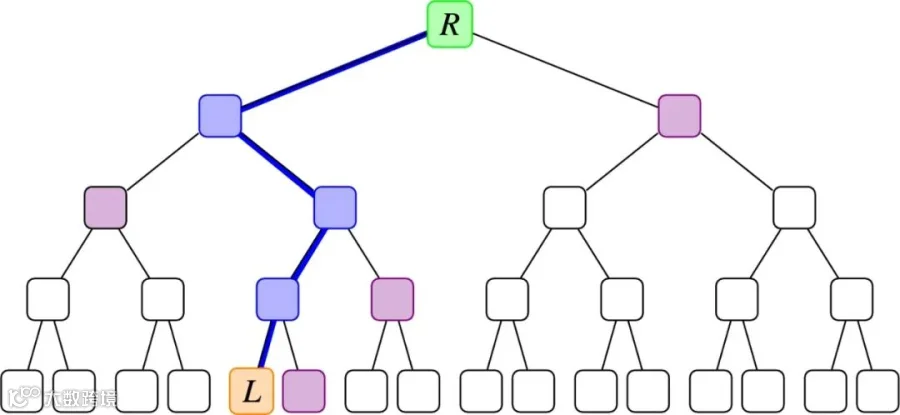
Fig. 1. Structure of a Merkle tree, highlighting the Merkle branch for a given value in the tree.  Orange is the leaf L that is being proven; the bottom row of the tree represents the entire dataset.  Green is the root hash R.  Blue is the path from the leaf to the root.  Purple are the sister nodes at each level. Note that the path can be computed by starting with the leaf and hashing it together with the sister node at each level, so there is no need to provide the path itself.
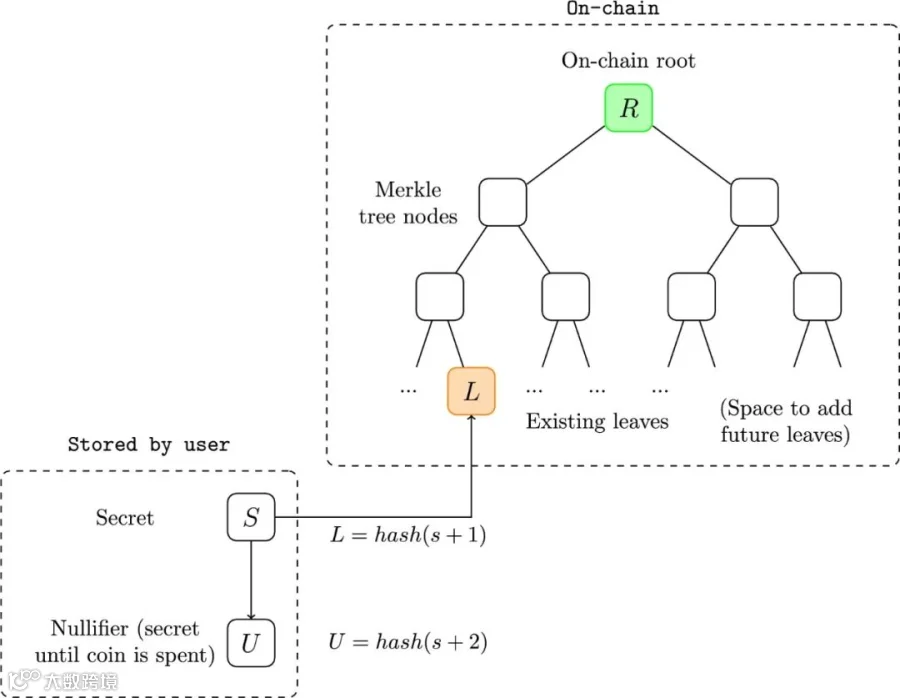

Fig. 2. Some of the data structures involved in a privacy-preserving coin transfer system. The Merkle tree shown is the coin ID tree; the nullifier set is not shown but is also stored on-chain. While a given coin exists but has not yet been spent, the coin ID (L) is on-chain, but the secret (s) and the nullifier (U) are only known by the holder of the coin.
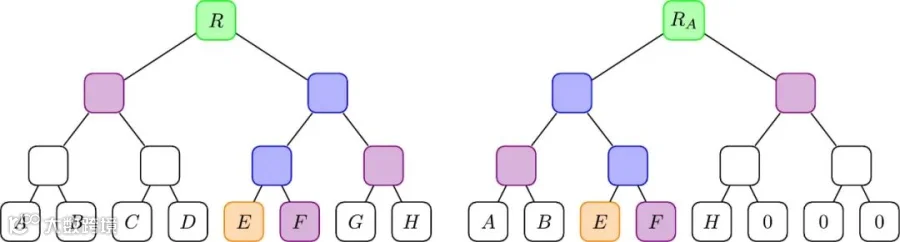
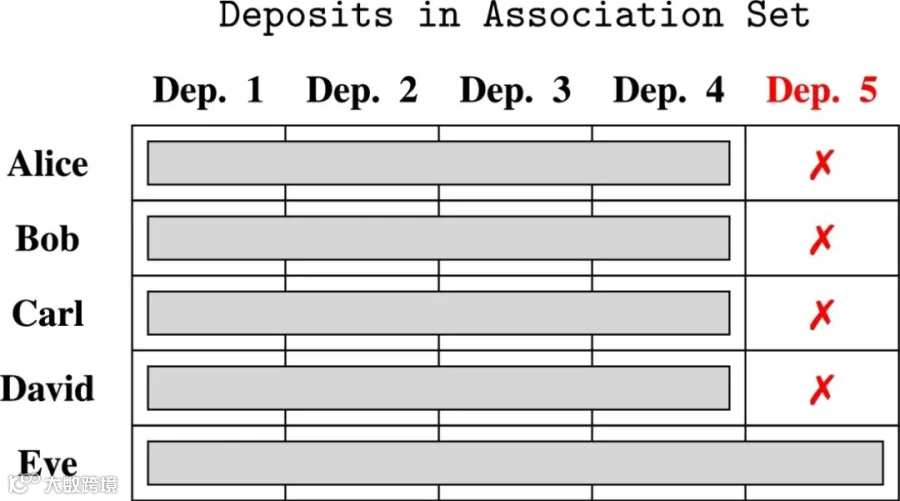
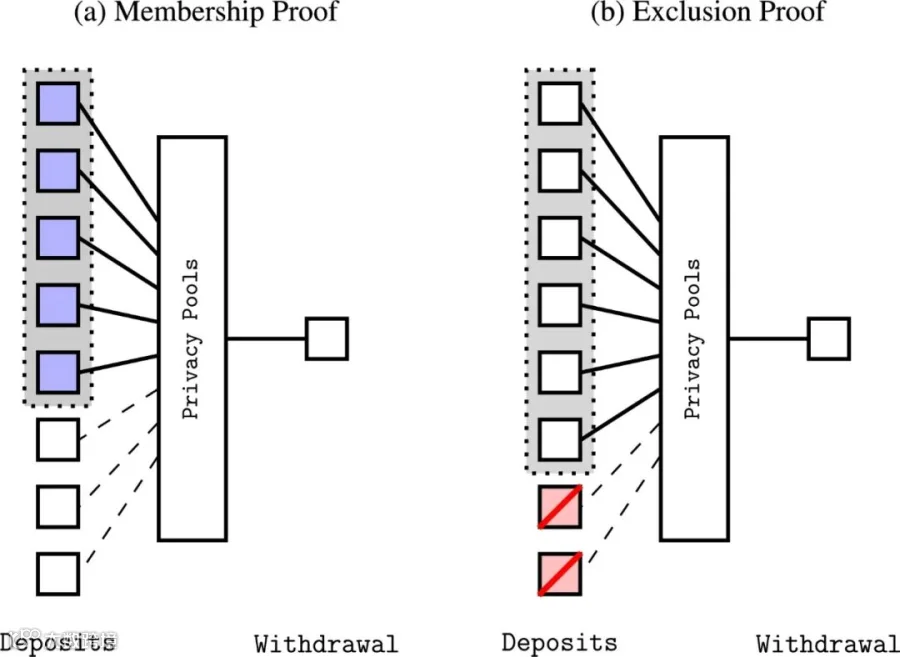
Fig. 3. A user zero-knowledge-proves two Merkle branches: One proving that their coin ID is somewhere in the coin ID tree, and another proving that the same coin ID is somewhere in the tree representing the user's provided association set (represented by its root RA).

Fig. 4. The gray area in each row represents the respective user's association set. In our simplified example, we assume that Alice, Bob, Carl, and David include all other “good” deposits in their respective association sets and exclude deposit 5, which originates from a known illicit source. Eve, on the other hand, cannot create a proof that disassociates her withdrawal from her own deposit.

Fig. 5. The membership proof includes a specific collection of deposits in its association set, while the exclusion proof's association set consists of anything but a specific collection of deposits. From a technical perspective, they are identical as both prove against the Merkle root of an association set.

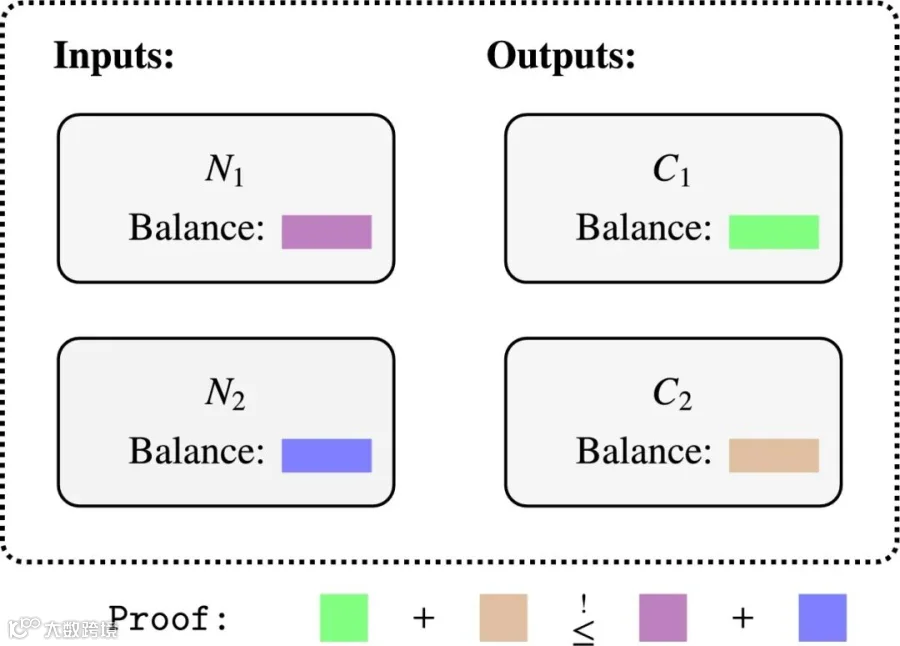
Fig. 6. The ZK-SNARK proves an additional claim that the encrypted denominations represent numbers such that the sum of the numbers on the output side does not exceed the sum of the numbers on the input side. Depending on the construction, it may also require an explicit proof that all of the newly created coin denominations are non-negative.

Fig. 7. In the UTXO graph, it appears that each withdrawal's source is the change output of the previous partial withdrawal. But in an economic sense, the “real” source in each case is the original deposit.

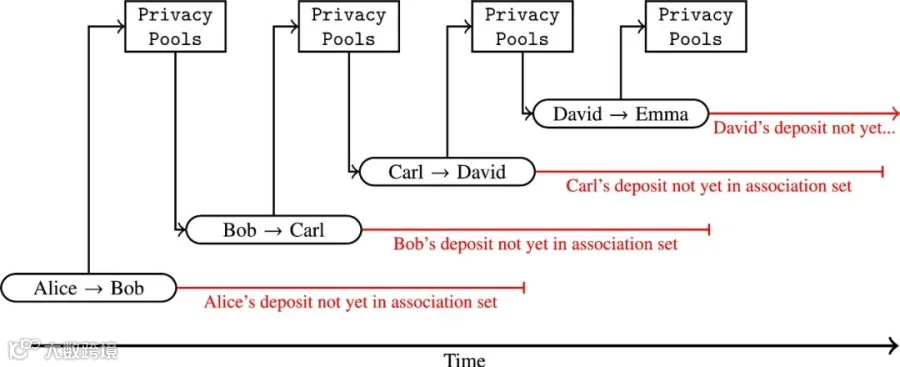
Fig. 8. When David sends his transaction to Emma, he needs to provide the Merkle branch and secret from himself, Carl, and Bob, but not Alice, because Alice's payment to Bob is now in the association set.

引用本文

V. Buterin, J. Illum, M. Nadler, et al. Blockchain privacy and regulatory compliance: Towards a practical equilibriumBlockchain: Research and Applications. 5 (1) (2024) 100176. 

https://doi.org/10.1016/j.bcra.2023.100176
扫码查看原文

期刊简介

Blockchain: Research and Applications (BCRA)《区块链研究》创刊于2020年12月,是由浙江大学主办,浙江大学出版社与Elsevier合作的开放获取期刊,旨在发布国际区块链学科领域的最新研究成果,打造区块链学科国际学术交流平台,推动区块链学科的交叉融合,引领未来信用社会和价值互联网的发展方向。

期刊由中国工程院院士、浙江大学陈纯教授担任主编,挪威科学院院士、IEEE区块链研究协同主席Chunming Rong教授担任共同主编。

数据库收录:ESCI、Scopus、EI、DOAJ 等。最新影响因子5.6,CiteScore 6.4,位于Q1区

期刊网站:www.sciencedirect.com/journal/blockchain-research-and-applications

投稿网址:https://www.editorialmanager.com/bcra/

联系我们:blockchain@zju.edu.cn

往期推荐

1. 专题速递 | 区块链安全与隐私

2. 文章目录 | BCRA Volume 4 Issue4

3. 文章目录 | BCRA Volume 4 Issue3

4. 文章目录 | BCRA Volume 4 Issue2

5. 文章目录 | BCRA Volume 4 Issue1

6. 文章目录 | BCRA Volume 3 Issue4

7. 文章目录 | BCRA Volume 3 Issue3

8. 文章目录 | BCRA Volume 3 Issue2

9. 文章目录 | BCRA Volume 3 Issue1


期刊动态

1. 最新发布 | BCRA 获得首个影响因子5.6

2. 最新发布 | BCRA 期刊收获第一个CiteScore分,位列Q1分区!

3. BCRA《区块链研究》被DOAJ收录


微信公众号

区块链研究 BCRA 


【声明】内容源于网络
0
0
界外科技
武汉界外科技有限公司是服务于区块链企业级应用的全球性基础设施网络,主要项目包括全网分布式域名和实名DID。
内容 237
粉丝 0
界外科技 武汉界外科技有限公司是服务于区块链企业级应用的全球性基础设施网络,主要项目包括全网分布式域名和实名DID。
总阅读27
粉丝0
内容237