

关注获取最新资讯及各种国贸资源
全文共534字,阅读大约需要3分钟
Data Collecting and Empirical Method in International Economics
Last month, we shared some papers related to CA (comparative advantage). Today we want to share a recent study on resource of comparative advantage. The motivation to share this paper is basically two reasons, i) the interesting story and unique insight of economic context, and ii) complete and amazing empirical work.
Introduction
Title:Population aging and comparative advantage
Author(s): Jie Cai& Andrey Stoyanov
Journal of International Economics
As much concerned, population aging does harm to countries’ economy. Many economies seem to suffer from this demographic change and contrive to figure out a way to get rid of it. However, this paper verifies that aged population could stand as a new resource of comparative advantage, which is of attraction.
And this time, we want to rule out the discussion and argument but simply focus on the data and empirical approaches used in this article. We’ll start with the empirical model.

Dependent variable: exports from country c to p in industry i.
Independent variable: the first term is interaction of age-related factors’ intensity and age structure, and the second term is interaction of other factors’ intensity and their endowment, while the rest are fixed effect of countries or industries.
From the equation, we’re asked to collect trade flow, age-dependent skills’ intensity in each industry, demographic structure, both factor endowment and intensity. We collect them as following:
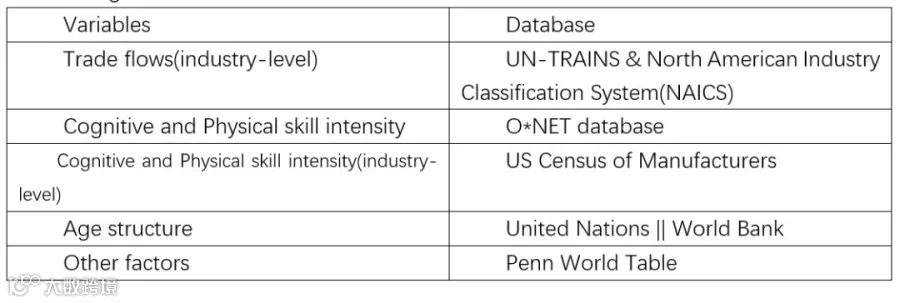
You can go to the website and download the database and handbook. It’s a good way to collect data that reading relative papers is. Besides, there are also some free database such as CEPII, WITS, IMF, OECD and etc. that you can turn to.
The most impressive aspect of this article is the fourth section where they make fully discussion on the robustness tests using more than ten methods.
For scale and measurement of independent variables, authors choose to alternative measures of human capital and alternative reference skills. Like many have done, test the same equation for different time periods and rule out some observation (USA in the paper). Using instrument variable as proxy of intensities in age-dependent skills and demographic composition. Change the measurement of the stock of age-depreciating cognitive skills. Rule out the effect of different education and health care level on cognitive skills. Further, they talk about the possible change in preferences during population aging.
Every method used in the paper are common but well-done. It’s helpful to learn some method like that. It would be blazing if an undergraduate use that kind of approach.
The key of success is an acute observer with a brilliant story and a complete discussion in empirical part. In summary, this paper finds a negative relationship between cognitive skill intensive products export and age structure when everyone is concerning about population aging. Then the authors build a model to capture both Ricardian and H-O channels in age structure. At last, perfect robustness discussion is very impressive.
If you’re interested in comparative advantage, it worth reading.

—责编:陈雨珩 —
—推送:张宇晗 —
长按LOGO
一键关注