

关注获取最新资讯及各种国贸资源
全文共2965字,阅读大约需要8分钟
原文链接:
Why and How Capitalism Needs to Be Reformed
“在这份报告中,我阐述了为什么我认为资本主义现在对大多数美国人不起作用,我分析了为什么它产生了这些不充分的结果,并就如何改革资本主义提出了一些建议。”
"In this report I show why I believe that capitalism is now not working for the majority of Americans, I diagnose why it is producing these inadequate results, and I offer some suggestions for what can be done to reform it."
——Raymond Dalio
Raymond Dalio
An American billionaire investor, hedge fund manager, and philanthropist.Dalio is the founder of investment firm Bridgewater Associates(桥水基金), one of the world's largest hedge funds. Bloomberg (彭博)ranked him as the world's 79th wealthiest person in January 2019.
编者按:
在Dalio眼中,美国梦已经是80年代的旧狂潮,它可以支持Steve Jobs在车库里创造一个苹果,但很难再在当代的美国继续激发经济发展。他的观点是美国的资本主义正处于一个阶级固化的瓶颈期,而这一切体现于资本利润的激增和阶级固化,科技进步也贫富差距拉大的现实中加了一把力。这不仅让编者想到刘慈欣《赡养人类》中对“私有财产神圣不可侵犯”这一社会原则的质疑,在科技进步的背景下,底层社会的工人会被挤出劳动力,且产品和服务日益倾向于上流阶层的需求,因而导致的财富分化是不可逆转的。Dalio的这篇文章将以美国社会为例分析贫富差距现状,并对资本主义改革提出建议。(注:在dalio眼中,资本主义capitalism是完备的经济制度,dalio仅质疑美国资本主义经济现状)
Part 2 Dalio’s diagnosis of it
and some suggestions for reform
我对资本主义为何不能很好地为大多数人服务的诊断
资本主义现在的运作方式是,人们和企业发现,制定政策和制造技术来降低人力成本是有利可图的,这会降低人口在社会资源中所占的很大比例。那些更富有的公司和人们有更强的购买力,这就促使那些寻求利润的人把他们的资源转移到生产富人想要的东西,而不是穷人想要的东西,这包括为穷人孩子提供良好的照顾和教育等基本需求。我们刚刚在大学招生作弊丑闻中看到了这一点。
这种动态的结果是,这个体系正在为富人制造自我强化的螺旋式上升,为穷人制造螺旋化下降,这将导致上层的有害过度行为和底层的有害剥夺。
更具体地说,我认为:
1. 对利润和更高效率的追求导致了新技术的发明,这些新技术取代了人,使公司运行更有效率,奖励了发明这些技术的人,伤害了被他们取代的人。这个力量将在今后几年内加速发展,目前还没有妥善处理这一问题的计划。
2. 追求更大的利润和更高的公司效率,也导致公司在其他国家生产,用具有成本效益的外国工人取代美国工人,这对这些公司的利润和效率有利,但对美国工人的收入不利。当然,全球化也让更便宜、或许质量更好的外国商品进入美国,这对外国卖家和美国买家都是好事,对与之竞争的美国公司和工人则是坏事。
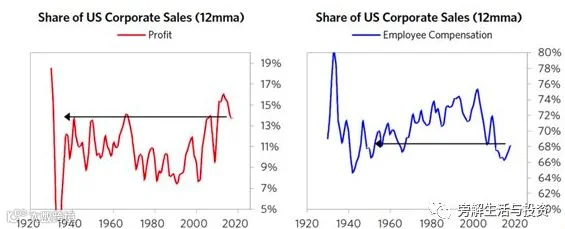
由于这两种力量的作用,收入中转化为利润的份额相对于工人的份额有所增加。下面的图表显示了自1929年以来公司收入中利润所占的百分比和员工薪酬所占的百分比。
3.央行印钞和购买金融资产(这对于应对2008年的债务危机和刺激经济增长是必要的)推高了金融资产的价格,这有助于让拥有金融资产的人比不拥有这些资产的人更富有。
4. 政策制定者过于关注预算与投资回报的关系。
Those companies and people who are richer have greater buying power, which motivates those who seek profit to shift their resources to produce what the haves want relative to what the have-nots want, which includes fundamentally required things like good care and education for the have-not children. We just saw this exemplified in the college admissions cheating scandal.
As a result of this dynamic, the system is producing self-reinforcing spirals up for the haves and down for the have-nots, which are leading to harmful excesses at the top and harmful deprivations at the bottom. More specifically, I believe that:
1.The pursuit of profit and greater efficiencies has led to the invention of new technologies that replace people, which has made companies run more efficiently, rewarded those who invented these technologies, and hurt those who were replaced by them. This force will accelerate over the next several years, and there is no plan to deal with it well.
2.The pursuit of greater profits and greater company efficiencies has also led companies to produce in other countries and to replace American workers with cost-effective foreign workers, which was good for these companies’ profits and efficiencies but bad for the American workers’ incomes. Of course, this globalization also allowed less expensive and perhaps better quality foreign goods to come into the US, which has been good for both the foreign sellers and the American buyers of them and bad for the American companies and workers who compete with them.
Because of these two forces, the share of revenue that has gone to profits has increased relative to the share that has gone to the worker. The charts below show the percentage of corporate revenue that has gone to profits and the percentage that has gone to employee compensation since 1929.
3. Central banks’ printing of money and buying of financial assets (which were necessary to deal with the 2008 debt crisis and to stimulate economic growth) drove up the prices of financial assets, which helped make people who own financial assets richer relative to those who don’t own them.
4. Policy makers pay too much attention to budgets relative to returns on investments.
我认为应该做什么
1. 来自高层的领导。我有一个原则,如果你不能影响那些掌握权力的人,让他们按照你希望的方式来改变事情,你就不会对他们产生影响。因此,需要来自国家高层的强大力量,将收入/财富/机会差距宣布为国家紧急状况,并承担起重新设计这一体系的责任,使其更好地发挥作用。
2. 两党人士和熟练的政策制定者共同努力,重新设计这一体系,使其更好地发挥作用。我相信,我们将以两党合作和熟练的方式做到这一点,否则我们将互相伤害。因此,我认为,领导层应该建立一个两党合作的委员会,把来自不同党派的技术人员召集到一起,提出一个计划,对金融体系进行重新设计,以便同时更好地分配和扩大经济蛋糕。
3. 清晰的指标,可以用来判断成功,并让负责实现它的人负责。
4. 重新分配资源,改善绝大多数人的福祉和生产力。例如,我考虑个人税率的变化可能如何发生,以及个人税率相对于企业税率的变化将如何影响资金的流动,以及一个地方相对于另一个地方的税率变化将如何推动资金流动和资金流动的结果。我还想了很多关于筹集到的钱将如何使用的问题——将有多少资金用于改善社会和经济成果的项目,以及有多少资金将用于再分配。这样的决定当然要由两党委员会的成员和领导层来决定,而且这是一项非常复杂的工程,我无法在这里发表意见。然而,我可以给出我的大方向。最重要的是,我想取得良好的双底线结果。要做到这一点,我想:建立公私伙伴关系(包括政府、慈善家和公司);改善筹集资金的方式使其既要改善条件,又要提高经济生产力,要考虑到社会的全部成本(例如,我要对会给社会带来可观的经济成本的污染和各种导致健康状况不佳的原因征税);通过税收从上层筹集更多资金,这些税收的设计不会对生产力产生破坏性的影响,并将专门用于帮助那些处于中间和底层的人。
5. 协调货币和财政政策。由于资金被顶层堵住,而且中央银行为扭转下一轮经济衰退而采取的足够宽松的货币政策能力有限,在保持美联储独立性的同时,财政政策将不得不与货币政策更加协调。
1.Leadership from the top. I have a principle that you will not effect change unless you affect the people who have their hands on the levers of power so that they move them to change things the way you want them to change. So there need to be powerful forces from the top of the country that proclaim the income/wealth/opportunity gap to be a national emergency and take on the responsibility for reengineering the system so that it works better.
2.Bipartisan and skilled shapers of policy working together to redesign the system so it works better. I believe that we will do this in a bipartisan and skilled way or we will hurt each other. So I believe the leadership should create a bipartisan commission to bring together skilled people from different communities to come up with a plan to reengineer the system to simultaneously divide and increase the economic pie better.
3.Clear metrics that can be used to judge success and hold the people in charge accountable for achieving it.
Redistribution of resources that will improve both the well-beings and the productivities of the vast majority of people.
a. Create private-public partnerships (including governments, philanthropists, and companies) that would jointly vet and invest in double bottom line projects that would be judged on the basis of their social and economic performance results relative to clear metrics.
b. Raise money in ways that both improve conditions and improve the economy’s productivity by taking into consideration the all-in costs for the society
c. Raise more from the top via taxes that would be engineered to not have disruptive effects on productivity and that would be earmarked to help those in the middle and the bottom primarily in ways that also improve the economy’s overall level of productivity, so that the spending on these programs is largely paid for by the cost savings and income improvements that they create.
4.Coordination of monetary and fiscal policies.
原文来源:RAY DALIO POSTED ON LINKED IN
翻译来源:华尔街见闻
—责编:衣诺—