

Overview of Sports Injuries
The term “sports injury” ,refers to the kinds of injuries that most commonly occur during sports or exercise. Sports injuries can result from:
Accidents.
Improper equipment.
Insufficient warmup and stretching.
Lack of conditioning.
Poor training practices.
The most common sports injuries include:
Muscle sprains and strains.
Tears of the ligaments that hold joints together.
Tears of the tendons that support joints and allow them to move.
Dislocated joints.
Fractured bones, including vertebrae.
Regardless of the specific structure affected, musculoskeletal sports injuries can generally be classified in one of two ways: acute or chronic.
Acute Injuries
Acute injuries, such as a sprained ankle, strained back, or fractured hand, occur suddenly during activity. Signs of an acute injury include:
Sudden, severe pain.
Swelling.
Inability to place weight on a lower limb.
Extreme tenderness in an upper limb.
Inability to move a joint through its full range of motion.
Extreme limb weakness.
Visible dislocation or break of a bone.
Chronic Injuries
Chronic injuries usually result from overusing one area of the body while playing a sport or exercising over a long period. The following are signs of a chronic injury:
Pain when performing an activity.
A dull ache when at rest.
Swelling.

Types of Sports Injuries
Following are some of the most common sports injuries.
Sprains and Strains
A sprain is a stretch or tear of a ligament, the band of connective tissues that joins the end of one bone with another. Sprains are caused by trauma such as a fall or blow to the body that knocks a joint out of position and, in the worst case, ruptures the supporting ligaments. Sprains can range from first degree (minimally stretched ligament) to third degree (a complete tear). Areas of the body most vulnerable to sprains are ankles, knees, and wrists.
A strain is a twist, pull, or tear of a muscle or tendon, a cord of tissue connecting muscle to bone. It is an acute, noncontact injury that results from overstretching or over-contraction. Although it’s hard to tell the difference between mild and moderate strains, severe strains not treated professionally can cause damage and loss of function.
Knee Injuries
The knee is a complex structure and is weight bearing and can be a commonly injured joint. Knee injuries can range from mild to severe. Some of the less severe injuries to the knee can include:
Runner’s knee, which causes pain or tenderness close to or under the knee cap at the front or side of the knee.
Iliotibial band syndrome, which causes pain on the outer side of the knee.
-
Tendinitis, also called tendinosis, which shows degeneration within a tendon, usually where it joins the bone.
View of the Knee
More severe injuries include bone bruises or damage to the cartilage or ligaments. There are two types of cartilage in the knee. One is the meniscus, a crescent-shaped disc that absorbs shock between the thigh (femur) and lower leg bones (tibia and fibula). The other is a surface-coating (or articular) cartilage. It covers the ends of the bones where they meet, allowing them to glide against one another. The four major ligaments that support the knee are the:
Anterior cruciate ligament (ACL).
Posterior cruciate ligament (PCL).
Medial collateral ligament (MCL).
Lateral collateral ligament (LCL).
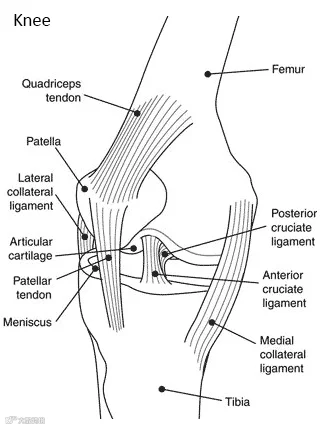
Knee injuries can result from a blow to or twist of the knee; from improper landing after a jump; or from running too hard, too much, or without proper warmup.
Compartment Syndrome
In many parts of the body, muscles, along with the nerves and blood vessels that run alongside and through them, are enclosed in a “compartment” formed of a tough membrane called fascia. When muscles become swollen, they can fill the compartment to capacity, causing interference with nerves and blood vessels as well as damage to the muscles themselves. The resulting painful condition is referred to as compartment syndrome.
Compartment syndrome may be caused by:
A one-time traumatic injury, also known as acute compartment syndrome, such as a fractured bone or a hard blow to the thigh.
Repeated hard blows or by ongoing overuse, also known as chronic exertional compartment syndrome. For example long-distance running can lead to this syndrome.
Shin Splints
Although the term “shin splints” has been widely used to describe any sort of leg pain associated with exercise, the term actually refers to pain along the tibia or shin bone, the large bone in the front of the lower leg. This pain can occur at the front outside part of the lower leg, including the foot and ankle (anterior shin splints) or at the inner edge of the bone where it meets the calf muscles (medial shin splints).
Shin splints are primarily seen in runners, particularly those just starting a running program. Risk factors for shin splints include:
Overuse or incorrect use of the lower leg.
Improper stretching, warmup, or exercise technique.
Overtraining.
Running or jumping on hard surfaces.
Running in shoes that don’t have enough support.
These injuries are often associated with flat (overpronated) feet.
Achilles Tendon Injuries
An Achilles tendon injury results from a stretch, tear, or irritation to the tendon connecting the calf muscle to the back of the heel. These injuries can be so sudden and agonizing that they have been known to bring down charging professional football players in shocking fashion.
The most common cause of Achilles tendon tears is a problem called tendinitis, a degenerative condition caused by aging or overuse. When a tendon is weakened, trauma can cause it to rupture.
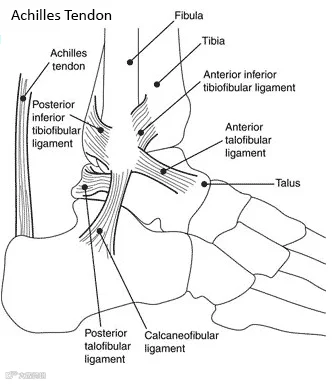
Achilles tendon injuries are common in middle-aged “weekend warriors” who may not exercise regularly or take time to stretch properly before an activity. Among professional athletes, most Achilles injuries seem to occur in quick-acceleration, jumping sports like football and basketball, and almost always end the season’s competition for the athlete.
Fractures
A fracture is a break in the bone that can occur from either a quick, one-time injury to the bone, also known as an acute fracture, or from repeated stress to the bone over time, also known as a stress fracture.
Acute fractures can be:
Simple, usually a clean break with little damage to the surrounding tissue.
Compound, meaning a break in which the bone pierces the skin with little damage to the surrounding tissue.
Most acute fractures are emergencies. One that breaks the skin is especially dangerous because there is a high risk of infection.
Stress fractures occur largely in the feet and legs and are common in sports that require repetitive impact, primarily running or jumping sports such as gymnastics or track and field. Running creates forces two to three times a person’s body weight on the lower limbs.
The most common symptom of a stress fracture is pain at the site that worsens with weight-bearing activity. Tenderness and swelling often accompany the pain.
Dislocations
When the two bones that come together to form a joint become separated, the joint is described as dislocated. Contact sports such as football and basketball, as well as high-impact sports and sports that can result in excessive stretching or falling, cause most dislocations. A dislocated joint is an emergency that requires medical treatment.
The joints most likely to be dislocated are some of the hand joints. Aside from these joints, the joint most frequently dislocated is the shoulder. Dislocations of the knees, hips, and elbows are uncommon.
Symptoms of Sports Injuries
The symptoms of a sport injury will depend on the type of injury you have.
Symptoms of an acute injury include:
Sudden, severe pain.
Swelling.
Not being able to place weight on a leg, knee, ankle, or foot.
An arm, elbow, wrist, hand, or finger that is very tender.
Not being able to move a joint as normal.
Extreme leg or arm weakness.
A bone or joint that is visibly out of place.
In addition, signs and symptoms of strains or sprains may also include:
Varying degrees of tenderness or pain.
Bruising.
Inflammation.
Joint looseness, laxity, or instability.
Muscle spasm.
Loss of strength.
Symptoms of a chronic injury include:
Pain when you play.
Pain when you exercise.
A dull ache when you rest.
Swelling.
This article is excerpted from:
https://www.niams.nih.gov/health-topics/sports-injuries
The copyright belongs to the creator

JK-Clive Pain Clinic specializes in management of acute and chronic pain caused by various "sports injuries" and "degenerative diseases",we are located in Beijing Sanfine International Hospital and our services can be paid directly by most of the international insurance.

JK will always care about your health!
Practical medical science will be shared constantly!
If you have any questions about muscles and joint pain.

Past recommendations
2.What Is Lumbago? Causes, Preventions, & Treatments


Light up sharing, like, watching
Look who's watching with you