


To help you develop time management skills through your internship and articulate the skills to potential employers, we found the following information that you could use as guidelines.
Time management skills are valuable in jobhunting, but also in many other aspects of life: from revising for examinations to working in a vacation job.
Matrix of teamwork skills:
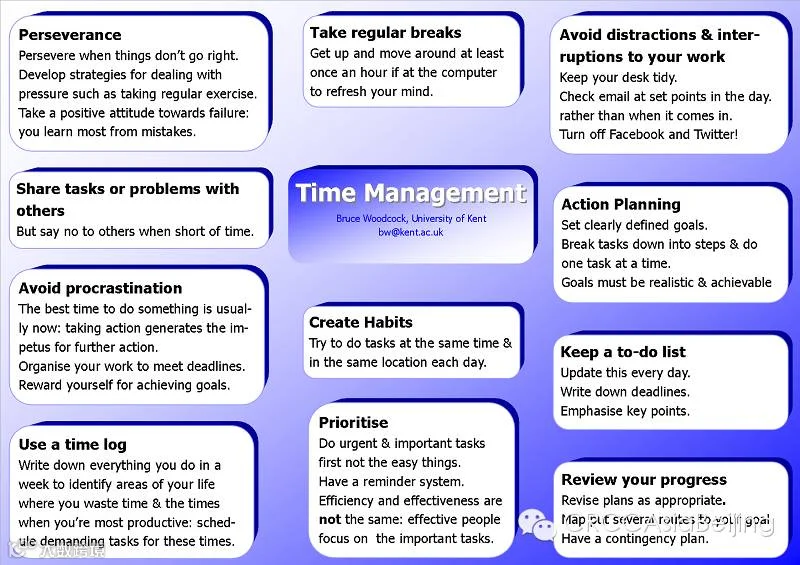
Keeping a to-do List
A daily list of tasks that need to be done is an essential part of action planning. Refer to and update this regularly. Prioritise items on the list into important/not important and urgent/non-urgent. Such a list can take a variety of formats but an example is given to the right. Update your list daily, crossing off completed tasks and adding new tasks that need to be done. Urgent or important tasks can be highlighted with an asterisk.
Setting Goals
Set yourself specific and clearly defined goals, and make sure that these are realistic and achievable. To do this, you first need to examine your present situation and assess what goals are important to you and what action you need to take to achieve your target.Have a contingency plan or alternative route to your goal in case you have to change your plans
Prioritising
Efficiency and effectiveness are not the same. Someone who works hard and is well organised but spends all their time on unimportant tasks may be efficient but not effective. To be effective, you need to decide what tasks are urgent and important and to focus on these. This is called prioritising. It's important to list the tasks you have and to sort these in order of priority, and then to devote most time to the most important tasks. This avoids the natural tendency to concentrate on the simple, easy tasks and to allow too many interruptions to your work. Differentiate also between urgent and important tasks: an urgent task may not necessarily be important!
Avoiding Procrastination
Procrastination is the scourge of action planning. It's important that you manage 'Your fear of doing things' you don't want to do and realise that the fear is often far worse than any possible negative results. Try to take decisions immediately when possible and when you don't need to gather more information pertinent to the decision. The best time to do something is usually NOW. Taking action generates the impetus for further action. Many applications to prestigious employers now need to be made in the first term of your final year and if you procrastinate you'll miss the deadlines.
Breaking down tasks
Break goals down into their components so that you can accomplish them one step at a time. Write these steps down, and try to be as specific as you can when you do this. Try to complete one task before you go on to the next. A mountain is climbed one step at a time ... Reward yourself for achieving these goals to maintain your enthusiasm. For example, when you are invited to your first interview, treat yourself to a good meal with friends. Regularly review your progress towards your goals and revise plans as appropriate to take account of unforeseen changes.
Persevering
Inevitably, things will not always run smoothly as you progress towards your goals. When things are not working out, you need to persevere and learn how to take a positive attitude towards frustration and failure. Mistakes are a crucial part of any creative process and each is a lesson leading you towards the right solution. Fear of making or admitting mistakes is a major handicap to taking effective action. It is said that the people who have achieved the most have made the most mistakes! Try to be aware that satisfaction comes as much from pursuing goals as from achieving them. Work at effective strategies to deal with pressure - these can vary from taking exercise, to relaxation techniques such as Yoga, to simply sharing problems with friends. Being assertive can also help here, for example, politely saying no to the demands of others when you are pushed for time. Sharing tasks and problems with others will spread the burden and will bring a fresh perspective to them.
Organising your time
Identify areas of your life where you are wasting time and try to reduce these. A good way to do this is to log everything you do for a week in meticulous detail and then examine your record to see how you use (or misuse!) your time. Develop a regular work routine. Keep your work space tidy so that you can work efficiently - it's hard to do this if things you need to find are buried under a pile of paper! Work to schedule so that you meet deadlines in good time - don't leave everything until the last minute.
Source: http://www.kent.ac.uk/careers/sk/time.htm