
The logistics industry is continuously evolving, with geopolitical shifts, trade disputes, and changing customs policies reshaping global supply chains.
This market update highlights the latest trends in air and sea freight, offering insights and strategies to help navigate these challenges.


USTR Port Fees on China: Strategic Shift in U.S. Maritime Policy
In April 2025, the United States Trade Representative (USTR) announced plans to implement port fees targeting Chinese-owned vessels, Chinese-built ships, and certain foreign-built carriers entering U.S. ports. These measures are set to take effect on October 14, 2025, aiming to reduce China’s influence in global shipping and boost domestic shipbuilding.
Shipping companies are adjusting their fleet operations to minimize exposure to Chinese-built vessels on U.S. routes, helping avoid potential fees. However, key uncertainties remain around vessel ownership definitions, leaseback arrangements, and emergency port calls. U.S. Customs is still finalizing payment mechanisms and compliance protocols.
Sources:US-China Business Council; USTR.gov/wfw.com
Freight Rates and Trends
After 11 consecutive weeks of decline, Drewry's World Container Index (WCI) stabilized, reflecting mixed trends across major trade lanes. Rising Transpacific rates were offset by sharp drops on the Asia–Europe route.
- Shanghai–Los Angeles: $2,522/FEU (+8%)
- Shanghai–New York: $3,677/FEU (+12%)
- Shanghai–Rotterdam: $2,385/FEU (-10%)
- Shanghai–Genoa: $2,653/FEU (-7%)
Drewry forecasts a decline in spot rates during the second half of 2025 due to weakening supply-demand balance. The timing and volatility will depend on future U.S. tariff policies and potential restrictions on Chinese vessels.
Sources:Drewry; Shanghai Shipping Exchange
Global Schedule Reliability
In July 2025, container shipping schedule reliability declined for the first time since January, dropping 2.2 percentage points month-on-month to 65.2%. Despite this dip, it remains 13 points higher than the same period last year. Average delays increased slightly to 4.68 days.
Sources:Sea Intelligence


Air Cargo Capacity Trends
According to IATA, global air cargo capacity in July 2025 rose 3.9% year-on-year, with international operations up 4.5%. Growth was primarily driven by a 7.3% increase in belly-hold capacity, supported by summer passenger flights. Dedicated freighter capacity saw only modest growth.
Sources:IATA; Financial Times, Drewry
Airfreight Pricing and Rate Development
Airfreight prices remained soft in August. Drewry’s East-West Airfreight Price Index rose just 1% month-on-month, with flat rates on Asia–Europe and Middle East–Europe routes, a 2% increase on the transpacific, and a decline on the westbound transatlantic. Compared to the same period last year, prices are still down approximately 11%.
Market conditions reflect weak spot demand and slow booking activity. While rates have stabilized slightly, the lack of a strong pre-peak season surge underscores ongoing pressure from overcapacity, tariffs, and shifting trade policies.
Sources:IATA; Financial Times, Drewry


Global Economic Outlook
The Conference Board has revised its global GDP growth forecast for 2025 upward to 3.0%, while maintaining the 2026 outlook at 2.8%. For comparison, 2024 growth is estimated at 3.2%.
This adjustment reflects stronger-than-expected economic performance in the first half of 2025 and a partial easing of trade-related uncertainty. Although tensions persist, recent developments suggest a more favorable environment for global trade and investment.
Sources:The Conference Board
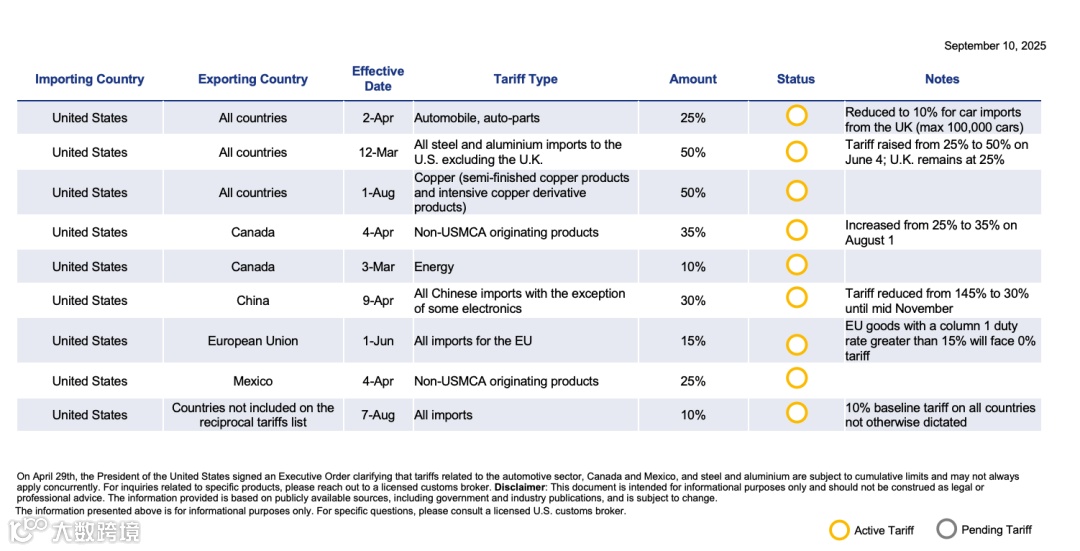
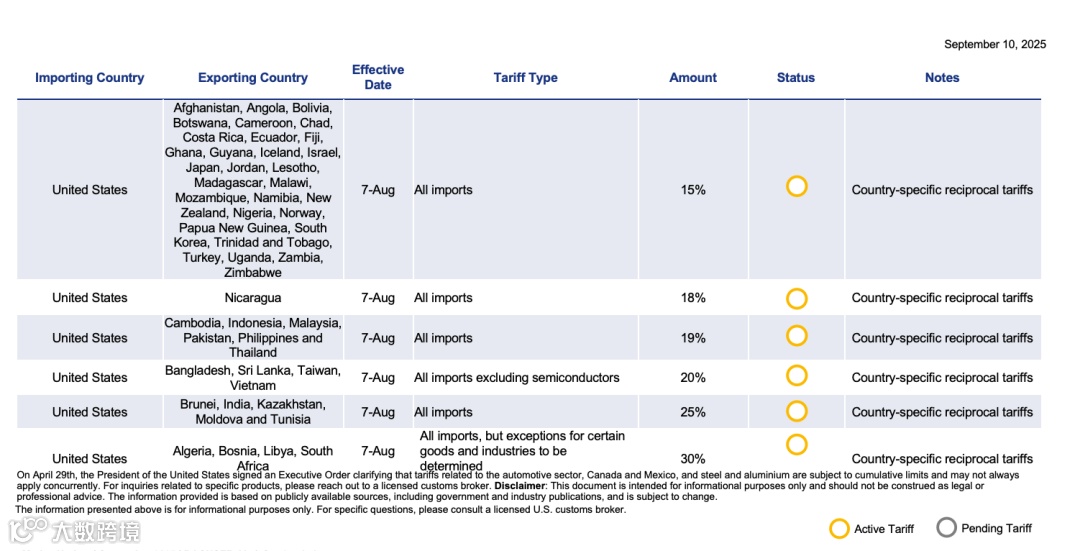
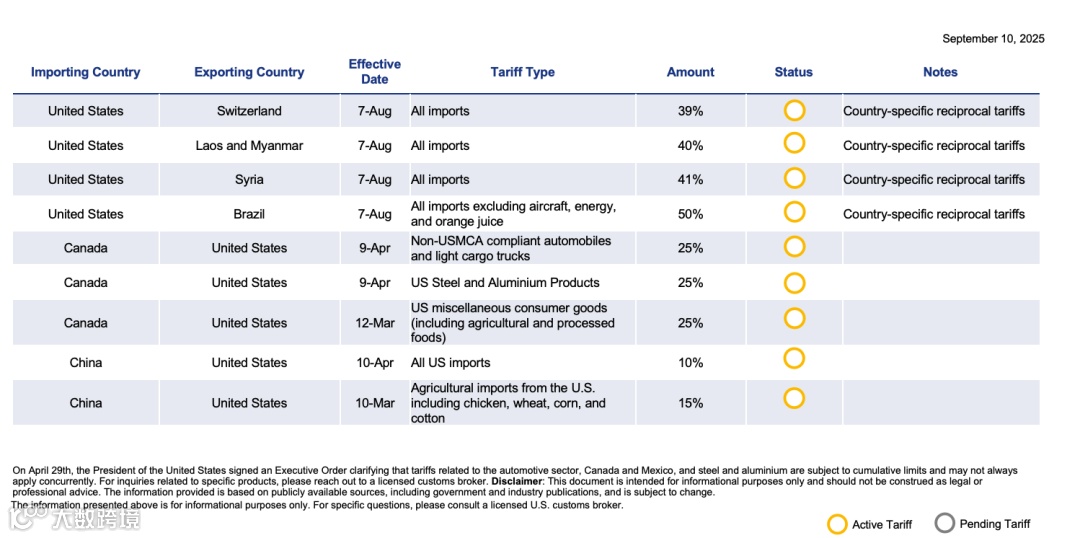
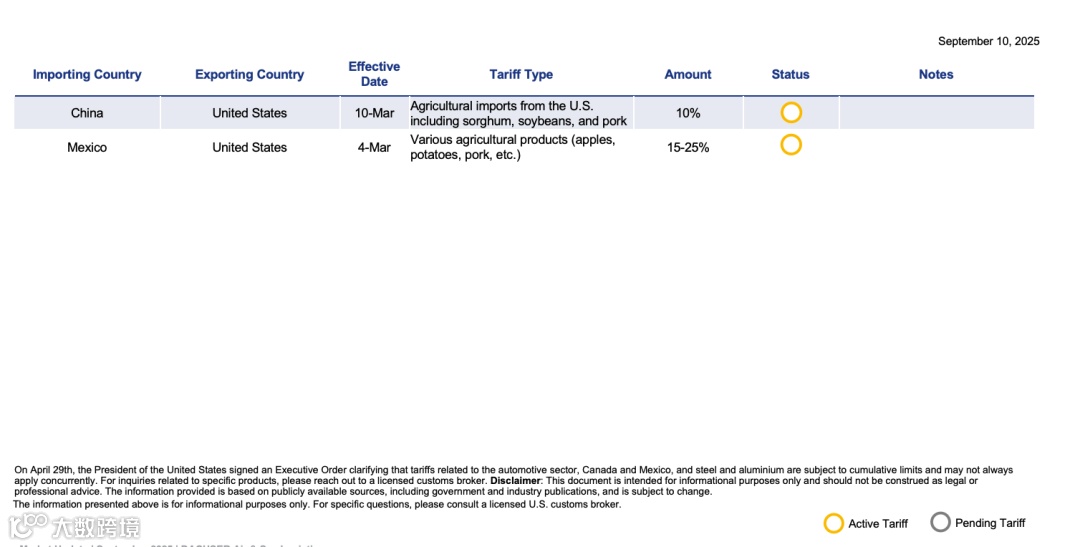
Tariff Tracker
On April 29, 2025, the U.S. President signed an executive order clarifying that tariffs on automotive imports, as well as those affecting Canada, Mexico, steel, and aluminum, may be applied cumulatively but not necessarily simultaneously.
Disclaimer: This document is for informational purposes only and should not be considered legal or professional advice. Information is based on publicly available sources and subject to change. For specific guidance, consult a licensed U.S. customs broker.