
点击公众号即可订阅
In this issue
▪ Image filtering
▪ Image enhancement
▪ Upcoming events
▪ Bruker microCT news
▪ Image of the month
Welcome
In our first Bruker MicroCT Academy of 2018, we discuss all the tools available to ensure a smooth analysis workflow:image filtering and image enhancement. CTAn offers a number of ways to filter 3D datasets, but how do they work and which one should you choose? You will find out more in method note 112. Having problems with dark images? Could use a bit more contrast? Method note 113 will tell you all about it!
Image filtering
One of the most annoying artefacts in micro-CT is image noise. No matter how careful you are during acquisition,no matter how many projections you take or how high you put the frame averaging, that dreadful noise is always there. Simply cranking up the smoothing during reconstruction looks great from a distance, but hmmm…looks like you lost all your porosity there.
Image filtering in CTAn can be a great help to make you images look better, and more importantly, make your results better! In “Method Note 112: Advanced image filtering”, all the different filtering algorithms are discussed theoretically and practically, by showing example images on a real dataset. We calculated the effect of all filters on signal-to-noise ratio, investigated which filters preserve resolution and which take the longest to calculate. By choosing smart filtering, we are confident you will be able to get A-level results on your most challenging datasets.
The filters you can find in CTAn include traditional filters like Gaussian smoothing and median filters, developed years ago for image and photo processing, and also more advanced algorithms such as Conditional Mean and Anisotropic diffusion filters, specifically developed for scientific image processing. Each algorithm has its strong and weak points, and we quantified each of these points as objective as possible.
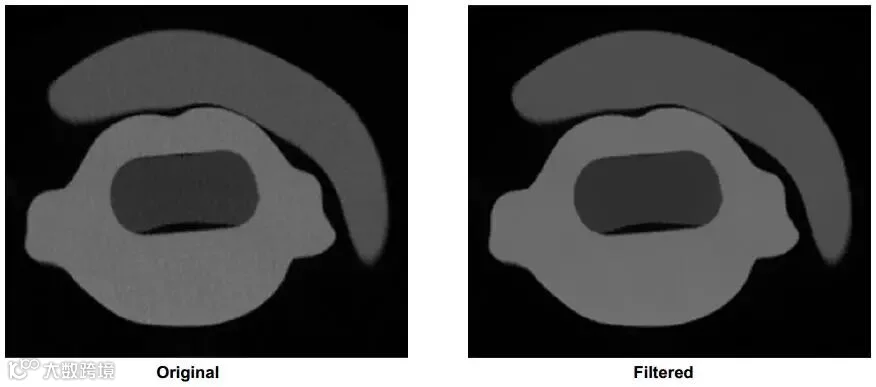
How smooth can you go? The effect of conditional mean filtering with a radius of 5 and threshold value of 10.
Image enhancement
Image filters are a great tool to improve your signal-tonoise ratio, but they can take a long time to compute.Sometimes you just need that little bit of extra contrast or brightness, and then some image enhancement tips can make a big difference.
In “Method Note 113: Image enhancement”, different ways to optimize image contrast are discussed. We begin in NRecon, by explaining the different ways of setting contrast limits, go over DataViewer, where new linear or non-linear look-up tables can be applied to images and end with CTAn, where automatic histogram optimization algorithms are implemented.
Upcoming events
Bruker microCT will participate with an exhibit in the forthcoming conferences. Please click the link below for more information. We hope to see you there!
▪ EMIM Mar.20–23 San Sebastián, Spain
▪ CONTROL Apr.24–27 Stuttgart, Germany
▪ ATS May.18–23 San Diego, USA
▪ ECTS May26–29 Valencia, Spain
▪ 3DMS Jun.10–13 Elsinore, Denmark
▪ BRS Jun.27–29 Winchester, UK
Bruker microCT news
Although the abstract deadline is over, you can still register for our annual User Meeting. This year we host it in the beautiful city of Ghent, from April 16th to April 19th.Registration is possible on the official Bruker website.
New version of DataViewer and NRecon have recently been released and are available for download through our website or the below links:
▪ DataViewer
▪ NRcon
Image of the month
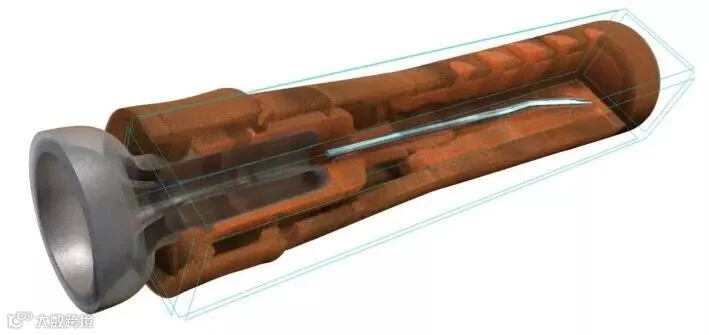
4 part oversized scan of a syringe, scanned using the SKYSCAN 1275. A quick scan at a voxel size of 10 µm reveals the needle without removing the rubber cap, allowing non-destructive quality control.