


2020年夏天,布鲁克将一台1.2 GHz Avance™ NEO核磁共振波谱仪运抵瑞士苏黎世联邦理工学院(ETH),并在成功装机升场后交付使用。现在,这台1.2 GHz核磁波谱仪已被用于记录各种蛋白质谱图,包括分子机器、膜蛋白、病毒壳等。
布鲁克独有的1.2 GHz 核磁共振磁体采用新型混合技术,内部采用先进的高温超导体(HTS),外部则采用低温金属超导体(LTS),配备快速魔角旋转(MAS)固体探头,可满足高分辨率固体核磁共振实验的要求。
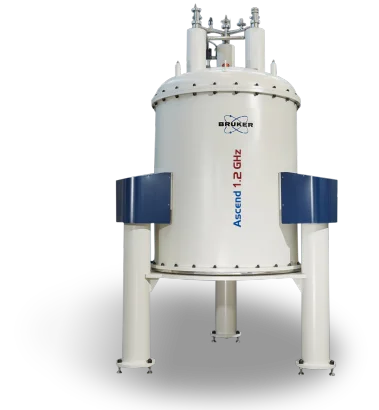
布鲁克1.2 GHz核磁共振波谱仪
1.2 GHz 的超高场强带来显著提升的谱仪分辨率,布鲁克行业领先的核磁共振波谱仪助力研究人员得到更优质的实验结果。我们推荐您阅读这篇ETH物理化学系研究项目组近期发表的学术论文,了解布鲁克超高场核磁共振技术的出色性能。
论文标题
超高场生物固体核磁共振波谱技术:1200 MHz助力固体NMR分辨率提升
Biomolecular solid-state NMR spectroscopy at highest field: the gain in resolution at 1200 MHz
论文摘要
磁场强度的提升显著改善了核磁共振技术的谱图分辨率和检测灵敏度,进而推动了核磁共振的整体发展,尤其是在生物分子研究领域的应用。
Progress in NMR in general and in biomolecular applications in particular is driven by increasing magnetic-field strengths leading to improved resolution and sensitivity of the NMR spectra.
近期,磁场强度为 28.2 特斯拉(对应质子共振频率为1200 MHz)的持久稳定型超导磁体已投入商用。
Recently, persistent superconducting magnets at a magnetic field strength (magnetic induction) of 28.2 T corresponding to 1200 MHz proton resonance frequency became commercially available.
在本文中,我们将介绍包括分子机器、膜蛋白和病毒壳在内的各种蛋白质的高场核磁共振谱图,目的是向读者介绍正在研究中的一系列代表性研究体系的概况,而不是某一个性能最佳的模型体系。
We present here a collection of high-field NMR spectra of a variety of proteins, including molecular machines, membrane proteins and viral capsids and others. We show this large panel in order to provide an overview over a range of representative systems under study, rather than a single best performing model system.
我们将讨论碳检测和氢检测的实验结果,其结果显示,与 850 MHz 相比,在碳检测谱图中可以分辨出更多的谱峰,而在氢检测谱图中,所观测到的分辨率提升最明显的是脂肪族侧链的共振峰。
We discuss both carbon-13 and proton-detected experiments, and show that in 13C spectra substantially higher numbers of peaks can be resolved compared to 850 MHz while for 1H spectra the most impressive increase in resolution is observed for aliphatic side-chain resonances.
结论
本文展示了我们在布鲁克1200 MHz 超高场核磁共振波谱仪上采集的第一个蛋白质样品的固体核磁共振谱,结果表明从淀粉样纤维、病毒衣壳蛋白、蛋白质复合物到解旋酶等各种蛋白质样品的碳检测和氢检测实验技术的谱图分辨率和灵敏度均得到了显著提升。这里描述的样品在分辨率上都有所提升,但提升程度各有不同。
We herein presented our first protein solid-state NMR spectra recorded at 1200 MHz revealing a significant gain in sensitivity and resolution for a variety of protein samples, ranging from amyloid fibrils, viral capsid proteins, protein complexes to helicases using 13C-, as well as 1H-detected experiments. For the samples described here, the improvement in resolution is variable but present for all samples.
大型蛋白质的碳检测谱图在分辨率上的提升,将大大减少谱峰的重叠,从而促进共振信号的归属,这就为取代费时费力的生化法(例如部分同位素标记或耗时的4D/5D谱图)提供了一种新的解决方法。
The gain in resolution for 13C-detected spectra of large proteins will push the current resonance assignment limitations due to reduced spectral overlap and thereby provides an alternative to laborious biochemical approaches, for example segmental isotope labelling, or time-consuming spectroscopic methods such as 4D and 5D spectra.
鉴于可以追踪更多孤峰的情况,因此还可以进一步用于研究高分子量蛋白质与其他蛋白质、核酸或小分子药物相互作用时的结构和动力学变化。
It will further allow studying structural and dynamic changes of high-molecular weight proteins upon interaction with other proteins, nucleic acids or small-molecule drugs, since the fate of more isolated peaks can be followed.
对于氢检测谱图来说,由于在更高的场强下化学位移分散度增加及其对谱峰线宽的贡献降低,可以得到分辨率更高的谱图。这对于质子化的样品更为明显,因为他们会形成强的质子耦合网。因此,高场有助于提高脂肪族侧链共振信号的分辨率并对其结构属性和动力学性质进行表征。
For proton-detected spectra, we observe an increase in resolution resulting from the increased chemical-shift dispersion as well as the reduced coherent contribution to the line width at higher magnetic field. This was shown to be stronger for protonated samples, due to their denser proton dipolar network. The high field thus allows to resolve aliphatic side-chain resonances and to characterize their structural properties as well as the dynamics.
重要的是,1200 MHz高场条件下的分辨率提升和随之而来的灵敏度提升相结合,为核磁共振波谱学开辟了一些新的机会,尤其是对于CH2和CH3基团。
Importantly, the improved resolution and the concomitant gain in sensitivity at 1200 MHz, notably for the CH2 and CH3 groups, creates several new spectroscopic opportunities.
首先,位于中间段的氨基酸指认和顺序归属中需要用到的侧链共振信号将更加容易获得。
First, side-chain resonances central in amino-acid identification and sequential assignments become more conveniently accessible.
其次,在均匀标记的样品中,通过侧链原子进行进行距离约束条件测量也可以实现了。
Second, the measurement of distance restraints involving sidechain atoms comes into reach also for uniformly labeled samples.
最后,我们的研究表明,通过13C弛豫来研究侧链动力学是现实可行的目标。
Last but not least, it renders the investigation of sidechain dynamics via 13C relaxation a realistic objective.
材料与方法
样品制备
13C-15N 标记蛋白质样品的制备按照如下文献所述:HET-s(218-289)纤维(van Melckebeke et al.,2010)、与ADP:AlF4-和DNA复合的DnaB(Wiegand et al.,2019)、RNA聚合酶II的两个亚基的Rpo4/7蛋白复合体(Torosyan et al., 2019)和含有caspase-recruitment结构域的小鼠凋亡相关斑点(ASC)蛋白的PYRIN结构域丝(Ravotti et al., 2016; Sborgi et al.,2015)。
13C-15N labeled protein samples were prepared as described in the literature: HET-s(218-289) fibrils (van Melckebeke et al. 2010), DnaB complexed with ADP:AlF4- and DNA (Wiegand et al. 2019), Rpo4/7 protein complex of two subunits of RNA polymerase II (Torosyan et al. 2019) and filaments of PYRIN domain of mouse apoptosis-associated speck-like (ASC) protein containing a caspase-recruitment domain (Ravotti et al. 2016; Sborgi et al. 2015).
TmcA、1型纤毛虫和ACNDVc的详细步骤可以在即将发表的论文中查看。
The detailed protocols for TmcA, type 1 pili and ACNDVc will be described in forthcoming publications.
2H-13C-15N标记和100%再质子化的乙型肝炎病毒外壳(dCp149)的制备如(Lecoq et al., 2019)所述,而2H-13C-15N标记的NS4B(dNS4B)是在H2O中合成的(Jirasko et al., 2020))。
2H-13C-15N labeled and 100 % re-protonated Hepatitis B Virus Capsid (dCp149) was prepared as described by (Lecoq et al. 2019) while 2H-13C-15N labeled NS4B (dNS4B) was synthesized in H2O (Jirasko et al. 2020)).
碳检测波谱学
固体核磁共振谱图在布鲁克宽腔850 MHz Avance III 和布鲁克标腔1.2 GHz Avance NEO 波谱仪上获取;
Solid-state NMR spectra were acquired on a wide-bore 850 MHz Bruker Avance III and on a standard-bore 1200 MHz Bruker Avance NEO spectrometer.
13C 检测固体核磁共振碳谱使用布鲁克BioSpin 3.2 mm “E-free 探头”进行记录;
13C-detected solid-state NMR spectra were recorded using 3.2 mm Bruker Biospin “E-free probes”.
在 850 MHz 和1200 MHz 谱仪上所用的魔角旋转速率分别为17.0 kHz 和 20.0 kHz;
The MAS frequency was set to 17.0 and 20.0 kHz at 850 MHz and 1200 MHz, respectively.
用水的信号作为内标对样品实际温度进行校准之后,将样品温度设置为278 K(Böckmann et al., 2009);
The sample temperature was set to 278 K using the water line as an internal reference (Böckmann et al. 2009).
2D 谱使用 TopSpin 软件(布鲁克 Biospin,3.5 和 4.0.6 版本)进行处理,间接维加窗函数gsine进行处理,位移因子SSB给3,同时在间接和直接维度上进行自动基线校正。更多实验细节请见原文中表S1。
The 2D spectra were processed with the software TOPSPIN (version 3.5 and 4.0.6, Bruker Biospin) with a shifted (3.0) squared cosine apodization function and automated baseline correction in the indirect and direct dimension. For further experimental details see Table S1.
氢检测波谱学
氢检测谱图是在布鲁克0.7mm三共振探头上100 kHz 魔角旋转条件下获得。
The 1H detected spectra were acquired at 100 kHz MAS frequency using a Bruker 0.7 mm triple-resonance probe.
通过测量质子横向弛豫时间T2’来调整魔角方向,直至质子的横向弛豫时间达到最长表明魔角方向调整准确(见图S2)。
The magic angle has been adjusted “on sample” by measuring T2’ proton transverse relaxation times and adjustment of the magic angle until the longest relaxation times were obtained (see Figure S2).
根据上清液水共振确定将样品温度设置为293 K(Böckmannet et al., 2009;Gottlieb,Kotlyar, Nudelman 1997)。
The sample temperature was set to 293 K as determined from the supernatant water resonance (Böckmann et al. 2009; Gottlieb, Kotlyar, and Nudelman 1997).
对样品dCp149、dNS4B Rpo4/7 蛋白复合物和 ASC采集了2D指纹波谱(hNH),并对样品 Rpo4/7 蛋白复合物、ASC 细丝和 HET-s(218-289)等采集了 2D-hCH 谱。
Two-dimensional (2D) fingerprint spectra (hNH) were recorded on dCp149, dNS4B Rpo4/7 protein complex and ASC, and 2D-hCH spectra on the Rpo4/7 protein complex, ASC filaments and HET-s(218-289).
在两种不同场强的谱仪上,采用相同的采样参数记录各蛋白质样品的2D谱(见表S2至表S4)。
At both spectrometer frequencies, the 2D spectra were recorded with identical acquisition parameters for each protein sample (see Tables S2 to S4).
所有氢检测谱图均在布鲁克 Topspin 4.0.6软件上进行处理,使用充零方式得到双倍采样点数,直接维和间接维均加qsine窗函数,位移因子SSB给2.5。
All 1H detected spectra were processed using Topspin 4.0.6 (Bruker Topspin) with zero filling to the double amount of data points and a shifted sine-bell apodization function in direct and indirect dimensions with SSB=2.5.
在两种不同场强谱仪上得到的谱图处理过程中直接维的FID长度均为12.9 ms。
The direct dimension was truncated to 12.9 ms during processing of measurements at both magnetic field strengths.
波谱分析使用了CcpNmr Anlaysis 2.4.2(Fogh et al., 2002;Stevens et al., 2011;Vranken et al., 2005)。谱图以 4,4-二甲基-4-硅戊烷-1-磺酸(DSS)为参考进行定标。将一维谱按比例缩放到相同噪声水平,并将 2D谱按比例缩放到相同强度水平,来比较在两个不同场强的谱仪上采集的谱图。
Spectral analysis was performed using CcpNmr Anlaysis 2.4.2 (Fogh et al. 2002; Stevens et al. 2011; Vranken et al. 2005). The spectra were referenced to 4,4-dimethyl-4-silapentane-1-sulfonic acid (DSS). One-dimensional spectra were scaled to the same noise level and 2D spectra to the same intensity level to compare spectra recorded at the two magnetic fields.
重要提示
本文最初于今年3月发表于bioRxiv,引用详情如下:Calon, Morgane, et al. "Biomolecular solid-state NMR spectroscopy at highest field: the gain in resolution at 1200 MHz." bioRxiv (2021).
您可以点击文末的【阅读原文】,获取原版英文论文;
如需获取更详细的布鲁克1.2 GHz核磁共振波谱仪产品信息及应用解决方案,欢迎浏览布鲁克官网详情页:https://www.bruker.com/zh/products-and-solutions/mr/nmr/ascend-ghz-class.html
关于布鲁克(Bruker)
布鲁克致力于支持科学家取得突破性的科学发现并开发新的应用以提升人类的生活质量。布鲁克的高性能科技仪器以及高价值分析和诊断解决方案,让科学家能够在分子、细胞和微观层面上探索生命和材料的奥秘。通过和用户的紧密合作,布鲁克致力于科技创新、提升生产力并实现用户的成功。我们的业务领域包括生命科学分子研究、应用和药物应用、显微镜和纳米分析、工业应用、细胞生物学、临床前成像、临床表型组学、蛋白质组学研究以及临床微生物学等。