

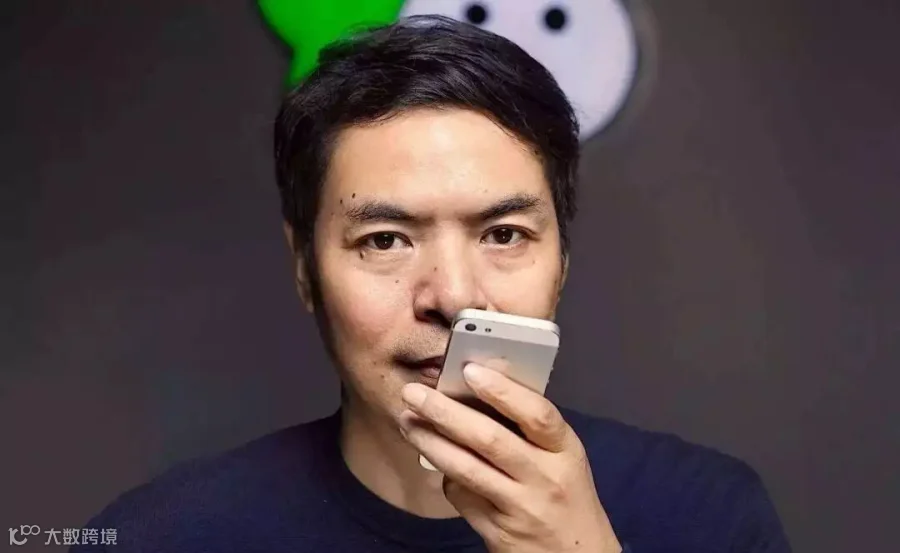
WeChat has a voice message function that allows you to press a button and record a voice message. For the uninitiated, this is just another way of sending messages that’s interchangeable with text messages.
© Image | WeChat
Why Sending A Voice Message
Is Abnoxious?
However, sending a voice message on WeChat is considered obnoxious in the Chinese professional world, and is usually only tolerated if it is sent from a superior to a subordinate.

© Image | Giphy
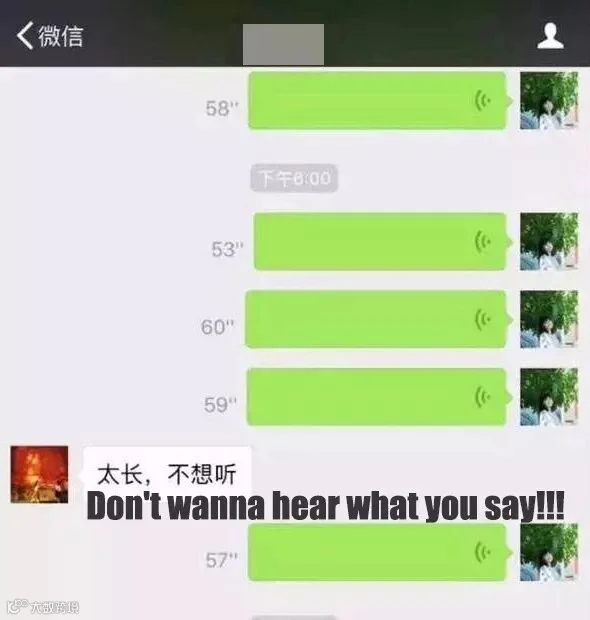
People in China use WeChat a lot more often than email as the primary medium for workplace communication. A chat situation like the one below is guaranteed to infuriate the recipient:
© Image | Baidu
Imagine receiving a 60-second audio message from someone.
If you’re in a noisy place (e.g., a networking event), you have to strain your ears or find a quiet place to hear it.
If you’re in a library, you have to dig out your headphones.
If you’re in a meeting, you have to wait until the meeting is over.
Fully taking in the message requires careful listening and sometimes even transcription.
What About Convert Audio
Messages Into Text Messages?
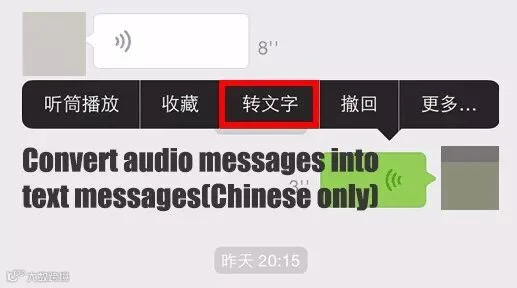
Worse still, you can’t search or forward audio messages. Even though WeChat does have a function to automatically convert audio messages into text messages, this only works in the simplified Chinese version of the WeChat app. And the conversion may not be accurate if the sender speaks a Chinese dialect or has a strong accent.
© Image | HACOS
Moreover, WeChat does not support pausing in the middle of playing a voice message or scrubbing the audio to jump to another point in time. If you miss one important word, you must replay the whole message from the very beginning. Receiving voice messages also takes up more data, which could incur costs if the recipient doesn’t have wifi.

© Image | SOOGIF
A Lot Better If You Type Instead
of Sending Voice Messages
Sending someone a voice message—instead of typing it out—tells them: “I’m obviously busier and more important than you.” The sender saves time—at the recipient’s expense. Thus it is almost always used in asymmetric relationships: when a boss is communicating a directive to a subordinate, for example.
So it would be a lot better if you do not send voice messages on WeChat in a professional situation unless you are communicating with people who clearly consider you to be their boss. Even if you are sending a very long message, type it out - and type it in one long message instead of in multiple short sentences. This reduces the number of times the recipient’s phone vibrates and saves them battery life.

© Image | hulu
If you have to send voice messages for special reasons (e.g., you are driving and the message is urgent, or if your fingers are broken and you cannot type), begin with an apology and communicate that you have no other choice.
While the microphone button is tempting,
stick to the keyboard.

Source(s): Quartz, BBC, Southenchina, Guideinchina





HACOS,Business Services Solutions Master