
Since April 1 this year, new policy on import & export issued by Indian Customs will come into effect.

Trader won’t be able to clear the customs formalities if he fails to meet the requirements. Worse still, he will suffer from punishment by the Customs!
What’s the new requirement?
According the Indian Customs, before goods are exported to NHAVA SHEVA port, the following information must be marked down on “Description” item of the B/L and the Shipping Bill:
❶ Import and Export code (IEC) of Importer;
❷ GST identifications no. (GST) of importer;
❸ Official email ID of Importer (to be used for correspondence by shipping lines and customs).
Note
● If there is inadequate space for writing down the information, you should attach another document with detailed information on it.
● If the Consignee (CNEE) is “to order” or bank, the mentioned information must be provided to the Notify (NTFY) Party.
Notes
For the time being, the policy is only applicable for cargoes unloaded in NHAVA SHEVA or transshipped via NHAVA SHEVA.
Specifically,
● The GST no. is in 15-digit. (Company which has registered with the government gets its own GST no.)
● The IEC no. is in 10-digit. (Company which owns License of Export & Import has its IEC no.)
Notice from shipping company
If the actual Consignee & Notify party is forwarder, who has no IEC, what should be paid attention to?
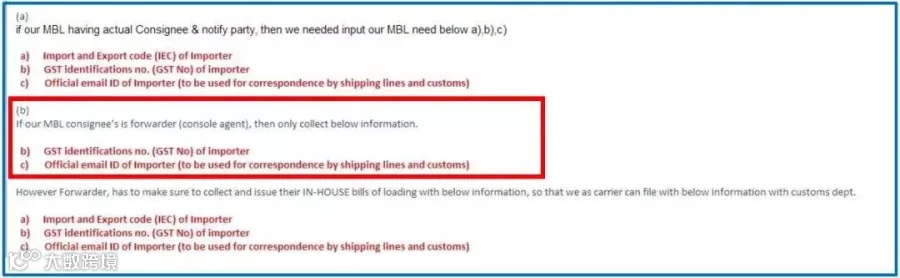
Here is the notice from shipping company:
Details:
(a)
If our MBL having actual Consignee & Notify party, then we needed input our MBL, and the following information is needed:
● Import and Export code (IEC) of Import.
● GST identification no. (GST) of importer.
● Official email ID of Importer (to be used for correspondence by shipping lines and customs).
(b)
If our MBL consignee’s is forwarder (console agent), then only collect below information:
● GST identification no. (GST) of importer.
● Official email ID of Importer (to be used for correspondence by shipping lines and customs).
(c)
However Forwarder, has to make sure to collect and issue their IN-HOUSE bills of loading with below information, so that we as carrier can file with below information with customs dept.
● Import and Export code (IEC) of Import.
● GST identification no. (GST) of importer.
● Official email ID of Importer (to be used for correspondence by shipping lines and customs).
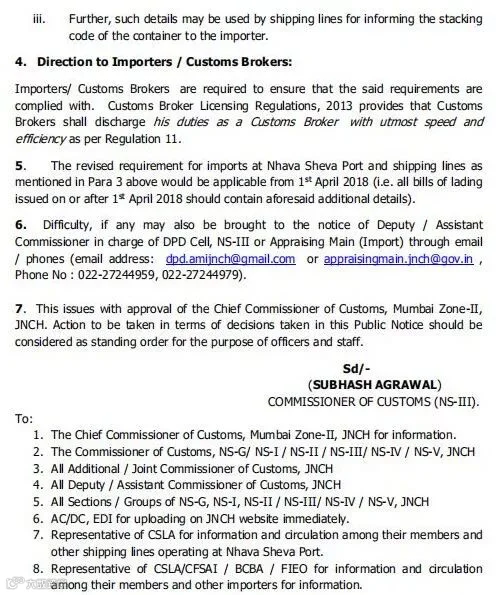
Official Public Notice
from Indian Customs
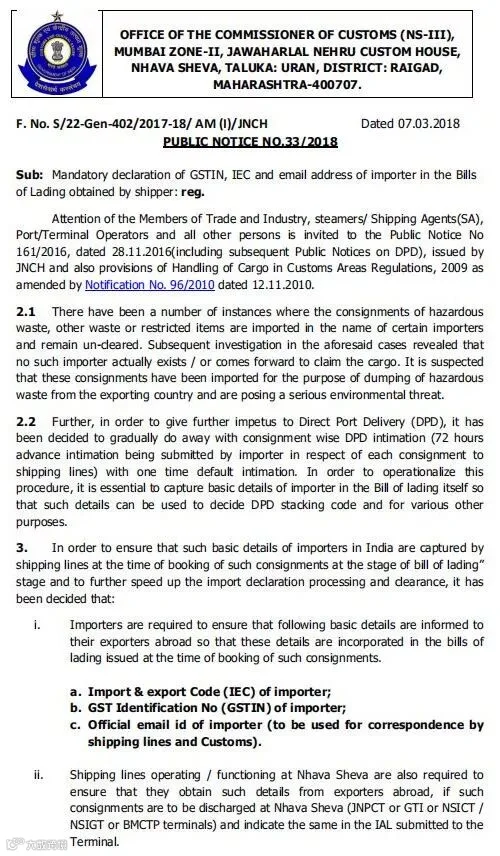
In such case, each trader who is doing foreign trade business with local companies and is about to export goods to India should adhere strictly to the rules in case of customs clearance failure.

For more shipping and logistics information, welcome to follow HACOSLogistics! Thanks for your support!
HACOS,Business Services Solutions Master