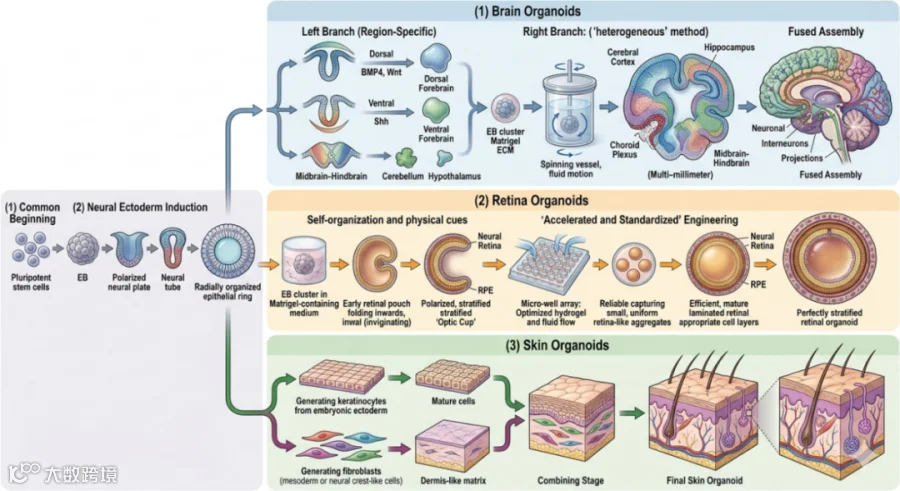
[1] Lancaster MA, Knoblich JA. Spindle orientation in mammalian cerebral cortical development. Curr Opin Neurobiol. 2012;22(5):737-746. doi:10.1016/j.conb.2012.04.003
[2] Cyranoski D. Tissue engineering: The brainmaker. Nature. 2012;488(7412):444-446. doi:10.1038/488444a
[3] Watanabe K, Kamiya D, Nishiyama A, et al. Directed differentiation of telencephalic precursors from embryonic stem cells. Nat Neurosci. 2005;8(3):288-296. doi:10.1038/nn1402
[4] Watanabe K, Ueno M, Kamiya D, et al. A ROCK inhibitor permits survival of dissociated human embryonic stem cells. Nat Biotechnol. 2007;25(6):681-686. doi:10.1038/nbt1310
[5] Eiraku M, Watanabe K, Matsuo-Takasaki M, et al. Self-organized formation of polarized cortical tissues from ESCs and its active manipulation by extrinsic signals. Cell Stem Cell. 2008;3(5):519-532. doi:10.1016/j.stem.2008.09.002
[6] Kadoshima T, Sakaguchi H, Nakano T, et al. Self-organization of axial polarity, inside-out layer pattern, and species-specific progenitor dynamics in human ES cell-derived neocortex. Proc Natl Acad Sci U S A. 2013;110(50):20284-20289. doi:10.1073/pnas.1315710110
[7] Danjo T, Eiraku M, Muguruma K, et al. Subregional specification of embryonic stem cell-derived ventral telencephalic tissues by timed and combinatory treatment with extrinsic signals. J Neurosci. 2011;31(5):1919-1933. doi:10.1523/JNEUROSCI.5128-10.2011
[8] Su HL, Muguruma K, Matsuo-Takasaki M, Kengaku M, Watanabe K, Sasai Y. Generation of cerebellar neuron precursors from embryonic stem cells. Dev Biol. 2006;290(2):287-296. doi:10.1016/j.ydbio.2005.11.010
[9] Muguruma K, Nishiyama A, Ono Y, et al. Ontogeny-recapitulating generation and tissue integration of ES cell-derived Purkinje cells. Nat Neurosci. 2010;13(10):1171-1180. doi:10.1038/nn.2638
[10] Wataya T, Ando S, Muguruma K, et al. Minimization of exogenous signals in ES cell culture induces rostral hypothalamic differentiation. Proc Natl Acad Sci U S A. 2008;105(33):11796-11801. doi:10.1073/pnas.0803078105
[11] Lancaster MA, Renner M, Martin CA, et al. Cerebral organoids model human brain development and microcephaly. Nature. 2013;501(7467):373-379. doi:10.1038/nature12517
[12] Chen A, Guo Z, Fang L, Bian S. Application of Fused Organoid Models to Study Human Brain Development and Neural Disorders. Front Cell Neurosci. 2020;14:133. Published 2020 May 15. doi:10.3389/fncel.2020.00133
[13] Bagley JA, Reumann D, Bian S, Lévi-Strauss J, Knoblich JA. Fused cerebral organoids model interactions between brain regions. Nat Methods. 2017;14(7):743-751. doi:10.1038/nmeth.4304
[14] Xiang Y, Tanaka Y, Cakir B, et al. hESC-Derived Thalamic Organoids Form Reciprocal Projections When Fused with Cortical Organoids. Cell Stem Cell. 2019;24(3):487-497.e7. doi:10.1016/j.stem.2018.12.015
[15] Linkous A, Balamatsias D, Snuderl M, et al. Modeling Patient-Derived Glioblastoma with Cerebral Organoids. Cell Rep. 2019;26(12):3203-3211.e5. doi:10.1016/j.celrep.2019.02.063
[16] Kim H, Xu R, Padmashri R, et al. Pluripotent Stem Cell-Derived Cerebral Organoids Reveal Human Oligodendrogenesis with Dorsal and Ventral Origins. Stem Cell Reports. 2019;12(5):890-905. doi:10.1016/j.stemcr.2019.04.011
[17] Cederquist GY, Asciolla JJ, Tchieu J, et al. Specification of positional identity in forebrain organoids. Nat Biotechnol. 2019;37(4):436-444. doi:10.1038/s41587-019-0085-3
[18] Wörsdörfer P, Dalda N, Kern A, et al. Generation of complex human organoid models including vascular networks by incorporation of mesodermal progenitor cells. Sci Rep. 2019;9(1):15663. Published 2019 Oct 30. doi:10.1038/s41598-019-52204-7
[19] Eiraku M, Takata N, Ishibashi H, et al. Self-organizing optic-cup morphogenesis in three-dimensional culture. Nature. 2011;472(7341):51-56. doi:10.1038/nature09941
[20] Nakano T, Ando S, Takata N, et al. Self-formation of optic cups and storable stratified neural retina from human ESCs. Cell Stem Cell. 2012;10(6):771-785. doi:10.1016/j.stem.2012.05.009
[21] Decembrini S, Hoehnel S, Brandenberg N, Arsenijevic Y, Lutolf MP. Hydrogel-based milliwell arrays for standardized and scalable retinal organoid cultures. Sci Rep. 2020;10(1):10275. Published 2020 Jun 24. doi:10.1038/s41598-020-67012-7
[22] Dequéant ML, Pourquié O. Segmental patterning of the vertebrate embryonic axis. Nat Rev Genet. 2008;9(5):370-382. doi:10.1038/nrg2320
[23] Driskell RR, Watt FM. Understanding fibroblast heterogeneity in the skin. Trends Cell Biol. 2015;25(2):92-99. doi:10.1016/j.tcb.2014.10.001
[24] Fernandes KJ, McKenzie IA, Mill P, et al. A dermal niche for multipotent adult skin-derived precursor cells. Nat Cell Biol. 2004;6(11):1082-1093. doi:10.1038/ncb1181
[25] Asakawa K, Toyoshima KE, Ishibashi N, et al. Hair organ regeneration via the bioengineered hair follicular unit transplantation. Sci Rep. 2012;2:424. doi:10.1038/srep00424
[26] Chuong CM, Cotsarelis G, Stenn K. Defining hair follicles in the age of stem cell bioengineering. J Invest Dermatol. 2007;127(9):2098-2100. doi:10.1038/sj.jid.5700947
[27] Ehama R, Ishimatsu-Tsuji Y, Iriyama S, et al. Hair follicle regeneration using grafted rodent and human cells. J Invest Dermatol. 2007;127(9):2106-2115. doi:10.1038/sj.jid.5700823
[28] Ikeda E, Morita R, Nakao K, et al. Fully functional bioengineered tooth replacement as an organ replacement therapy. Proc Natl Acad Sci U S A. 2009;106(32):13475-13480. doi:10.1073/pnas.0902944106
[29] Gledhill K, Guo Z, Umegaki-Arao N, Higgins CA, Itoh M, Christiano AM. Melanin Transfer in Human 3D Skin Equivalents Generated Exclusively from Induced Pluripotent Stem Cells. PLoS One. 2015;10(8):e0136713. Published 2015 Aug 26. doi:10.1371/journal.pone.0136713
[30] Itoh M, Umegaki-Arao N, Guo Z, Liu L, Higgins CA, Christiano AM. Generation of 3D skin equivalents fully reconstituted from human induced pluripotent stem cells (iPSCs). PLoS One. 2013;8(10):e77673. Published 2013 Oct 11. doi:10.1371/journal.pone.0077673
[31] Oh JW, Hsi TC, Guerrero-Juarez CF, Ramos R, Plikus MV. Organotypic skin culture. J Invest Dermatol. 2013;133(11):1-4. doi:10.1038/jid.2013.387
[32] Sun BK, Siprashvili Z, Khavari PA. Advances in skin grafting and treatment of cutaneous wounds. Science. 2014;346(6212):941-945. doi:10.1126/science.1253836
[33] Koehler KR, Hashino E. 3D mouse embryonic stem cell culture for generating inner ear organoids. Nat Protoc. 2014;9(6):1229-1244. doi:10.1038/nprot.2014.100
[34] Koehler KR, Mikosz AM, Molosh AI, Patel D, Hashino E. Generation of inner ear sensory epithelia from pluripotent stem cells in 3D culture. Nature. 2013;500(7461):217-221. doi:10.1038/nature12298
[35] 刘中民.干细胞研究:从基础到临床[M].北京:人民卫生出版社, 2024:101-103.