

Is Harvard Discriminates Against Asian Americans?
Finding my secret garden
序
近期,哈佛大学被揭露在招生时歧视亚裔学生,在国际社会引起轩然大波。那么哈佛歧视案的来龙去脉如何?哈佛有一个怎样的招生系统?哈佛在此案中又面临着一个怎样的挑战呢?本期Quriosity带您一看究竟。
1
-Being Acaused-
The long-awaited trial over Harvard’s admissions policies began Monday in a packed federal courtroom in Boston with perhaps the university’s most important witness taking the stand to defend its policies.
当地时间周一,哈佛大学的招生歧视案在波士顿联邦法庭开审。法庭里座无虚席,哈佛大学或许是最重要的证人威廉·菲茨西蒙斯为招生政策进行辩护。
The trial’s opening day also telegraphed critical questions that witness—Harvard’s Dean of Admissions William Fitzsimmons—is likely to face Tuesday about a key piece of evidence that, at first blush, looks fairly damning for the university.
此案开审之日还公布,哈佛大学的招生办主任菲茨西蒙斯周二可能要面对一份关键证据的质询。初看之下,该证据对哈佛大学极为不利。
The case, filed in 2014 by a conservative interest group called Students for Fair Admissions, was once billed as the next big test for the survival of affirmative action, but Judge Allison Burroughs has already ruled in Harvard’s favor on the question of whether the use of race in admissions is constitutional.
此案最初于2014年由非营利性组织“大学生公平入学(以下简称SFFA)”递交法院,一度被认为是平权法案将面对的下一个重大考验。但当时对于招生政策中种族配额的合法性问题,法官埃里森·巴勒斯作出了对哈佛有利的裁决。
The trial will instead focus on allegations that Harvard illegally discriminates against Asian Americans in its admissions process, particularly in relation to white applicants.
而本次庭审的重点是针对哈佛大学对亚裔学生的招生非法歧视的指控。与白人相比,亚裔申请者遭受的歧视尤为明显。
2
-What’s this case about?-
The plaintiff’s questioning of its first witness, Fitzsimmons, largely followed in this vein.
原告对第一证人菲茨西蒙斯的质问基本如下:
Of particular interest Monday was the university’s outreach efforts to more sparsely populated areas of the country.
在周一的听证会上,人们主要的关注点在于哈佛对于人口稀少地区的对外宣传工作。
Harvard sends invitations to apply to high school students who score well on a standardized test called the PSAT.
哈佛每年会向那些在PSAT标准测试中成绩优异的高中生发放邀请函。
(注:PSAT即SAT预考,SAT成绩是世界各国高中生申请美国大学入学资格及奖学金的重要参考)
Internal documents showed that the cutoff score for white students to receive the invitations was 1310, while the cut off was 1350 for Asian women and 1380 for Asian men.
而哈佛的内部文件显示,它邀请白人的分数线是1310分,而面向亚裔女生和男生的邀请线则分别是1350分和1380分。
Under questioning, Fitzsimmons largely fell back on platitudes about getting “Harvard on the map” for disadvantaged students and a desire to “have a diverse class.” Fitzsimmons, who has held a central role in Harvard admissions for decades, will have a tougher time dodging questions about his apparent lack of concern with three internal reports that tell a similar story.
面对这些问题,菲茨西蒙斯转而大量地阐述一些“哈佛在通过'Harvard on the map'项目帮助贫困生”、“哈佛渴望形成一个多样的课堂”等诸如此类的陈词滥调。在哈佛招生办担任了几十年重要角色的他将会更费力地在质问中回避他之前对外界三篇相似报道的明显忽视。
It’s unclear how exactly the documents, produced by Harvard’s Office of Institutional Research in 2013, will factor into the legal questions raised by the case.
尚不清楚的是,哈佛大学机构研究办公室(以下简称OIR)在2013年发布的文件将如何准确地收录案件中提出的合法质疑。多大程度上会被纳入该案的法律问题中。
However, the reports strongly suggest that Harvard has exhibited a pattern of willful disregard for evidence that its admissions process suppresses the number of Asian-American applicants it accepts.
然而,这些报告明确指出,对那些指认哈佛故意减少亚裔美籍申请人通过率的证据,哈佛大学表现出了一种刻意忽视的态度。
The most consistent and striking findings from the three reports was that white applicants have a disproportionate advantage over Asian Americans, and that preferences for legacies and athletes account for much of that racial inequity.
三份报告中最一致和最引人注目的发现是,白人申请人相比亚裔美国人具有超出其人口比例的录取优势。哈佛对校友子女和运动员的录取偏好很大程度上造成了这种不平等。
The plaintiffs allege, and Harvard partly admits, that Fitzsimmons chose not to look further into the matter when presented with the findings. In fact, it looks as if he and other university officials buried at least one of the studies in part because of what it revealed about Asian-American applicants.
原告声称,同时哈佛也部分承认了,菲茨西蒙斯在面对调查结果时选择了不进一步探究此事。事实上,看起来他和其他大学官员忽视了至少其中一项研究,部分由于它揭示了亚裔申请人的情况。
3
-The Three OIR Reports:
Does the admissions process disadvantage Asians?-
In February 2013, the OIR produced a report titled “Admissions and Financial Aid at Harvard College.” One of the three questions the report addressed is:
在2013年二月,OIR制作了一份名为“哈佛大学入学和经济援助”的报告。该报告提出的三个了问题,其中一个为:
Does the admissions process disadvantage Asians?
招生程序是否对亚洲人不利?
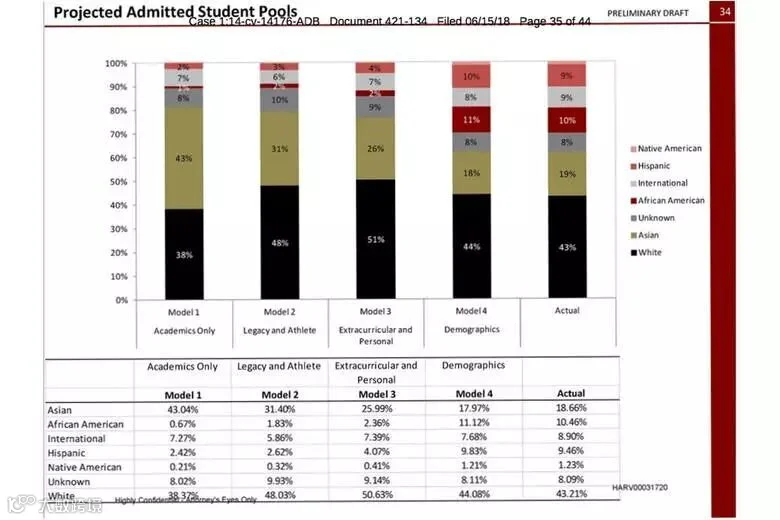
To answer the question, the OIR devised four theoretical admissions systems based on 10 years of admissions data, each considering different applicant criteria. The analysis produced the chart below:
为了回答这个问题,OIR根据10年的入学数据设计了四个理论上的入学系统,每个系统都考虑了不同的申请者标准。分析图表如下:
Report 1
If academic ratings were the only factor in admissions, Asian Americans would make up 43 percent of the incoming class. Once you consider legacy and athlete preferences, however, that proportion drops to 31 percent. Also taking into account extracurricular and personal ratings further drops Asian representation to 26 percent. Adding demographic factors to the equation then depresses Asian admissions to 18 percent. (The actual admissions percentage for Asian Americans that year was 19 percent.)
如果学术评分是唯一的入学指标,亚裔美国人可以涵盖一个班级的43%的人员构成。若加入校友子女和偏袒运动员的因素,这个百分比会降到31%。如果考虑到课外评分和个人评分的因素,亚裔比率将进一步降到26%。再加上人口统计上的均衡,亚裔合格率将继续减少到18%。(实际上,这一年的亚裔录取率是19%)
Report 2
After coming to these conclusions, Harvard’s OIR subsequently conducted another study, summarized in a report entitled “Admissions Part II.”
得出这些结论后,哈佛OIR接下来展开了另外一个研究,并总结成了一份报告,名为“录取工作第二部分”。
The study narrowed the analysis to compare Asian admissions trends to white admissions trends and further found that “athletes and legacies explain the difference in raw admit rates for Asian and white applicants.”
这个研究集中对比了亚裔与白人录取趋势,并进一步发现“运动员和校友子女这两个因素解释了亚裔与白人的初始通过率差异”。
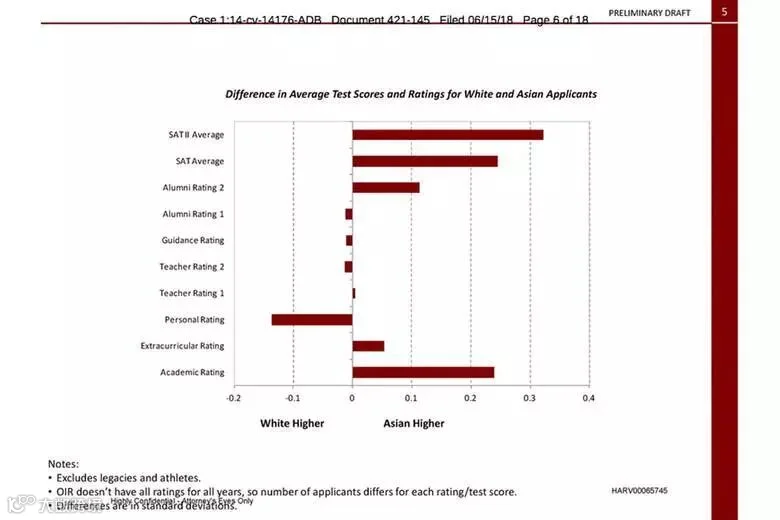
This study also compared Asian-American and white applicants who were not legacies or athletes, and nevertheless found that these Asian-American applicants performed better on SAT II, SAT I, academic, and extracurricular ratings.
这个研究还比较了既不是运动员也不是校友子女的亚裔美国人和白人申请者,并且发现了这些亚裔美国人在SATⅠ,SATⅡ,学术,和课外评分上表现得更为出色。
The only area where Asian Americans significantly fell behind white applicants was in the personal rating, which in part judges the essays, teacher recommendations, and qualities such as courage and kindness. The personal rating is not supposed to take race into account, but OIR’s studies demonstrate that the scores tend to be racialized.
亚裔美国人唯一明显比不上白人申请者的领域是个人评分,这一部分评估论文、教师推荐、以及个人品质,比如勇气和善良。个人评分不被考虑在竞争范围内,但是OIR的研究表明这个评分有着种族化的倾向。
Difference in average test scores and ratings for white and Asian applicants
白人以及亚洲人平均分和录取率的差异
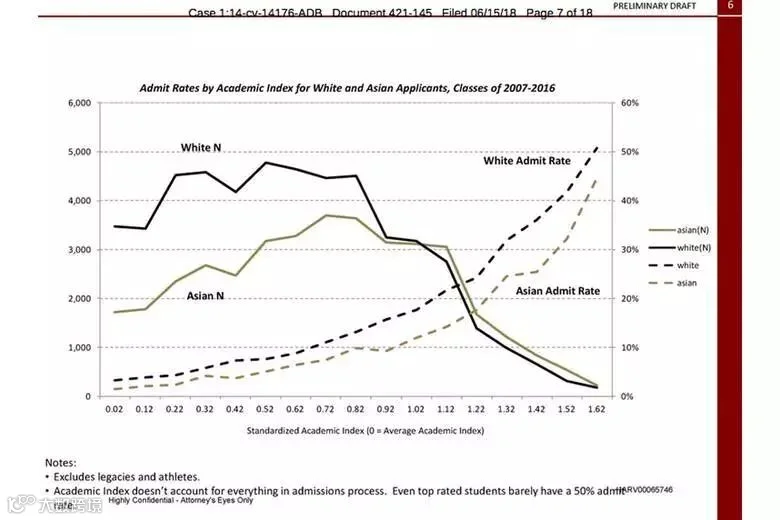
Despite these discrepancies, white admit rates still far outstripped Asian ones.
尽管有这些差异,白人通过率仍然远远高于亚洲人。
Admit rates by academic index for White and Asian applicants, classes of 2007–2016
2007-2016年白人和亚洲人申请者的学术指数评分
Report 3
In April 2013, the OIR conducted a third study in response to a scholarly article that found a majority of high-achieving, socioeconomically underprivileged students were not applying to elite colleges, which had stirred public criticism of Harvard.
2013年4月,OIR针对一篇学术文章进行了第三项研究。该文章发现,大多数成绩优异但是社会经济地位低下的学生没有申请精英学院,这使哈佛饱受公众批评。
Fitzsimmons asked the OIR to investigate the admissions office’s handling of low-income applicants, and the resulting study found that Harvard was in fact giving a “tip,” or advantage, to those students.
菲茨西蒙斯要求OIR调查招生办公室是如何对待低收入申请者的。最终调查结果显示哈佛事实上为这些学生提供了好处,或者说有利条件。
However, the study also concluded that legacy and athlete applicants had an even bigger tip, and that there was a 6 percent “negative effect” for Asian applicants compared to those of other races.
然而,这项调查还断定,校友子女或者运动员申请者会有更多的优惠条件。并且和其他人种相比,亚洲的申请者有6%的“消极影响”。
In an email summarizing the study, OIR officers consider the prospect of making the study public to refute recent criticisms, but ultimately decide against it.
在一封总结这次调查的邮件里,OIR本来考虑将结果公之于众以驳倒批评言论,但最终否决了这个想法。
The email reads, “To draw attention to the positive benefit that low income students receive, may also draw attention to the more controversial findings around Asians, or the expected results around legacies and athletes.”
那封邮件中这样写道,“在人们注意到低收入学生获得的优待的同时,他们也可能注意到更具争议的关于亚裔学生的调查结果,或者对校友子女和运动员的预期结果。”
4
-Harvard’ Objection-
The findings of at least two of these reports should not have surprised Fitzsimmons.
至少两份报告的发现对于菲茨西蒙斯来说并不陌生。
In the 1980s, a series of news articles questioned the differences in admissions rates for white and Asian-American applicants.
早在1980年代,一系列的新闻文章就对白人和亚裔申请者的通过率差异提出了疑问。
In response to this public attention, Fitzsimmons, who was dean of admissions even back then, issued a statement that read, in part,
“While Asian-Americans are slightly stronger than whites on academic criteria, they are slightly less strong on extracurricular criteria.
为了回应公众的关注,时任哈佛招生办主任的菲茨西蒙斯发布了一份公开声明,其中有这样一段话:
“虽然亚裔申请者在学术层面略强于白人申请者,但他们在课外活动方面略逊一筹。
In addition, there are very few Asian-Americans in our applicant pool who are alumni children or prospective varsity athletes. When all these factors are taken into account, the difference in admissions rates for the two groups disappears.”
而且,在我们的申请者中只有极少数的亚裔学生是校友的孩子或是未来的校队运动员。综合考虑之下,白人申请者和亚裔申请者的录取率差异就不存在了。”
In its rebuttal to the plaintiffs, Harvard contended its studies used incomplete data and were not reliable.
哈佛方面对原告进行了反驳,其中声称原告的研究使用的数据不完整且不可靠。
As the university’s lawyers wrote, “The OIR employees who created the documents had a limited understanding of the admissions process, and they neither examined nor reached any conclusion on the question whether the admissions process discriminates against any group.”
哈佛的律师团写道:“写这份文件的OIR雇员对招生的流程的认识十分局限,而且,他们没有调查或得出关于招生过程是否歧视任何群体的结论。
Harvard’s lawyer, Bill Lee, also argued in his opening statement on Monday that the report was riddled with errors—citing, for example, that the date on the first slide listed the wrong year.
哈佛方面的律师比尔·李也在周一的公开讲话中表示,这份报告充满了错误,比如第一页列出的年份就是错误的。
5
-Harvard on Trial-
Burroughs previously cited Harvard’s refusal to follow up on the OIRreports in her decision denying the university’s attempt to get the case thrown out of court.
法官巴勒斯先前列举哈佛大学拒绝跟进OIR报告这一事实,以拒绝其提出的庭外和解的诉求。
In her opinion, she wrote, “Determining whether Harvard’s explanation for its response to the OIR reports is credible, or as SFFA submits, an implausible post-hoc justification in light of this lawsuit, requires the Court to assess the credibility of Harvard’s witnesses and to consider expert testimony regarding the OIR reports.”
她写道,“法庭需要评估哈佛提供的证据的可信度,并考虑专家关于OIR报告的证词,才能判定哈佛大学对OIR报告答复的解释是可信的,还是如SFFA所言是难以置信、颠倒黑白的辩护。”
Prioritizing athletes and legacies at the inadvertent expense of Asian Americans is not technically illegal; this practice is not at issue at the current trial and has little to do with affirmative action. (Scoring Asian-Americans lower in personal rating, on the other hand, would be legally suspect.)
哈佛为运动员和校友子女提供优先权,却牺牲了亚裔美国人的利益。这一做法在技术上并不违法,也并没有在审判过程中形成争论,并且与当前的平权运动无关。(但是,亚裔美国人在个人评分中得分较低,这在法律上却相当可疑。)
Fitzsimmons will take the stand again on Tuesday, and the plaintiffs will almost certainly dig into those reports. It’s a shame that his explanations for legacy and athlete admissions won’t likely be legally relevant to this case, but he’ll nevertheless have to explain why he didn’t feel the need to examine the disparity any further.
菲茨西蒙斯将于周二再次出庭作证,几乎可以肯定的是,原告也将继续深入研究那些报告。遗憾的是,他对校友子女和运动员入学的解释在法律上可能与本案无关,但他不得不说明为何他认为没有必要深入研究这一不公现象。
Sources
https://slate.com/news-and-politics/2018/10/harvard-admissions-lawsuit-trial-asian-american-discrimination-reports.html
https://www.nytimes.com/2018/10/15/us/harvard-affirmative-action-asian-americans.html
编译:张殷雯 邱思怡 貟扬 陈宁 杨二一 谢伊雯 常慧
指导老师:刘佳
排版:常慧