


全文约3111字,阅读时间10分钟
Maybe you're a college freshman, emailing all of your professors before the semester starts to tell them how absolutely thrilled you are to be in their class. Or perhaps you're a world leader expressing how totally great your international trade talks are about to go. And you may use the word “Gung-Ho”.
也许你是一名大学新生,在学期开始之前你向教授们发送电子邮件,告诉他们你是多么激动于能修他们的课程。也许你是一位世界领袖,你想要表达你将参与的国际贸易谈判是多么重大。你可能会用到“Gung-Ho”这个词。
Gung-ho describes enthusiasm — often to the point of naivete. But it didn't always. The original Chinese is 工業合作社, which means "industrial cooperative" —工業, (gōng yè) meaning "industry", and 合作社, (hé zuò shè) meaning "cooperative."We' re talking organizations democratically run by workers, producing industrial goods like blankets and military uniforms.
“Gung-Ho”一词用于表达热情——通常是真诚到天真的程度。但它并非向来如此。最初的中文是工业合作社(industrial cooperative)——这是指生产毯子和军服等工业产品的,由工人民主经营的组织。
工業合作社 was abbreviated, as many long Chinese proper nouns are, to the first character of each part, 工合.
“工业合作社”就像许多汉语专有名词一样,取每个部分的第一个字符,缩写为“工合”。
So how did it go from describing a leftist co-op to an overzealous try-hard? To get the full story, we have to go back almost a century, to 1930s China.
那么,它是如何从指称左派合作组织,转变为描述过度热情的尝试的呢?要想了解前因后果,我们必须追溯到近一个世纪前,中国的1930年代。

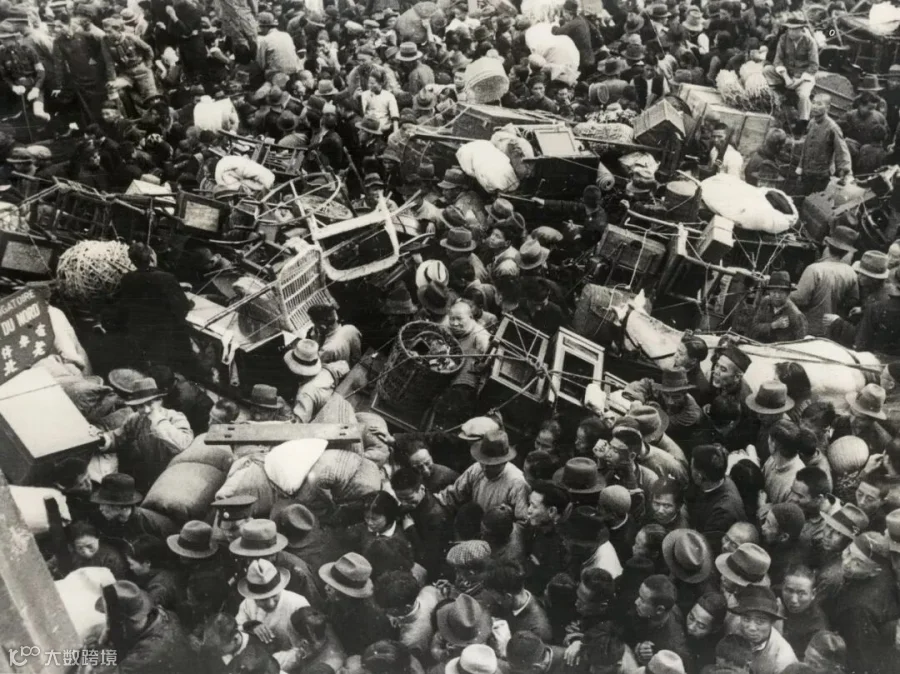
By many accounts, China during that era was not doing super well. Civil war was breaking out. In 1937, Japan invaded and kicked off the second Sino-Japanese War. Tens of millions of people living around Shanghai flooded inland, becoming refugees in their own country. Over eight years, an estimated 17 million civilians died, and 95 million more people became refugees.
出于许多原因,那个时代的中国处在困境之中。那时,内战也正在爆发。1937年,日本入侵中国并发动了第二次中日战争。上海周围数千万人涌入内陆,成为自己国家境内的难民。八年多的时间里,估算有1700万平民丧生,超过9500万人沦为难民。
The industrial cooperative movement sought to address the problems caused by the war: a general lack of resources for both civilians and the military, and refugees in need of work. Though the movement was relatively small, with 30,000 workers at 3,000 factories at its peak, it got outsized attention because English-speaking foreigners were involved, many of whom were central to forming the International Committee for the Promotion of Industrial Chinese Cooperatives (ICCIC). Its mission was "organizing the unemployed workers and refugees for production to support the War of Resistance."
工业合作社运动试图解决由战争引起的问题:平民和军人普遍缺乏资源,难民们需要工作。尽管该运动规模相对较小,在鼎盛时期只有30,000名工人在3,000家工厂工作,但由于涉及讲英语的外国人的参与,它吸引了很多关注,其中许多外国人是成立中国工业合作国际委员会的核心成员。这一组织的任务是“组织失业的工人和难民进行生产劳动,以支持抗日战争。”
According to Anne-Marie Brady, that collaboration was how gung-ho entered the lexicon of English. Brady is a professor at the University of Canterbury in New Zealand who specializes in politics in China. She says that the country back then "It was quite easy for foreigners to engage with activities in China and be part of a solution for addressing a serious problem like refugees."
Anne-Marie Brady是新西兰University of Canterbury的教授,她专精中国政治。Brady表示,这一合作就是“Gung-Ho”进入英语辞典的方式。她说,当时外国人在中国从事活动非常容易,并参与解决难民等严重问题。”
One such foreigner was a fellow named Evans Fordyce Carlson was a U.S. Marine who was somewhat involved with the ICCIC. The current use stems from the way Carlson interpreted and popularized it.
在此行列之中有一个叫做Evans Fordyce Carlson的外国人,是美国海军陆战队员,他参与了ICCIC(中国工业合作国际委员会)。现在Gung-Ho这个词的应用就来源于Carlson对它的诠释和普及。
In 1937, Carlson arrived in Shanghai to serve his third tour in China. He was the first foreign military observer of the guerrilla soldiers of the 8th Route Army, (aka the Red Army). Carlson spent nearly two years with the members of the Red Army, traveling thousands of miles with them, sometimes behind enemy lines. He was impressed by their mobility and flexibility, as well as the concern for their fellow soldiers' welfare. A Life magazine profile from 1943 said, "
1937年,Carlson来到上海,那是他在中国的第三次军旅之行。他是八路军游击队(即红军)的第一位外国军事观察员。Carlson与红军军人们一同度过了快两年的时间,走过千里征途,有时就在敌人防线之后。八路军游击队的机动性和灵活度,以及战友之间的关心、团结,都给他留下了深刻的印象。在一期1943年的《生活》杂志中有这样一段简述:“Carlson认为,就规模和战斗目标而言,八路军是当今世界上组织最严密,领导最得当的武装力量。”
And for some reason, Carlson associated the Red Army with the Industrial Cooperative movement. He believed that gung-ho meant something about teamwork. (It doesn't, and according to Brady, the cooperatives would have only been affiliated with the Communists in local pockets.)
出于某些原因,Carlson把红军和工业合作社联系在一起。他相信Gung-Ho这个词意味着团队合作精神。(其实并不然。但根据Brady的说法,这些合作社只会和地方的共产党组织有关系。)
Between 1939 and 1941, Carlson's life took some odd twists and turns. In 1939, he resigned from the Marine Corps because he was being censured for his vocal pro-China views. Then he wrote two books about China (one titled Twin Stars of China: A Behind-the-Scenes Story of China's Valiant Struggle for Existence by a U.S. Marine who Lived & Moved with the People).
从1939年到1941年,Carlson的生活经历了一些奇怪的曲折。在1939年,他从海军陆战队辞职,因为他因发表亲华观点而受谴责。之后,他写了两本关于中国的书(其一本名为《中国双星:一个美国海军陆战队员亲身经历的中国人民为生存而英勇奋斗的幕后故事》)
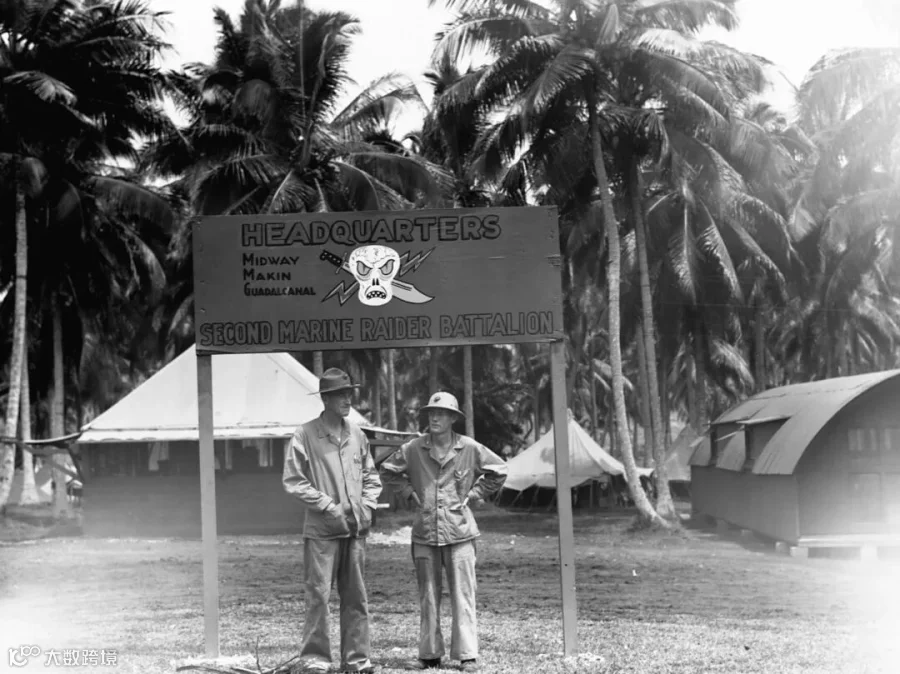
So soon enough, Carlson rejoined the Marines and was given control of the newly-established 2nd Marine Raider Battalion, which came to be known as "Carlson's Raiders."
很快,Carlson重新回到海军陆战队,并成为了海军陆战队第二突击营的长官,该营后来被称为“Carlson的突袭者”。

Carlson told Life, "I was trying to build up the same sort of working spirit I had seen in China where all the soldiers dedicated themselves to one idea and worked together to put that idea over. I told the boys about it again and again, I told them of the motto of the Chinese Cooperatives, Gung Ho. It means Work Together — Work in Harmony." (Again, it did not.)
Carlson在受《生活》杂志采访时说:“我正在尝试建立一种工作精神,这种精神就像我在中国见到的一样,军人们众志成城,精诚合作,实现目标。我一遍又一遍地跟孩子们说,我告诉他们那些中国合作社的格言——Gung-Ho, 这个词代表着合作——和睦工作。”(当然,这个词其实不是这个意思。)
He went on: "My motto caught on and they began to call themselves the Gung Ho Battalion. When I designed a field jacket to replace the bulky and orthodox pack they even called it the Gung Ho jacket. And they named every new thing Gung Ho. It became the watchword."
他继续说道:“我的格言起了作用,他们开始称自己为Gung-Ho突击营。当我设计了一款野战夹克来取代笨重的正统包时,他们甚至称它为Gung-Ho夹克。之后他们把任何一种新事物都冠上Gung-Ho之名。它成为了一个口号。”
Carlson's Raiders gained acclaim and recognition for the action they saw in the Gilbert and Lower Solomon Islands in mid-1942. These were some of the first World War II victories for the U.S. against Japan, so the U.S. made sure to get the story in front of the public. Carlson's Raiders were celebrated by the military and covered extensively in the Saturday Evening Post.
卡尔森突袭者队因为其在1942年中旬在吉尔伯特和下所罗门群岛的行动而赢得了赞誉和认可。这是第二次世界大战中美国与日本作战获得的第一批胜利,因此美国确保了将这个故事公诸于众。军方为卡尔森突袭者举办了庆祝活动,其事件也在《星期六晚报》上广泛报道。
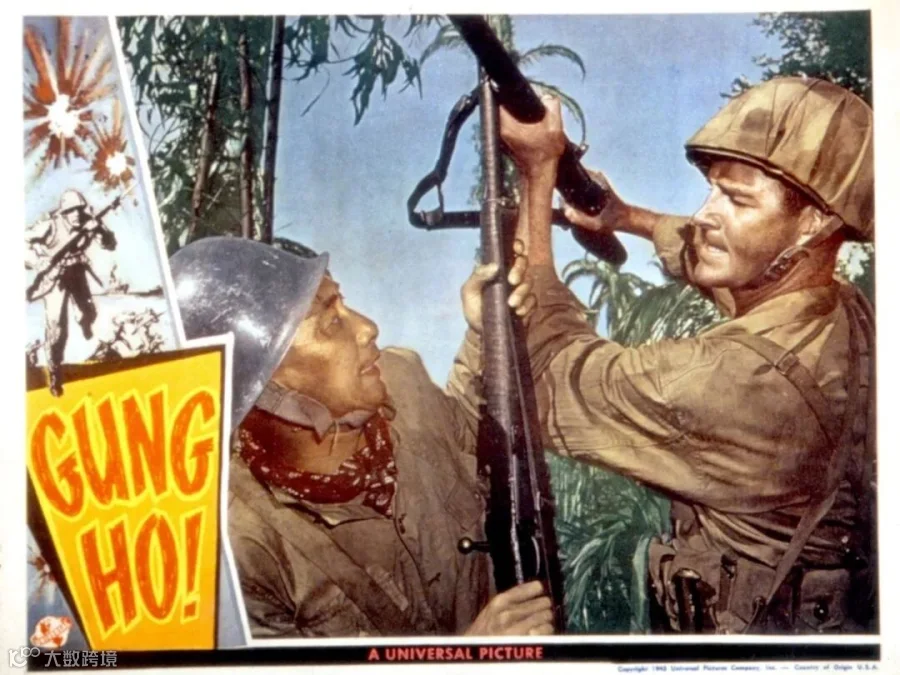
In 1943, there was even a movie released called Gung Ho!: The Story of Carlson's Makin Island Raiders. And so, the phrase leaked its way into the English language.
1943年,还上映了一部名为《Gung Ho!》的电影:《卡尔森的麦金岛突袭者故事》。也正因为如此,该短语流传到了英语中。
A curious thing happened to gung-ho as it spread, though — it started to be a little less earnest, taking on the meaning it has now, that someone's a little too enthusiastic. The linguist Albert Moe, who wrote an extensive article about gung-ho in 1967, writes, "As early as the latter part of 1942, Marines other than those in the Second Raider Battalion used gung-ho as a term of disparagement to describe anyone whose conduct or behavior was obnoxious or offensive." Apparently, the Marine Raiders were known for being rowdy and ready to prove how "rough and tough" they were. "As a result, the Gung Ho Battalion and its personnel soon were referred to as the 'gung ho bastards.' "
但是,随着Gung-Ho一词的传播,奇怪的事发生了,这个词变的不再那么郑重严肃,逐渐呈现出现在的含义,现意即“有点过于狂热”。语言学家Albert Moe在1967年撰写了一篇有关Gung-Ho的文章,他写道:“早在1942年下半年,第二突击营以外的海军陆战队就用gung-ho来形容那些行为粗暴引人反感的人。” 显然,海军陆战队突袭者以粗暴而闻名,并想要证明他们的“强悍”。“然而结果是,Gung-Ho营及其人员很快被称为“Gung-Ho”杂种。”
Moe cites a 1952 glossary of Marine slang with the following definition: "GUNG-HO. 1. aggressive esprit de corps; 2. sometimes sardonically employed to characterize cocky indiscipline or contempt toward orthodox procedures and regulations."
Moe引用了1952年的海军词汇表的定义:“ Gung-Ho:1.侵略性的兵团;2.有时用以讽刺的方式来形容傲慢无纪者或蔑视正统程序和规范的人。”
Outside of conversational use, gung-ho seems to have taken on some other vague definitions, in order to signal anything from teamwork to militariness to a kind of broad "Asian-ness." It's the name of so many different companies (like really): a French-Cajun G.I. Joe Character, a business strategy book from 1998 that exotifies both the Chinese origins AND Native Americans, and a 1986 Ron Howard film about Japanese businessmen in Pennsylvania, featuring Engrish that will make your skeleton ache.
除了用于对话之外,Gung-Ho似乎还有一些其他的模糊的定义,可以表示从团队合作到军国主义再到一种广泛的“亚洲性”。许许多多不同的公司使用了这个名称:一个法裔卡津特种部队人物玩具模型,1998年的一本异化了中国人和美国原住民的企业战略书,和1986年在Ron Howard电影中的主人公——一个在宾夕法尼亚州的操着一口蹩脚的日式英语的日本商人。
With time and enthusiasm (maybe too much enthusiasm) gung-ho has come to mean whatever people want it to mean. So next time you hear it in the wild, remember that it was originally Chinese jargon that English speakers wanted to be meaningful so hard that they just ... made it happen.
随着时间流逝和人们持续的热情(也许是过多的热情),人们对于Gung-Ho的解读变得随心所欲了。因此,你下次在野外听到它时,请记住,它最初来源于中文术语,只是讲英语的人努力的想赋予其意义,于是他们就……成功地做到了。

原文链接:https://www.npr.org/sections/codeswitch/2019/10/18/406693323/the-long-strange-journey-of-gung-ho?from=groupmessage

编译:徐铖佑 郦丹萍 薛妍
排版:薛妍