全文字数: 3454
阅读时间: 11 分钟

Mobilizing a “Bot” Army
僵尸账户总动员

On Twitter, meanwhile, hundreds of accounts were busy posting anti-Clinton messages and promoting the leaked material obtained by Russian hackers. Investigators for FireEye spent months reviewing Twitter accounts associated with certain online personas, posing as activists, that seemed to show the Russian hand: DCLeaks, Guccifer 2.0, Anonymous Poland and several others. FireEye concluded that they were associated with one another and with Russian hacking groups, including APT28 or Fancy Bear, which American intelligence blames for the hacking and leaking of Democratic emails.
同时,在Twitter上,数以百计的账号不断发布反对希拉里的信息并且扩散那些被俄罗斯黑客获取的已经泄露的文件。FireEye的调查员花费了数月的时间审查与伪装成激进主义分子的虚拟用户身份有关的账号。这些账号似乎是俄罗斯在背后操纵,比如DCLeaks, Guccifer 2.0,“匿名波兰”等等。FireEye总结称这些账号相互关联,且与包括“奇幻熊(也被称为APT28)”在内的俄罗斯黑客团体有关。美国情报局强烈指责这些黑客非法入侵并泄露民主党邮件的行为。
Some accounts, the researchers found, showed clear signs of intermittent human control. But most displayed the rote behavior of automated Twitter bots, which send out tweets according to built-in instructions.
研究者发现,有些账号明显有断断续续的人为操作痕迹。但是大部分账户符合Twitter僵尸账户的机械反应,它们根据事先输入的指令来发布推文。
The researchers discovered long lists of bot accounts that sent out identical messages within seconds or minutes of one another, firing in alphabetical order. The researchers coined the term “warlist” for them. On Election Day, one such list cited leaks from Anonymous Poland in more than 1,700 tweets. Snippets of them provide a sample of the sequence:
研究者发现了许多由自动程序控制的账号,它们在几秒或者几分钟的时间里发布了完全相同的消息,并且按字母表顺序连珠炮弹般地发布。研究者们为它们创造了“warlist战争列表”这个新名词。在大选当天,一个这样的系列账号援引了从“匿名波兰”泄露的信息,并出现在其1700多条推文中。它们中的一小段表现出了以下的顺序:
@edanur01 #WarAgainstDemocrats 17:54
@efekinoks #WarAgainstDemocrats 17:54
@elyashayk #WarAgainstDemocrats 17:54
@emrecanbalc#WarAgainstDemocrats 17:55
@emrullahtac #WarAgainstDemocrats 17:55
Lee Foster, who leads the FireEye team examining information operations, said some of the warlist Twitter accounts had previously been used for illicit marketing, suggesting that they may have been purchased on the black market. Some were genuine accounts that had been hijacked. Rachel Usedom, a young American engineer in California, tweeted mostly about her sorority before losing interest in 2014. In November 2016, her account was taken over, renamed #ClintonCurruption, and used to promote the Russian leaks.
率领FireEye团队检查信息运作的李·福斯特,声称一些“战争列表”Twitter账户之前被用来做过非法的市场营销,暗示它们可能是从黑市中购买来的。一些账户是被黑客攻击了的真实账户。来自加利福尼亚的一名年轻的美国工程师雷切尔.乌瑟多姆直到2014年失去兴趣之前,她的推文几乎都是关于大学女生联谊会的。在2016年11月份,她的账户被盗取,被重命名为Clinton Curruption(希拉里腐败),并且被用来宣传俄罗斯泄露的消息。
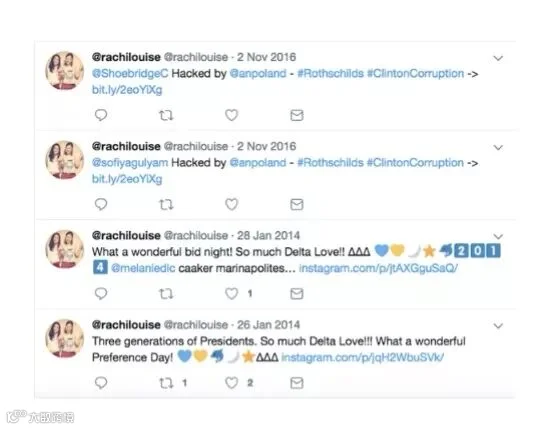
Rachel Usedom’s Twitter account was taken over and used to post political leaks.
雷切尔·乌瑟多姆的Twitter账户被盗号后开始发布泄露的政治消息。
Ms. Usedom had no idea that her account had been commandeered by anti-Clinton propagandists. “I was shocked and slightly confused when I found out,”she said.
乌瑟多姆完全不知道她的账号被反希拉里的宣传者霸占了。“当我知道这一事实时,我非常震惊并且感到些许困惑,”她说。
Notably, the warlist tweets often included the Twitter handles of users whose attention the senders wanted to catch news organizations, journalists, government agencies and politicians, including @realDonaldTrump. By targeting such opinion-shapers, Mr. Foster said, the creators of the warlists clearly wanted to stir up conversation about the leaked material.
值得注意的是,“战争列表”推文通常包含一些发布者很想引发关注的用户名。这些用户有新闻组织,记者,政府机构,政治家,包含特朗普个人账号在内。福斯特先生说,通过瞄准这类意见领袖,“战争列表”的创造者明显想要引起情报泄露的话题。
J. M. Berger, a researcher in Cambridge, Mass., helped build a public web "dashboard" for the Washington-based Alliance for Securing Democracy to track hundreds of Twitter accounts that were suspected of links to Russia or that spread Russian propaganda. During the campaign, he said, he often saw the accounts post replies to Mr. Trump’s tweets.
剑桥的研究人员贝格尔为了保证民主党位于华盛顿的联盟,出力建立了公共网站“仪表盘”。这是用来追踪数以百计的被怀疑与俄罗斯有关或散布俄罗斯方面政治宣传的Twitter账户的。他说,在竞选期间,他经常看到这些账户对特朗普的推文发表评论。
Mr. Trump “received more direct replies than anyone else,” Mr. Berger said. “Clearly this was an effort to influence Donald Trump. They know he reads tweets.”
特朗普先生“获得了最为直接的回复,”贝格尔先生说,“很明显,这是影响唐纳德.特朗普的一种尝试。他们知道他会看推文。”
The suspected Russian operators at times lacked sophistication. “They are not always Americanophiles who know every nuance of U.S. politics,” said Mr. Foster, the FireEye researcher.有时候,俄罗斯操作员显得不够精明老练。“他们并不是知道美国政治中每一个细微差别的美国通,”Fire Eye研究员福斯特先生说道。
For instance, last October, hundreds of Anonymous Poland Twitter accounts posted a forged letter on the stationery of the conservative Bradley Foundation, based in Milwaukee, purporting to show that it had donated $150 million to the Clinton campaign. The foundation denied any such contribution, which would have been illegal and, given its political leaning, highly unlikely.
比方说,去年10月份,数以百计的“匿名波兰”Twitter账号发布了保守的布拉德利基金会的伪造信件,该基金会总部位于密尔沃基。这些账号想要影射该基金会为希拉里竞选捐助了150百万美元。该基金会否认了这种说法,称这样的捐助不仅违法,而且与其政治倾向相悖,基本不可能发生。

‘A Battle of Information’
“信息之战”

Only a small fraction of all the suspect social media accounts active during the election have been studied by investigators. But there is ample reason to suspect that the Russian meddling may have been far more widespread.
在选举期间活跃的所有可疑社交媒体账户中,只有一小部分受到调查人员的调查。但有充分的理由怀疑俄罗斯的干预可能更广泛。
Several activists who ran Facebook pages for Bernie Sanders, for instance, noticed a suspicious flood of hostile comments about Mrs. Clinton after Mr. Sanders had already ended his campaign and endorsed her.
例如,几位为伯尼·桑德斯管理Facebook页面的活跃分子注意到,在桑德斯先生已经结束他的竞选活动并且表示支持希拉里之后,出现了一大波针对希拉里的恶意言论。
John Mattes, who ran the “San Diego for Bernie Sanders” page, said he saw a shift from familiar local commenters to newcomers, some with Eastern European names — including four different accounts using the name “Oliver Mitov.”
负责“圣迭戈支持伯尼·桑德斯”页面的约翰·马特斯说,他看到了从熟悉的当地评论员到新人的转变,其中一些人的名字是东欧的,包括使用“奥利弗·米托夫”这个名字的四个不同的账户。
“Those who voted for Bernie, will not vote for corrupt Hillary!” one of the Mitovs wrote on Oct. 7. “The Revolution must continue! #NeverHillary”
“那些投票给伯尼的人,不会投票给腐败的希拉里!”其中一个米托夫在10月7日写道。“革命必须继续!#绝对不选希拉里”
While he was concerned about being seen as a “crazy cold warrior,” Mr. Mattes said he came to believe that Russia was the likely source of the anti-Clinton comments. “The magnitude and viciousness of it — I would suggest that their fingerprints were on it and no one else had that agenda,” he said.
虽然他担心被视为“疯狂的冷战思维者”,但马特斯说,他开始相信俄罗斯可能是反希拉里言论的来源。他说:“此番网络攻击规模之大,恶意之深,我认为俄罗斯的确染指此事,其他势力没有这样的议程。”
Both on the left and the pro-Trump right, though, some skeptics complain that Moscow has become the automatic boogeyman, accused of misdeeds with little proof. Even those who track Russian online activity admit that in the election it was not always easy to sort out who was who.
然而,无论是左派还是支持特朗普的右派,一些怀疑论者抱怨说,人们不假思索地把俄罗斯看作一个恶魔,指控它违法操作,即使缺乏证据。 即使是那些追踪俄罗斯网上活动的人也承认在选举中分清谁是谁并不容易。
“Yes, the Russians were involved. Yes, there’s a lot of organic support for Trump,” said Andrew Weisburd, an Illinois online researcher who has written frequently about Russian influence on social media. “Trying to disaggregate the two was difficult, to put it mildly.”
“是的,俄国人参与了。是的,特朗普得到了很多有组织的支持,”伊利诺伊州在线研究员安德鲁·魏斯伯德说,他经常写关于俄罗斯对社交媒体的影响的文章。“委婉地说,试图将两者分开是很困难的。”
Mr. Weisburd said he had labeled some Twitter accounts “Kremlin trolls” based simply on their pro-Russia tweets and with no proof of Russian government ties. The Times contacted several such users, who insisted that they had come by their anti-American, pro-Russian views honestly, without payment or instructions from Moscow.
魏斯伯德说,他把一些Twitter账户贴上了“克里姆林宫水军”的标签,但仅仅是基于他们亲俄的推文,并没有俄罗斯政府关系的证据。“纽约时报”联系了几个这样的用户,他们坚称自己是真诚地支持反美亲俄观点的,并没有得到莫斯科的付款或指示。
“Hillary’s a warmonger,” said Marilyn Justice, 66, who lives in Nova Scotia and tweets as @mkj1951. Of Mr. Putin, she said in an interview, “I think he’s very patient in the face of provocations.”
“希拉里是个好战分子,”66岁的玛丽莲·贾斯蒂丝说。她住在新斯科舍省,并在Twitter上发了@mkj 1951的关于普京的消息。她在接受采访时说,“我认为他在面对挑衅时很有耐心。”
Ms. Justice said she had first taken an interest in Russia during the 2014 Winter Olympics in Sochi, Russia, while looking for hockey coverage and finding what she considered a snide anti-Russia bias in the Western media. She said she did get a lot of news from Sputnik and RT but laughed at the notion that she could have Kremlin connections.
贾斯蒂丝说,她第一次对俄罗斯感兴趣是在2014年俄罗斯索契冬奥会期间,当时她在寻找关于曲棍球的报道,结果在西方媒体上找到了她认为是反俄罗斯的偏见言论。她说自己确实从俄罗斯卫星通讯社(Sputnik)和今日俄罗斯(RT)那里得到了很多消息,但对自己可能与克里姆林宫有关系的说法嗤之以鼻。
Another of the so-called Kremlin trolls, Marcel Sardo, 48, a web producer in Zurich, describes himself bluntly on his Twitter bio as a “Pro-Russia Media-Sniper.” He said he shared notes daily via Skype and Twitter with online acquaintances, including Ms. Justice, on disputes between Russia and the West over who shot down the Malaysian airliner hit by a missile over Ukraine and who used sarin gas in Syria.
另一个所谓的克里姆林宫水军名叫马塞尔·萨尔多,是苏黎世一位48岁的网络制作人,他在Twitter简介上直言不讳地描述自己为“亲俄媒体狙击手”。他说他每天都通过Skype和Twitter与网上的熟人在线分享笔记,其中也包括贾斯蒂丝女士,他们曾经争论过:俄罗斯和西方谁在乌克兰上空用导弹击落了马来西亚的客机,以及谁在叙利亚使用了沙林毒气。
“It’s a battle of information, and I and my peers have decided to take sides,” said Mr. Sardo, who constantly cites Russian sources and bashed Mrs. Clinton daily during the campaign. But he denied he had any links to the Russian government.
“这是一场信息之战,我和我的同事决定倾向其中一方,”萨尔多说。他经常引用俄罗斯的消息来源,并在竞选期间每天抨击希拉里。但他否认了与俄罗斯政府有任何联系。
If that’s so, his prolific posts are a victory for Russia’s information war — that admirers of the Kremlin spread what American officials consider to be Russian disinformation on election hacking, Syria, Ukraine and more.
诚若如此,他那实有成效的帖子于俄罗斯的信息战而言是一场非凡的胜利。克林姆林宫的追随者们才是在叙利亚、乌克兰在选举中美国政府指控的虚假情报宣传黑客行为的主体,而非俄罗斯政府。
But if Russian officials are gleeful at their success, in last year’s election and beyond, they rarely let the mask slip. In an interview with Bloomberg before the election, Mr. Putin suggested that reporters were worrying too much about who exactly stole the material.
俄罗斯官员或许欣喜于其在去年选举以及此后诸多运作的成功,不过他们表面上不动声色。在大选前接受彭博社采访时,普京认为记者过分关心到底是谁偷了这些材料。
“Listen, does it even matter who hacked this data?” he said, in a point that Mr. Trump has sometimes echoed. “The important thing is the content that was given to the public.”
“听着,是谁黑了这些数据真的重要吗?”他说,特朗普有时也会这么说。“重要的是公众看到了什么内容。”

The end.

文章来源:纽约时报
图片来源:纽约时报
翻译:张文钰 谢伊雯 莫羽 何平芳 徐小涵
整理校对:徐小涵