

据
澳洲媒体报道,澳大利亚同性婚姻法案于12月7日在联邦众议院获得多数票正式通过,这意味着澳洲成为全球第26个同性婚姻合法化的国家。此举也兑现了澳大利亚总理特恩布尔去年大选前的竞选承诺。据估计,同性伴侣最早在2018年1月9日就可以在澳洲合法注册结婚。不过短短30年, 是什么改变了澳大利亚对LGBT同性恋婚姻的态度?世界又是怎么看待LGBT结婚问题?请看本期Quriosity。

投票显示支持同性婚姻的一方领先。
This year’s vote in Australia in favor of same-sex marriage will ultimately make the country the 26th in the world to legalize such unions. The worldwide trend began nearly two decades ago when the Netherlands voted in 2000 in favor of letting same-sex couples marry; most recently, Germany became the latest country to pass same-sex marriage legislation this summer.
今年澳大利亚关于赞成同性婚姻的公投结果或将使澳大利亚成为全球第26个同性婚姻合法化的国家。2000年荷兰同性婚姻合法化是全球同性婚姻合法化趋势的开端;今年夏天,德国成为最新的一个同性婚姻合法化国家。
While the legalization of same-sex marriage has spread rapidly in the 21st century, it hasn’t spread all that far.[u3] In Europe, just 15 countries have legalized same-sex marriage. Though Chile is among the latest countries to put forward legislation to legalize same-sex unions, it’s one of the few Latin American countries to do so, joining Argentina, Brazil, Columbia, Uruguay, and parts of Mexico. Taiwan this year became the first and only place in Asia where same-sex marriage is legal.
同性婚姻合法化尽管在21世纪发展迅速,但其影响范围仍然有限。在欧洲,仅有15个国家将同性婚姻合法化。尽管智利最近使得同性婚姻合法化,但是它仅是包括阿根廷,巴西,哥伦比亚,乌拉圭和墨西哥的部分地区在内的拉丁美洲少数将同性婚姻合法化的国家。今年,台湾成为亚洲首个也是唯一将同性婚姻合法化的地区。
But unlike countries where the issue was hotly contested (like the U.S., where it took more than a decade for same-sex marriage legalization to apply to all 50 states), Australia’s story with same-sex marriage is different—in large part because support for it is not new. Whereas a majority of Americans still opposed same-sex marriage a decade ago, the same cannot be said for Australians—57 percent of whom were polled to support legalizing same-sex marriage in 2007.
然而,不像其他热烈争辩这一话题的国家,(比如美国,用了超过十年的时间才在50个州将同性婚姻合法化),澳大利亚在同性婚姻方面的经历不同—很大程度上是因为人们很早就支持同性婚姻。早在2007年,57%的澳大利亚人就投票支持将同性婚姻合法化。
一位男同性恋学者的死如何改变澳大利亚

乔治邓肯博士于1972年在阿德莱德溺亡,时年41岁。
On 27 August, 1975, South Australia became the first Australian state to fully decriminalise homosexual acts.
在1975年8月27日,南澳大利亚成为澳大利亚第一个停止将同性恋行为视为犯罪的州。
It’s hard to believe now but up until 1899 in Australia, the death penalty could be applied in cases of buggery or sodomy. For many years thereafter, the maximum penalty was life in prison. Change came slowly and individuals were still being arrested, charged and convicted for homosexual acts during the 1970s.
你很难相信在1899年之前,鸡奸或兽奸在澳大利亚可被判死刑。之后的很多年,最严重的处罚也只是终身监禁。人们接受同性恋行为的进程缓慢,在二十世纪七十年代公民仍然因同性恋行为而被捕,起诉和定罪。
The 1975 South Australian legislation was largely driven by the determination of Don Dunstan who was state premier from 1967 to 1968 and from 1970 to 1979.However,the death of a university lecturer in Adelaide led to an even more fundamental change for Australia's gay community. This lecturer, named George Duncan, was a gay who in 1972 was killed a stone's throw away at a riverbank in an attack suspected to have been committed by police officers. The crime, still unpunished, raised public awareness of widespread harassment of homosexuals and resulted in a push for law reform by some parliamentarians and by the gay rights organization known as the Campaign Against Moral Persecution (CAMP).
1975年南澳大利亚的立法很大程度上受唐邓斯坦的推动,他在1967 年到 1968年和1970 年到1979年担任州长。然而,一名阿德莱德市大学讲师的死引发了澳大利亚同性恋群体更为根本的改变。这名名叫乔治邓肯的讲师,1972年在离河岸一箭之遥的地方死于人为攻击,这被怀疑是警察所为。这场仍未破获的罪行提高了公众对广泛的同性恋被骚扰状况的意识,也让一些议员推进了法律改革,同时,一些被称为“对抗道德指控运动”的同性恋权益组织建立也相应建立。
Today, there may be debates about same-sex marriage but no-one advocates the re-criminalisation of homosexuality.
今天,也许还存在关于同性婚姻的争论,但是没有人赞同再次给同性恋定罪。
人们对同性恋群体的接受度快速上升,但在调查更深层次地分析人们对LGBT的看法时,调查显示的结果却不容乐观。
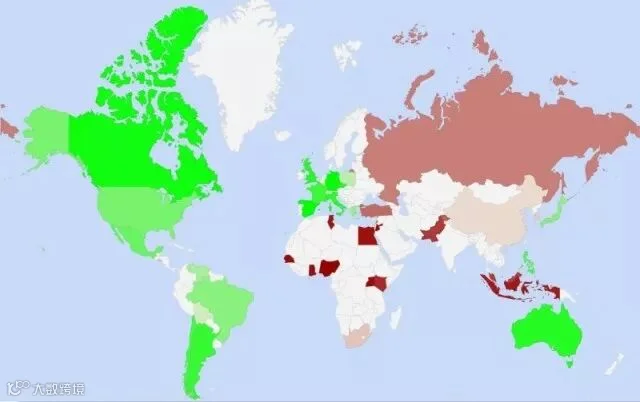
.这张地图中,红色越深的国家,国民认为同性恋不该被接受的比率就越高,反之绿色越深的国家,该比率就越低。Source:Pew Research / Adam Taylor / Business Insider
Presently there is much less reports of sexual prejudice for people of the homosexual orientation. The LGBTQ community has received much more support for homosexuality and gay marriage than ever before. Norc (2011) reported that in 1986, a mere 11 percent supported gay marriage compared to 46 percent in 2010.According to Justin McCarthy (2014), 55 percent support or accept the idea of gay marriage which shows a steady increase over such a small period of time.
当前,关于具有同性恋倾向的人的性别歧视报道已经少了很多。同性恋群体比以往任何时候都能获得更多在同性关系与同性婚姻上方面的支持。据美国民意调查中心于2011年报道,1986年仅仅有11%的人支持同性婚姻,然而到了2010年,这个数字变成46%。2014年,美国历史学家贾斯廷·麦卡锡曾说,55%的人对同性婚姻持支持或者是接受的态度。这个数字在短期内显示出稳定的增长。
Nowadays people have been becoming more and more educated on the topic of homosexuals. They now understand what causes them to be this way, which can cause the way they think about gays to change. David Masci (2015) states that 58 percent of post-graduate degree receivers understood that homosexuals were born this way and 35 percent of people with a high school diploma thought this as well.
如今人们对同性恋群体的认知在不断提升,并明白造成同性恋倾向的原因。对同性恋群体的深入了解可以使得大众改变他们对同性恋的看法。大卫马斯2015年时称,58%拥有硕士学历的人们认为同性恋是天生如此的,35%的拥有高中文凭的人们也有相同的想法。
There is however a generation gap that causes a divide in public attitudes of gays as a whole. 64 percent of people under the age of 30 tend to support gay marriage and on 27 percent of people over the age of 70 support it (McCarthy 2014). There is a huge gap here because of how different generations were raised and brought up to think.44 percent said sexual relations between adults is always wrong and similarly, 41 percent thought it wasn’t wrong at all. Since numbers of each age group that support gay marriage differ so drastically, this could sway the results of the amount of people that support homosexuality as a whole. People look to others’ opinion in order to form their own so although we cannot correlate acceptance of same-sex marriage with acceptance of homosexuals, we cannot deny the impact this dis-cause has had upon attitudes.
然而,在有关公众对同性恋的态度调查中,因年代而产生的代沟问题暴露无遗。根据麦卡锡2014年的调查,30岁以下的人群中有64%的人倾向于支持同性婚姻,70岁以上的人群中只有27%的人持支持态度支持。每代人的成长环境不同,思维方式不同,观念之间存在着巨大的鸿沟。44%的人们认为成人间的两性关系总是错的,同样有41%的人们认为这一点错都没有。每个年龄段支持同性婚姻的人数存在着惊人的差异,这影响了支持同性婚姻的人数的最终结果。人们在表达自己观点的时候,会受到他人观点的影响。虽然我们不能将同性婚姻的接受与同性恋的接受联系起来,但是我们不能否认别人的观点会影响自己的看法这一因素所带来的影响。
When some surveys exploring deeper into how people thought of LGBT, some strikingly negative results were generated from all regions of the world.
一些调查在深入探究人们对于LGBT的看法的同时,世界各地产生了一些显著负面的结果。
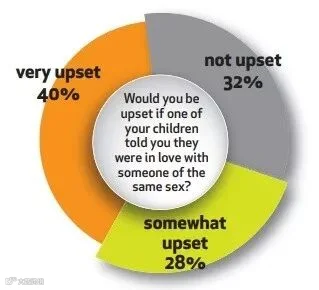
ILGA-RIWI全球态度调查公司与Logo TV合作,在2016年调查了65个国家近100000个人
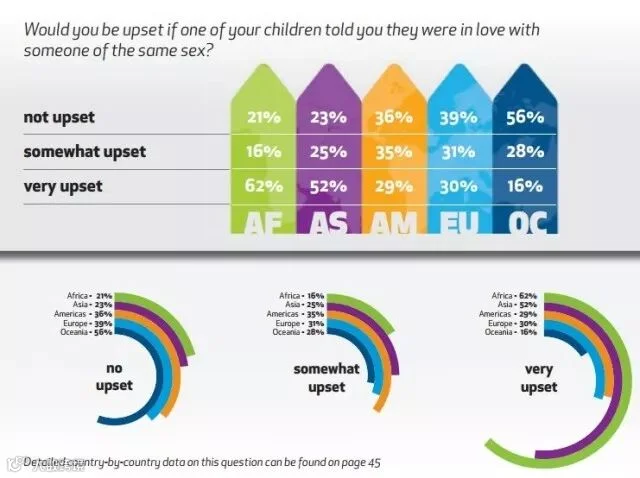
There is a pattern of negativity towards finding out such news in all regions, but it is most pronounced in Africa, where only 21% would not be upset, but 62% would be ‘very upset’ to hear this. The responses are only marginally milder in Asia where an average 23% would not be upset and 52% ‘very upset’. However, respondents in large population societies such as the Philippines and China both returned much more positive findings, where 35% and 28% respectively would not be upset if one of their children told them they were in love with someone of the same sex, 36% and 37% would be ‘somewhat upset’ and only 29% and 35% would be ‘very upset’.
几乎所有的地区都排斥关于LGBT的新闻,,但非洲表现最为明显。当听到有关同性婚姻的新闻时,只有21%的人不会感到不适,但62%的人会感到“十分不适”。在亚洲地区,人们的反应比非洲地区稍微温和一些,平均有23%的人会感到不适,52%的人会感到‘十分不适’。然而,在菲律宾和中国等人口众多的社群中,受访者反馈了更加积极的结果,如果父母被告知自己的孩子是同性恋,在菲律宾,有35%的人不会感到不适,36%的人感到“稍微有点不适”,仅有29%的人感到非常不适;在中国,有28%的人不会感到不适,37%的人感到‘稍微有些不适’,仅有35%的人会感到‘十分不适’。
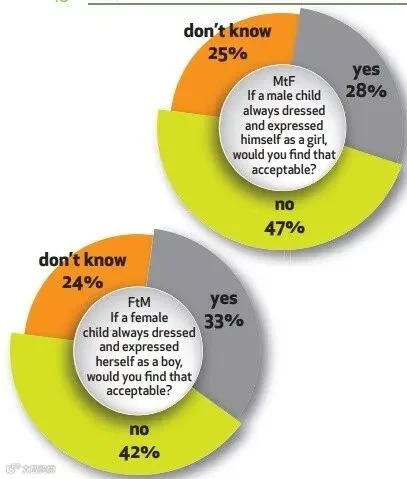
At the global level, the average parental acceptance rate stands at 28% of male to female (MtF) and 33% FtM. Interestingly, outright rejection or answering ‘no’ (not acceptable) is 47% for MtF, and 42% FtM. Around a quarter of both respondent cohorts ‘do not know’ – 25% MtF and 24% FtM.
在从全球范围考察,父母对于男性变性和女性变性的平均接受度分别是28%和33%。有趣的是,对于男性变性和女性变性直接拒绝或者回答‘不’(不可接受)的受访者分别为47%和42%。大约有四分之一的受访者表示‘不置可否’——25%男变女和24%的女变男。
At regional levels there are familiar patterns of stark rejection in Africa (65% MtF and 56% FtM), Asia (52% MtF and 46% FtM), and gradually more acceptance or more people who ‘don’t know’ across the Americas, Europe and Oceania.
在地区层面,非洲(男性变性65%,女性变性56%)、亚洲(男性变性52%,女性变性46%)对于这个问题表现出了明显的排斥,美洲、欧洲和大洋洲的受访者也逐渐对这个问题接受程度更高,或是更多的人表示‘不置可否’。

未完待续…更多精彩下期见