




Photoshop Isn’t the Problem
女性广告不再P图 伪真实or真噱头?
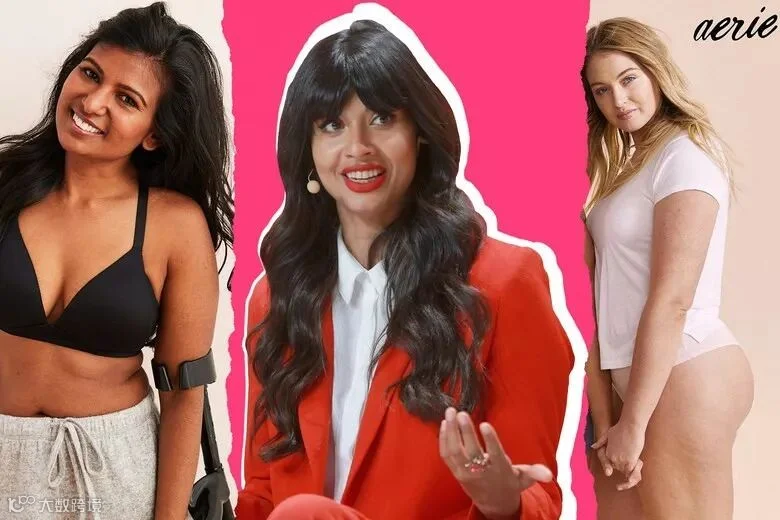
Photo illustration by Slate. Photos by Aerie and Rich Fury/Getty Images for Girlboss.
图片合并:Slate 照片来自:Aerie and Rich Fury/Getty Images for Girlboss
It’s nice to think that a move toward more authenticity would help women. Unfortunately, brands are starting to figure out how to sell authenticity, too.
崇尚真实性能帮助女性获得更多自由,这样的想法固然很好。可不幸的是,商业品牌开始考虑如何消费真实性了。

By SHANNON PALUS
DEC 10, 20185:08 PM

In 2014, American Eagle’s underwear brand, Aerie, announced that it would no longer be airbrushing its models.
“We want to help empower young women to be confident in themselves and their bodies,” Jennifer Foyle, who is now the brand’s global president, said in a press release at the time.
Sales have soared ever since, and the brand never looked back.
A slogan on the website today reads: “Girl power. Body positivity. No retouching.”
2014年,American Eagle旗下的内衣品牌Aerie宣布它不会再PS宣传照。
该品牌的全球总裁Jennifer Foyle当时在新闻发布会上说:“我们希望能帮助到年轻女性,给她们力量,让她们对自己和自己的身材更加自信。”
那次发布会之后,Aerie的销售额前所未有地猛增了,而该品牌也没有放弃这一主张。
如今其官方网站的标语是:“女性力量。身体自爱。无需修图。”

How did these ads affect the teen girls who shop at Aerie?
Researchers have attempted to suss this out.
A team at San Diego State University used photos of a model from the Aerie ad (for the purpose of the study, the researchers changed the name of the brand to the fictional “Anea”) to assess what signals in the ads—the image itself, or text describing how it was created—left an impression on the consumer.
The young woman in the ad they selected is thin, white, with effortlessly wavy hair, lying on a bed on her side in a pink bra and neon green undies.
One version of the ad bears the words, “The girl in this photo has been retouched”; a second reads, “The girl in this photo has not been retouched.” (In a control, there was no text.)
In each case, the photo was otherwise exactly the same: The model is well-lit with smooth skin.
这些广告是如何影响在Aerie消费的年轻女孩的呢?
研究人员想要发现其中的奥秘。
圣地亚哥州立大学的一支团队选用了Aerie的广告照片,想要知道广告中的什么因素影响了消费者,是图片本身?还是表明图片未经PS的说明?
他们挑选的广告中被摄的年轻女模又瘦又白,拥有一头自然漂亮的卷发,她穿着粉色的胸罩和霓虹灯绿色的小裤裤,侧身躺在床上。
版本一标注着“照片中的女孩经过PS修饰”,版本二则是“照片中的女孩未经PS修饰”。
还有一个研究对照组的版本没有文字说明。两个版本的照片是完全一样的:光线充足,模特皮肤光滑。
The researchers showed a version of the ad to 230 female college students (the majority of whom were happy with their appearance, had high self-esteem, and “appeared to have a healthy BMI”).
研究人员将其中一个版本展示给230名女性大学生看,她们中的大部分人对自己的外貌很满意,有很强的自尊心,并且看起来BMI指数很健康的样子。
After seeing it, subjects rated both their own appearance and their interest in purchasing the featured lingerie.
There wasn’t a significant difference between the results for the ad with no text and the one with the disclaimer that the ad was retouched, a finding that has been borne out in other research.
Millennials, the researchers concluded, are familiar with the fact that much of the stuff they see is a poreless, airbrushed fiction.
观看过广告后,实验对象给自己的外貌和她们对上述特写内衣的购买兴趣进行了打分。
研究发现,广告有无“此广告未经润饰”的声明对评分结果并无显著影响。其他一些研究也证实了相同结论。
研究人员总结,千禧一代已经习惯他们平时看的很多东西都是无暇的,修饰过的虚假照片了。

The addition of token flaws seems to have allowed the brand to sport a label of authenticity while still adhering to a societal norm.
添加一些象征性的瑕疵,似乎允许品牌在遵循传统习俗之外再贴上一层真实性的标签。
Interestingly, though, the condition in which the ad noted that it had not been retouched correlated with the women in the study saying that they were more satisfied with their own looks (they rated their own appearance 10 points higher on a scale of 0 to 100 compared with those who viewed the “retouched” ad).
This suggests that, via its no-photoshopping policy, Aerie may be making tangible improvements to how advertising makes us feel.
有趣的是,广告注明未经修饰这点和对自己外表感到更自信的女性研究对象呈正相关关系。这部分女性对自身外貌的评分比观看了“经过润饰”广告的人的评分要高出10分(满分100))
这表明,在改善广告对其受众感受上, Aerie公司可能正通过不P图政策取得一些实质性的进展。
At the same time, these results are a positive only if we take advertising that deploys women’s bodies as a given; the study did not address if the “unretouched” images improved self-esteem versus viewing nothing, or how the women would feel about themselves if the ad, say, featured a picture of the undies and bra laid out by themselves.
And even in the context of traditional ads, the wider literature is inconsistent on how much good labels can do: In a 2013 study, researchers at Flinders University in Australia found that showing unaltered images of a fashion shoot with and without a label resulted in the same thing: body dissatisfaction.
同时,只有在给定对照组是女性身体广告的条件下,这些结果才呈正相关。实验并没有研究,相对于什么都没看,或者仅仅看了自然摆放的内裤、文胸的广告的情况下,未经润饰的图像是否还能提升女性的自信。
即使在传统广告的背景下,更广泛的文献研究对标注能起多大作用也没有一致的看法:在2013年的一项研究中,澳大利亚弗林德斯大学的研究人员发现无论是否带有真实性的标注,展示未经修改的时装摄影都会引起同一结果——对自己身材的不满。
What’s clearer is how a vocal-but-flimsy (the model was still a thin, conventionally attractive brunette woman*) social effort plays out for a brand.
不过有一点比较清楚了:高调但经不起推敲的(它雇的模特还是苗条的,传统意义上迷人的棕发女性)社会推广会给品牌带来什么样的效应。
In the Anea study, participants liked the labeled ad more overall and expressed a greater interest in buying undies from the fictional Anea.
The same happened in real life with the Aerie campaign: Sales have increased since 2014, and at a faster pace than for the mothership brand, American Eagle.
“Aerie is simply on fire,” Foyle told investors, Business Insider reported earlier this year.
This spring, the brand ran a campaign centered on role models who, in addition to posing in Aerie undies for photos, gave motivational talks in Aerie stores.
在“Anea”的研究中,标注了“照片未经修饰”的广告总体上更受人们青睐,并让人们更有购买欲望。
现实中,Aerie的宣传也收到了同样的成效:其销售额从14年开始增长,且比它的母品牌AE美国鹰还要快。
今年早前,据《商业内幕》报道,Foyle对投资者说:“Aerie简直是火了。”
今年春,Aerie开展了一项以榜样重点宣传活动:模特不仅穿上Aerie内衣摆拍,而且在Aerie门店发表了鼓舞人心的讲话。
That even just a small note about no airbrushing was enough to make participants in that study, and presumably in the real world, feel warmer toward the brand suggests advertisers can capitalize on body positivity without fundamentally changing much about the ad itself.
单是一点“图片未加润饰”的注释就足以让参与研究的人表示对品牌心生好感。现实中很可能也是这样。这表明广告商可以利用“身体自爱运动”获利,而不用根本上改变广告本身。
Aerie’s “unretouched” lingerie ads are still in principle the same as other lingerie ads, offering a fantasy of attractive and relatively skinny folks wearing their goods.
When the brand made very white and thin and smiley Emma Roberts a spokesmodel, one writer noted with frustration, “Aerie’s campaigns are a body positivity fiction.”
Aerie“未经修图”的内衣广告本质上仍和其他品牌一样,让人幻想漂亮和相对瘦削的人在穿这个产品。
当这个品牌请白皙苗条、笑容可掬的Emma Roberts担任代言模特时,一位作家沮丧地指出,“Aerie的宣传是虚构的“身体自爱”。
Sizing for the brand still tops out at 40DD for bras and XXL for briefs.
Larger sizes are available online only; it was a shock for me to walk into an Aerie store several years into the campaign and find that I could still not try on bras that fit me.
Overall, the addition of token flaws and loud campaigns about diversity seems to have allowed the brand to sport a label of authenticity while still in key ways adhering to a societal norm.
该品牌文胸的最大码仍是40DD,内裤仍是XXL。
大号的内衣只能在网上买到;在宣传活动的几年后,我在Aerie商店仍不能试穿合身的文胸,这让我很震惊。
总的来说,该品牌在广告上添加象征性的瑕疵,又大张旗鼓宣传身体多样性,似乎只是在有意突出标签化的“真实性”,而事实上仍支持着社会关于美的固有标准。

“Authenticity” got a boost last week when Jameela Jamil made headlines by announcing that she, a conventionally attractive person, wants to ban airbrushing too.
She detailed her reasoning in a BBC opinion piece: It’s used to lie to consumers, it can contribute to eating disorders, and it whitewashes away ethnicity.
上周,真实性这个话题得到了推动。演员Jameela Jamil登上了报纸头条,她宣称自己作为一个公认的美人,也想禁止修图行为。
她在BBC的一篇评论文章中详述了她的理由:修图被用来欺骗消费者,导致他们饮食失调,并且粉饰掉了种族特点。
She’s not wrong, and her candor about how these images affect even her, a successful, powerful person, helps to underscore the scope of the problem.
Her insistence on going airbrush-free in ads and magazine covers is a positive choice against unrealistic standards, even if it’s a pretty small one.
她没错,坦率承认这些图片甚至会影响到像她这样成功又强大的女性,更说明了问题的严重性。
她坚持在广告和杂志封面上使用自己的未经修图的照片。
这是一个向不现实审美标准抗议的正面选择。
But it’s worth realizing that her wider call against retouching feels a little bit limp when you realize that Jamil is a woman who doesn’t need to be airbrushed to grace magazine covers or sell things.
Indeed, in committing to the ideas espoused in her op-ed, she seems to be fashioning herself into a human version of Aerie: She’s a pretty and professionally styled person for whom a performance of authenticity might also, conveniently, be used to sell things.
As she told Nylon in a December cover story: “I’m about to shoot a swimwear campaign without any retouching, which will be the rare opportunity to see cellulite on the side of a bus or building.”
Small win for improving beauty standards, big win for Jamil.
但是,人们应该能感觉到Jamil反对修图的呼吁有些苍白无力,毕竟她本身不需要经过修图就能在杂志封面或其他刊物上大放异彩。
事实确实如此,Jamil在专栏中所表达的观点,仿佛将她塑造成了Aerie的真人版:她漂亮且拥有独到的职业风格,即使展现真实的一面,也能够轻易地保证销量。
在Nylon杂志12月的封面故事中,她说:“我将要拍摄一套不经修图的泳装大片,巴士和大楼上的广告会出现橘皮组织了,这可不多见。”
此举对改善美丽标准的实际作用不大,Jamil却成了大赢家。

None of this is to criticize Jamil for modeling bathing suits.
It is pretty much in the job description of a modern famous person to produce images to sell goods and magazines, and even if her efforts are frustratingly small, she is at least attempting to change the broader narrative while still holding down a career.
The real problem, according to mental health professionals, isn’t so much the airbrushing of the media that we constantly see, but the prevalence of media that is perpetually centered on women’s bodies as props in a fantasyland of products and editorial spreads.
Jamil拍摄泳装大片的行为本身无可厚非,这几乎是所有现代名人为了提高产品或杂志的销量都会做的事。
即使她的努力不值一提,至少她在保住自己事业的同时试图推动更大的社会改变。
心理健康专家称,问题的重点不是我们常常看到的精修广告,而是媒体不断以女性身体来推广产品和社论的行为已成为了主流。
These images attempt to invoke the desire to be better and prettier and now a tad realer through buying things.
这些图片激发了人们想变得更好、更美的欲望,并通过购物找到一些真实的自我。
When I asked psychologists who work with teens with eating disorders whether going airbrush-free could help their patients, they agreed that it was technically better than nothing.
当我问起那些治疗饮食失调的青少年的心理学家,呼吁不修图是否能帮助到他们的病人,他们认为这样做总比无动于衷要好。
But really, limiting media consumption is the preferred route.
“Ideally, none of us would engage in comparisons, period,” said Deborah Glasofer, a psychologist at Columbia, who advises paying attention to what kinds of media make you feel good vs. crappy and curating a selection along those lines.
When it comes to comparison-inducing images, “we’re bombarded,” says Michelle Miller, a psychologist at NYU.*
She further pointed out that eating disorders, like unrealistic images, predate airbrushing. Miller encourages patients to skip beauty magazines altogether.
但实际上,限制媒体消费是最佳途径。
哥伦比亚的心理学家Deborah Glasofer建议人们关注哪种类型的媒体让你感到开心舒适、哪些让你感觉糟糕,然后进行区分。
她还说:“理想状态下,我们之中没有人会加入到这个比较中去。”谈到照片等图像的比较时,纽约大学的Michelle Miller说:“我们已经被各种图像包围了。”
她还指出“饮食不规律”,还有不现实的图像,在修图行为之前就有了。Miller鼓励病人们不要看那些花哨的杂志。
Even if images from Aerie and Jamil track a bit closer to reality, they won’t necessarily help women who are struggling the most.
As the lines between real life and fantasy life blur on sponsored Instagram posts and in campaigns that play up realness, it is important to understand what these images are: attempts to invoke the desire to be better and prettier and now a tad realer through buying things.
即便是Aerie和Jamil的图像比较接近现实,它们也不一定能帮助那些苦苦挣扎的女士们。
因为在Instagram的赞助海报以及那些自称符合现实的活动中,现实生活和虚拟生活的界线很模糊,所以,了解清楚这些图片是什么非常重要:这些图片想要激起人们变得更好、更美、更真实一点儿的欲望,然后进行购买。
What Jamil is successfully doing is positioning herself to be the kind of cover girl who’s friendly in a post-Aerie advertising world.
This trend is visible more broadly: Victoria’s Secret is on the downswing, while ModCloth is gaining popularity.
“Millennials are skeptical,” says Erlinde Cornelis, an assistant professor of marketing at San Diego State University and the first author on the Aerie/Anea study.
“Traditional advertising doesn’t have much of an effect.”
Jamil成功之处在于,她把自己定位成一个后Aerie广告世界中友好可亲的封面女孩。
这个趋势席卷了更广阔的范围:维多利亚的秘密在渐趋衰落,然而Modcloth人气渐涨。
“千禧世代至关重要,”圣地亚哥州大学商科的助教授Erlinde Cornelis如是说,
“传统广告已经落伍了。”
Companies know this, and they’re getting craftier.
An open letter in the New York Times lambasted Victoria’s Secret’s chief marketing officer for proudly putting on a fashion show as fantastical and harmful standards–packed as possible.
Sounds cool. But the open letter was printed on paid ad space: It was a stunt from ThirdLove, a bra company.
Jamil has fashioned herself as a rebel boldly speaking out against beauty standards, but as companies increasingly move to apply a sheen of authenticity atop expert lighting and makeup, she’ll fit right in.
公司们都知道这点,它们也变得更精明了。
纽约时报上的公开信件严厉斥责了维多利亚的秘密的市场主管,称其高调上演了一场梦幻时装大秀,同时也把有害的审美标准包装得似乎可行。
听起来很酷吧。但是这封公开信发表在付费广告处,因而它其实是胸衣公司ThirdLove的一个噱头。
Jami自我标榜为一个勇于向传统审美挑战的叛逆战士,但随着商家在专业布光和化妆之外愈加看重真实性,她马上就能融入新市场。
新闻来源丨slate.com
编译丨张进宁 范仪亦 谢伊雯 张殷雯 陈宁
排版丨陈宁