
It's no surprise that using negative language to refer to a minority group can produce negative effects among those being targeted. But what about using positive language to refer to a majority group? Could doing so suggest negative ideas about the minority group?
用负面语言形容一个少数群体会使人们对其产生负面看法,这一点不足为奇。但如果用正面语言去形容一个多数群体,情况又会怎样呢?是否依旧会对少数群体产生负面影响?
Noting a "surprising" lack of research on this question, a new study titled "If I Am Straight You Are Askew": Labelling Heterosexuals as Straight Worsen Gay Men's Perception" aimed to fill the gap by exploring whether referring to heterosexual people as "straight" produces negative perceptions of gay men.
注意到这一问题目前鲜有研究涉足,一项研究旨在通过探究将异性恋者定义为 "直 "是否会使人们对男同性恋者的认知趋于负面,来填补这一研究缺口。这项研究名为"如果我是直的,你就弯了:将异性恋者贴上‘直’的标签将加剧性取向偏见"。
To examine how the word "straight" might affect heterosexual participants' perceptions of gay men, Sacchi and her colleagues conducted three studies involving 275 English-speaking and 131 Italian-speaking participants. The researchers collected data on participants' levels of religiosity and prejudice against gay men, as measured by the Modern Homonegativty Scale.
为了探究“直”这一标签是如何影响异性恋者对男同性恋群体的认知,Sacchi和她的同事进行了三轮研究,招募了275位讲英语和131名讲意大利语的参与者。在进行实验前,研究人员用现代同性恋负面量表收集了参与者的宗教信仰信息和对男同性恋者的偏见程度。

Round 1
In the first study, participants were shown a fictitious Facebook profile belonging to a man named James. All participants read the same profile describing James, except for one difference: Half of the participants read that he was "heterosexual," while the other half read that he was "straight."
在第一轮研究中,研究员向参与者们展示了一份虚构的Facebook个人简介,该简介属于一个名叫James的男子。所有参与者都阅读了描述詹姆斯的相同内容的资料,唯一的区别是:一半的参与者读到他是“异性恋”, 而另一半读到“他是直的”。
Then, both groups were shown a fictitious Facebook profile of a man named Chris, who was described as gay. The researchers asked participants to rate their impressions of Chris. The results showed that participants who had been recently exposed to the word "straight" tended to report worse perceptions of Chris, however this was true only among participants with higher levels of religiosity and prejudice.
而后,两组参与者又阅读了Chris的个人简介,在同样是虚构的资料中,他被描述为同性恋。研究者要求参与者为他们对Chris的印象进行评分,结果表明,先前接触过“直”这一描述的参与者更倾向于对Chris产生负面态度,但这种情况仅限于宗教信仰和性取向偏见程度高的参与者。
Round 2
The researchers conducted the same study again, but this time they included a third group of participants who read a profile of James that didn't describe him as "straight" or "heterosexual."
第一轮实验过后,研究者们再次进行了一组对照实验。他们向第三组参与者展示了James的个人简介,但并未对他做出“异性恋”或“直”这样的描述。
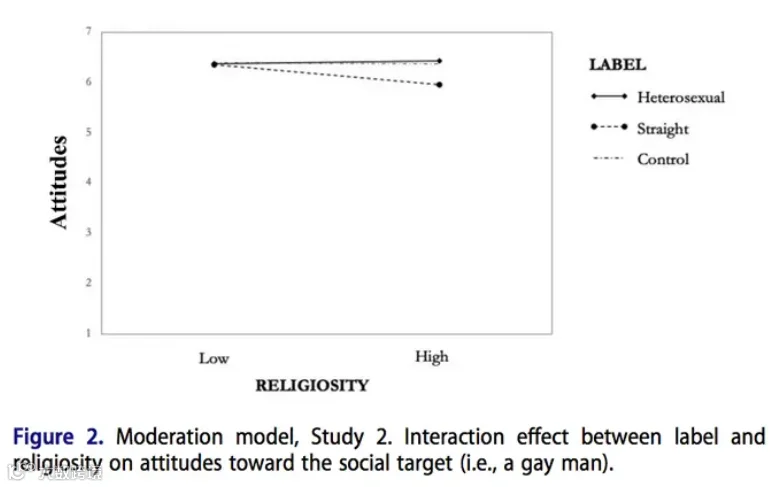
The second study produced similar results: Highly religious participants reported worse impressions of Chris after being exposed to the label "straight," although in general there wasn't a significant difference between the three groups ("heterosexual," "straight" and control).
第二轮实验得出了相似的结果:高度宗教化的参与者报告说,在接触过 "直 "这一标签后,对Chris的印象变差了,尽管总的来说,三组("异性恋"、"直 "和对照组)之间并没有显著的差异。
Round 3
The first two studies involved participants who commonly used the word "straight" to refer to heterosexual people. But what about cultures that don't use such language?
前两轮实验涉及的参与者在其所处的文化语境中也会经常使用 "直 "一词来指代异性恋者。但对于那些不使用这一描述的文化,情况又是如何呢?
The researchers decided to conduct a third study in Italy, where people don't use the word "straight" to refer to heterosexual people. In the study, all participants were asked to classify 20 pictures. Ten pictures showed heterosexual couples, while the other ten showed non-romantic partners, such as a pair of police officers.
研究者们于是决定在意大利开展第三轮实验,因为在意大利,人们不会用 “直 ”这个词来指代异性恋者。在研究中,所有参与者被要求对20张图片进行分类,十张图片显示的是异性恋情侣,而另外十张图片显示的是不存在交往关系的搭档或伴侣,比如一对警察。
The first group of participants was asked to apply the Italian word for "straight" ("retti") to pictures of people in romantic relationships, and to label those who weren't as "other" ("altro"). Meanwhile, the second group was asked to perform the same task, but to label the romantic couples with the Italian word for yellow ("gialli").
第一组参与者被要求用意大利语中 "直的"("retti")一词标注出异性恋情侣的照片,而将其他照片标注为 "其他"("altro")。与此同时,第二组参与者被要求执行同样的任务,但要用意大利语中的“黄色”("gialli")一词来标注异性恋情侣的照片。
"The word "gialli" was selected because this is a common, neutral adjective, related to a visual feature (in this case, color instead of shape) and unrelated to sexual orientation," the researchers wrote.
研究员表示,之所以选择 “黄色”("gialli ")这个词是因为在意大利文化中,这是一个常见的中性形容词,与视觉特征有关(在这种情况下,视觉特征指颜色而非形状,因此不会对实验造成误差),并且与性取向无关。
Again, the results showed that being exposed to the word "straight" tended to worsen participants' perceptions of gay men — but only for highly religious participants. Interestingly, all three studies showed that participants low in religiosity actually reported better impressions of gay men after reading the word "straight."
实验结果再次表明,对于宗教信仰水平较高且本身对于男同性恋群体存在偏见的人来说,“直”这一标签会加剧他们对男同性恋群体的性取向偏见。有趣的是,三轮实验都显示,宗教信仰水平较低的参与者在接触“直”这一描述后,对男同性恋群体的认知反而有所改善。
The researchers said their study is the first to examine the consequences of using positive language to describe majority groups, and that they hope the results will lead to "fruitful" future research to better understand the effects of positive labeling.
研究人员表示,他们的研究首次了考察使用正面语言描述多数群体产生的影响,并希望研究结果能促成未来更为丰富多元的研究,以更好地理解积极标签产生的效应。
"We should remember that modern prejudice is often subtle, indirect, invisible to the perpetrator, and revealed more by ingroup favoritism than explicit outgroup derogation," Sacchi told PsyPost. "In contemporary society, ingroup-directed favoritism and accentuated positive feelings, as sympathy and admiration, toward ingroup members could be the 'modern' basis for discrimination."
“我们应该记住,现代偏见往往是微妙、间接的,不自知的,且更多的是由内群体偏好而不是外群体歧视揭示。”Sacchi告诉PsyPost,“在当代社会,人们对自己所处群体更易产生正面情感,如同情和钦佩等,这可能是歧视的‘现代’基础。”
编译 | 蒋吉衣
排版 | 蒋吉衣