
Officials destroy illegal products that claim to identify sex of fetus.
By Ni Dandan
Three boxes of sex-testing kits have been seized by customs officers, according to a report by party newspaper People’s Daily. The products claim to determine a fetus’ sex by detecting the presence of certain hormones, said the report.
A ban on prenatal sex identification for non-medical reasons officially appeared in China’s Population and Family Planning Law, which went into effect on Sept. 1, 2002, to prevent parents from aborting fetuses based on their sex.
China has the world’s most imbalanced sex ratio at birth, with 113.5 boys born for every 100 girls — a skewed picture stemming from a traditional preference for boys and the nearly four-decade-long enforcement of a nationwide one-child policy.
Despite strong policies to prevent prenatal sex-selection services from reaching prospective parents, there remains a large market for such products in China.
Just last month, a vast network of middlemen who help parents determine the sex of their unborn babies via blood testing was exposed, and yet such services remain available online.
The recently seized urine tests were purchased by an e-commerce company and sent to China, explained the Beijing Entry-Exit Inspection and Quarantine Bureau.
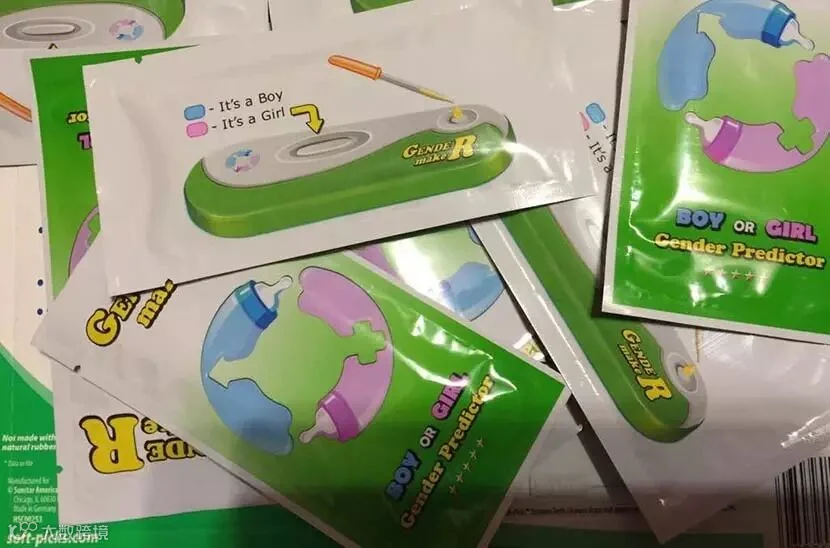
‘Sex predictors’ imported by an online vendor based in China. From the vendor’s Weibo account.
The rising convenience of international online shopping guarantees access to such products. Although there is no trace of baby sex-predictors on domestic shopping sites, you can find a wide variety of similar tests on American websites that deliver to China, such as Amazon.com, which expanded its Prime worldwide shipping service to China last month. The kits’ prices range from less than $10 to nearly $80.
The first conversations about baby gender-predicting products began appearing on domestic online forums around 2009, with reviewers’ reactions varying widely depending on the accuracy of the predictions.
Wang Wen, who is five months pregnant with her second child, told Sixth Tone that she recently bought a baby sex-predictor from a salesman on messaging app WeChat for nearly 200 yuan ($30). “It’s not that expensive, and no matter what the result is, I would definitely keep the baby. I am simply curious,” said the 36-year-old.
“It’s almost impossible to get the ultrasound physician to tell you the baby’s sex,” Wang added. “And if you try to ask them during a scan, you’re definitely going to be rebuked.”
Sex-predicting products have no scientific guarantee of accuracy, and vendors make promises about their predictions deliberately vague.
Dr. Wu Xiaofeng told Sixth Tone that there’s no scientific evidence behind these products.
“The level of hCG, a type of hormone produced by the placenta after implantation, in women’s urine can accurately tell if one is pregnant. But it’s not scientific to say that simply based on the amount of male hormone in a woman’s hCG, we can judge the sex of a fetus,” said Dr. Wu, who works at the Maternity and Infant Health Hospital in Shanghai’s Songjiang District. “Such products are more for entertainment.”
(Header image: Taxi Japan/VCG)