
How a 15-year-old with two children born of rape is searching for justice in China's broken system.
By Ni Dandan & Qian Jinghua
Chinese tradition dictates that new mothers, physically weakened by childbirth, spend the first month at home being cared for by relatives. But this was never going to happen for 15-year-old Sisi.
In September last year, the teenage girl left her remote mountain village in central China and boarded a train for Beijing, nine hours away.
The date was September 11, 2015, and she’d given birth two weeks earlier to her second daughter, who was born as a consequence of rape.
Today, Sisi barely remembers the journey, just the parting words of her father: “You have brought shame on our family.”
She was headed to the Children’s Hope Foundation in Beijing, an NGO that had been supporting her for three years, ever since she gave birth to her first child at 12 years old after being raped by a 74-year-old man. In China, the age of consent is 14.
Sisi’s story of how she was treated after multiple rapes by different men reveals the sad truth of how sexual abuse of minors is handled in China, where young victims are regularly blamed and perpetrators rarely face prosecution.
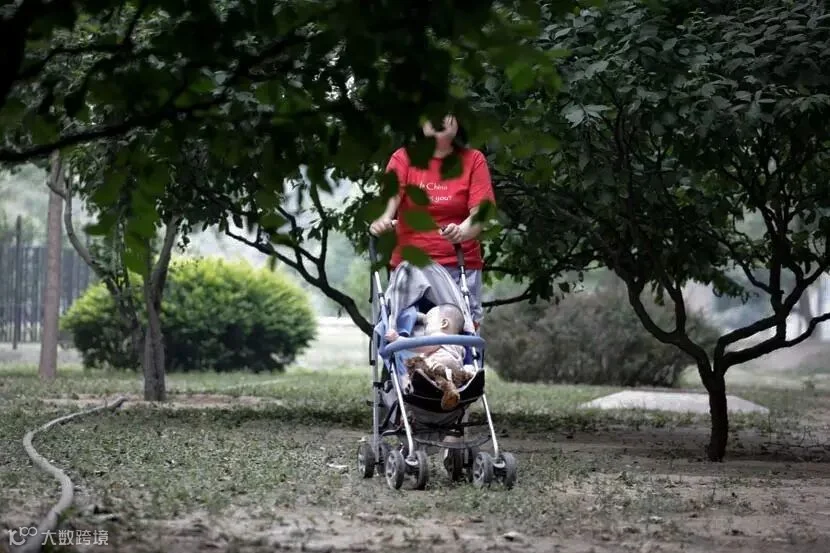
Sisi pushes her baby girl in a stroller in Beijing, June 7, 2016. Han Meng/Sixth Tone
From 2013 to 2015, China’s courts saw an increasing number of child molestation cases each year, with 6,620 offenders from 7,610 cases sentenced over the three-year period, in addition to more than 60,000 rape cases that included both adult and underage victims. But a culture of silence, shame, and private settlement means that many cases never reach the justice system: The People’s Public Security University estimates that only one in eight cases of child sex abuse is reported.
Quoted by the Supreme People’s Court Monitor, Paul Schmidt, Beijing-based legal counsel and adjunct professor of law at Peking University, determined that in 2014 there was approximately one rape investigation in China for every 50,000 people. In contrast, a city like New York in the United States saw around one investigation for every 5,000 people in the same period. In China, Schmidt says, “A lot of crime is dealt with through administrative means or informal ‘mediations’ adjudicated by the police between victims and perpetrators.”
Fifteen-year-old Sisi, though, will settle for nothing less than prison time for the father of her second child. “My urgent wish at the moment is to put that evil man behind bars,” she says from the NGO in Beijing.
She’s referring to Mr. Xia, a man in his 50s whom Sisi accuses of raping her and fathering her 10-month-old baby.
Sisi claims that Xia — who runs three kindergartens — invited her to his home in the southern Chinese city of Shenzhen after reading about her first rape case in the news. The two then began a sexual relationship when she was 13 years old.
A simple DNA test would close the matter, but attempts to find out the truth have so far been thwarted by the Shenzhen police department.
For the past 10 months, attorney Lai Weinan has been pushing the police department to conduct a DNA test that would prove the relationship between the baby and Xia.
At the start of July, Lai phoned the police officer in charge of the inquiry but was given a string of excuses as to why there had been a delay. He told Sixth Tone: “I’m lost. I have no idea why it has taken so long. I will keep contacting them until I get an answer.”
Lai was told that Xia was questioned earlier this year and then released.
Utterly perplexed by the delay, Lai speculates that the officers’ lack of experience in dealing with his type of evidence could be the root cause.
Sisi is one of the first child victims of rape to be forced into the media spotlight in China. Journalists from across the country appeared in her home village deep in the mountains of Hunan province after she gave birth to her first child.
Sisi’s cases have lifted the lid on a systemic problem which has since been reported on more widely.
Between 2013 and 2015 the media highlighted 1,035 cases of children being sexually abused, according to figures from Girls’ Protection, a project that aims to raise awareness of sexual assaults against children.
In recent years several high-profile cases of child sexual abuse have shocked the nation. In May 2013, a primary school principal, Chen Zaipeng, and a local government official, Feng Xiaosong, raped six girls aged 12 and 13 in the island province of Hainan. Then in July of the same year, a 62-year-old primary school teacher, Tao Biaogong, was arrested after sexually assaulting seven girls aged 8 and 9 in Jiangxi province. He transmitted genital warts to six of the victims. Though all three men were eventually convicted of rape and sentenced to prison terms (13 years for Cheng, 11 for Feng, and 14 for Tao), preliminary investigations by local authorities concluded that the suspects did not have sexual intercourse with the victims, leading to the public perception that government workers felt entitled to abuse young girls with impunity.
Increased attention has resulted in greater protections, but oversights remain. Legislative and judicial efforts on the issue have sometimes sent mixed messages by toughening penalties but also narrowing protections to limited circumstances. A legal opinion issued by the Supreme People’s Court in October 2013 stipulated heavier punishments for offenders, particularly for state employees such as teachers, but appeared to suggest that the physical development, speech, mannerisms, or other attributes of a girl aged 12 or 13 could determine whether a perpetrator should have known the girl was underage.
Disillusionment with the legal system has led lawyer Lai to devote more time to awareness-raising rather than to helping the victims’ families pursue abusers.
“Once the harm is done, it could last a lifetime,” Lai told Sixth Tone. “And what’s even sadder is that the country’s judicial system can’t effectively punish the evil attackers.”
Lai says police don’t have the skills to question children, some of whom are as young as three years old, and they don’t take children’s testimonies seriously enough.
“Sadly, based on my observations an extremely low proportion of cases involving children being raped end up with encouraging results,” Lai says. “The suspects are often released due to lack of evidence. We have to introduce a fundamental systematic change to ensure that criminals are punished severely.”
Sisi in Beijing
Sisi is now living in suburban Beijing in an apartment provided by the Children’s Hope Foundation, whose primary purpose is to support sick children from poor families.
“It’s boring to watch childish cartoons all the time,” said Sisi, referring to the preferred TV programming of her roommates, who are all under the age of 10.
But despite the occasional monotony, Children’s Hope Foundation has been a lifeline for the young mother.
When the country’s media descended on Sisi’s village three years ago, there was one unexpected benefit: Reporters put Sisi in touch with organizations that could help her recover from her ordeal.
Liu Fengqin, chief psychologist at Beijing Maple Women’s Psychological Counseling Center, was the first to offer counsel to Sisi.
Liu’s comments highlight the complicated issues around culpability in the case of teen rape victims: “Teenagers experience a stronger sense of shame than younger children. They also experience physical impulses as their hormones change, which can lead to forming relationships with their abusers.”
Sisi’s second pregnancy caused many around her, including family members, to place the blame squarely on her, explains Li Zikun, a social worker with Children’s Hope Foundation who has dedicated her time to Sisi for the past two years.
“The case was misread by people who concluded that there’s no hope for Sisi,” says Li. “People don’t understand victims like her.”
Sisi’s situation highlights the depressing reality of rape culture — that no matter how brutal the attack or how blameless the victim, people’s first instinct is often to find fault with the victim rather than the perpetrator.
In China, the law assumes that children under the age of 14 are too young to give informed consent, that nothing a minor does can be interpreted as consent, and that any act of sex between an adult and a child is an act of violence.
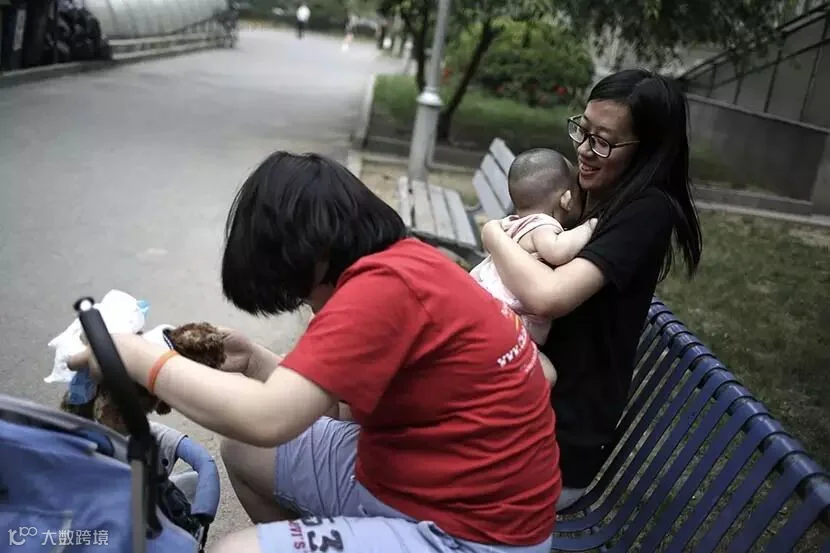
Li Zikun (in black), a social worker with the Children’s Hope Foundation, holds Sisi’s baby girl as Sisi plays with a pet dog, Beijing, June 7, 2016. Han Meng/Sixth Tone
Yet often in child rape cases, perpetrators will claim they were seduced by their victim, or give the defense that the crime is less severe if it didn’t involve physical force.
In the months after Sisi moved to Beijing with her newborn girl, the NGO tried to help her and her family recover from the trauma together. Her parents and daughter came to the capital city in late 2013, but as the family of four went on living together, the situation only deteriorated.
Mother and father would fight verbally and physically in front of their daughter.
“It’s pathetic that Sisi’s parents never taught her what love is, and that they continued with their bad habits even after these tragedies occurred,” says Li.
Sisi looked quite calm as she told Sixth Tone how her father frequently beat her for no reason during their stay in Beijing. “They never showed me love,” she said. “When the old man touched me and told me that was love, I trusted him.”
She’s referring to the 74-year-old man who abused her for several months, sometimes giving her 5 yuan (around $0.75) in exchange for sexual intercourse. He was sentenced to 12 years in jail.
The psychologist Liu spent time with Sisi and her parents, discussing ways in which they could communicate with their daughter. At first, Sisi was completely silent, so Liu encouraged her to draw on sand tables and play interactive games to express her feelings.
Soon after meeting Sisi, Liu turned to Children’s Hope Foundation to help her find a safe place to stay in Beijing. Sisi moved into an apartment with other children who had become mothers as a result of rape. She was also offered a place at an international school in the capital.
Li the social worker says it took more than a year for Sisi to open up and talk to her. “She had lost her sense of security and was always on the defensive,” she recalls. “It’s not easy for anyone who wants to help these hurt children. You have to consistently show them unconditional love.”
Sisi's home
Despite the best intentions of counselors and social workers, Sisi’s parents are consumed by feelings of shame about their daughter’s plight.
At night in their home in rural Hunan, you can’t see the dark for the stars. During the day, the sky is the kind of blue that would make Beijingers jealous, dotted with fluffy clouds, and fading into mountains on the horizon. The house is high on the forested hillside, and the road down to the town where Sisi went to school was only paved last year. These days Sisi’s parents scrape by raising chickens, ducks, geese, and fish, while bringing up their 3-year-old granddaughter, Yanyan. For most of Sisi’s childhood, however, her father worked in faraway cities.
Sisi's parents in Qiyang County, Hunan Province, share how her rape has impacted the family.
Li Chunsheng tells Sixth Tone that the town blamed him and his wife for what happened to their daughter more than they feared for their own children. “Everyone spoke badly about us,” he says. “They’d say, ‘Your daughter’s bad, you didn’t teach her well.’ What’s a father supposed to do? Are we supposed to be at home with the child every day? That’s not possible. How am I supposed to make a living and feed them? There are my parents to feed as well.”
But Sisi’s mother, Xin Fuxiang, says that some of the other parents in the town were anxious after they heard of Sisi’s first pregnancy, assuming that a teacher was responsible. “The next school term, 40 or 50 students transferred to other schools or stopped going altogether,” she says.
Xin and her husband worry about where they’ll send Yanyan once she reaches school age because of the stigma attached to their family. They seem to see the situation more in terms of disgrace than abuse, holding their daughter responsible for what has happened to their family.
When Li found out his then-11-year-old daughter was pregnant, he flew into a rage and beat her. Though he acknowledges his immediate reaction was that she must have been raped, he also thinks it is Sisi who needs to change, believing that she sought out men for money.
“Honestly, I don’t feel sorry for her,” he says. “If she becomes a good child, she’ll remain my daughter.” But despite Sisi’s age and the current consent laws, Li says he has no sympathy for her: “I tell her, if it happens again, I can’t do anything. Haven’t I lost enough face already?”
Li says his daughter is reluctant to tell him anything about what happened, and doesn’t believe the little she has told him. “She doesn’t tell me the truth,” he says. “I don’t know why. She talks to her mother more. I have more of a temper; I’ll hit her if she’s bad.”
Xin appears to have more sympathy for her daughter. “How could I not hurt for her?” she asks. “She’s my only child. My first died.” (Before Sisi was born, Xin and Li had a child who died at just three months.)
But Xin, too, feels that Sisi was at fault. “My first reaction was, What’s done is done,” she says. “Beating her to death is no use.”
Though the tragedy has permanently altered the lives of Sisi’s mother and father, they say it hasn’t significantly changed their parenting. Hitting and cursing are the only forms of discipline Li knows, and he says he can’t change his behavior as long as he remains in the village.
Li is teaching Yanyan the same values he taught her mother, and this worries Sisi. “I believe they’re bringing up my older daughter the same way they raised me,” she says. “My first child, now 3 years old, says dirty words all the time.”
Li maintains he has simple principles when it comes to parenting. “I’d tell my daughter, ‘Study hard, and don’t get into fights with the other kids,’” he says. “Now I tell my granddaughter, ‘Greet your grandma, your auntie, your uncle.’ That’s the kind of education we give.”
To continue reading click the 'Read more' link at the bottom of the screen to go to the original article.
Additional reporting by Liu Lu and Owen Churchill.
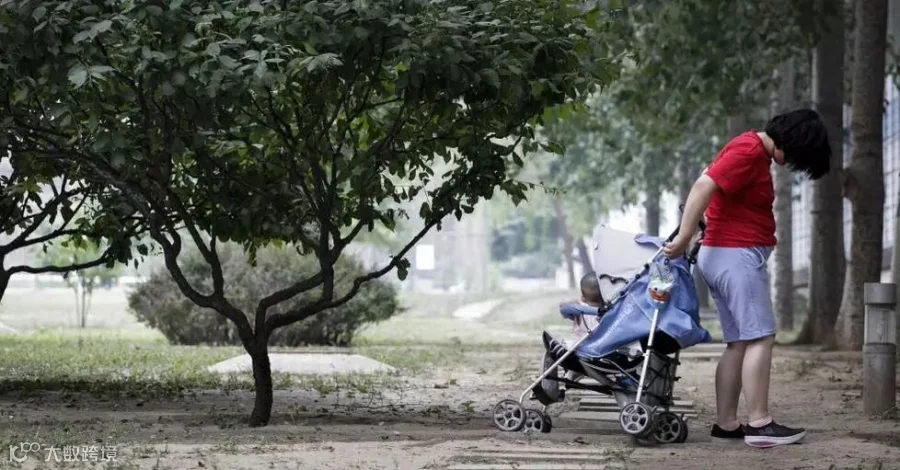
(Header image: Sisi takes her baby girl through the park in a stroller in Beijing, June 7, 2016. Han Meng/Sixth Tone)