
In Yunnan province, mining operations cause villagers to fear for their lives.
By Denise Hruby
YUNNAN, Southwest China — Late into the night, Zhang Gonghua studied a government-issued booklet on disaster preparedness. In comic-like drawings, one chapter explained the warning signs of an imminent landslide. Zhang was puzzled.
The drawings matched the changes he had seen on the mountain where he lives, and the booklet also mentioned the dangers of mining. Then, he connected the dots: the fissures in their houses and the land, the disappearance of the mountain springs, the vast coal mine underneath the village — and the looming likelihood of a landslide.
“The pictures in the booklet look like what’s happening on our mountain,” says Zhang, the village head. “I realized how dangerous it is.”
Hazardous Landscape
Without GPS coordinates, Xiaotun Village is almost impossible to find on a map. Located in a remote and mountainous pocket of Zhenxiong County in northeastern Yunnan province, it’s home to just over a dozen families living in stone houses, with thatched roofs protecting them from wind and rain. The last home at the edge of the village sits at an altitude of just under 2,000 meters, an hourlong hike from the nearest road.
Overgrown with high grass and often shrouded in mist, the village’s steep slopes are eerily beautiful. Yunnan is known for mountainous scenery like this, but it’s also what makes the province dangerous, says Tan Shucheng, director of Yunnan University’s School of Resource Environment and Earth Sciences.
“Many mountains in Yunnan are prone to landslides,” Tan says, explaining that steep slopes like the ones found here are a prerequisite for such disasters.
Landslides can be triggered by earthquakes, heavy rains that weaken the soil, or a combination of factors. In 1920, an earthquake in northwestern China triggered a landslide that killed 180,000 people — the world’s deadliest landslide, according to Guinness World Records. More recently, landslides caused by an Aug. 8 earthquake in Yunnan’s neighboring Sichuan province killed 25 people, just weeks after another Sichuan landslide caused 15 deaths following heavy rains. In a village near Xiaotun, 18 children and one adult died when a school was buried by a landslide in 2012.
There are no reliable statistics on landslides in China, but according to data compiled by Shanghai’s Tongji University and Sixth Tone’s own research, at least 352 people have died in landslides since 2008 in Yunnan alone.
It’s easy to shrug off landslides as natural occurrences, unavoidable disasters for which there is no one to blame. But that’s not always true: Some of the world’s deadliest landslides have been caused — and could have been prevented — by humans.
Construction can destabilize slopes, as can the removal of trees and other flora whose roots help hold the soil together, Tan says. By and large, however, mining is the human activity most commonly associated with landslides. And while mines around China are falling into disuse as the country moves toward cleaner forms of energy, they continue to destabilize the ground above. Xiaotun Village is a case in point.
Warning Signs
At 60 years old, Zhang is remarkably spritely. He smokes as he climbs up and down the mountain — never short of breath — and he’s intent on pointing out every sinkhole in the ground, every crack in the nearby houses, and every fissure in the earth.
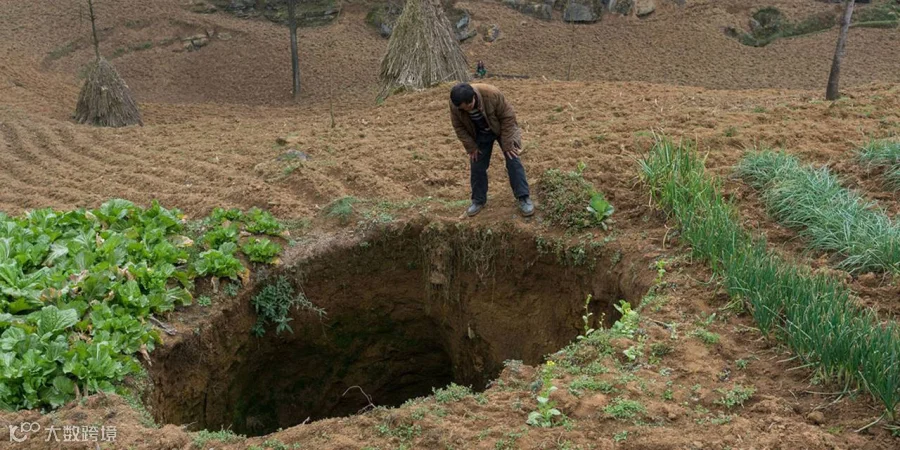
The mine that runs underneath the village received its safety permit in 2005, and the first available output figures date back to 2006. “Three years after the mine opened, there were holes everywhere on our mountain,” Zhang says, staring down one sinkhole so big that a house could fit inside.
Dozens of other sinkholes of various sizes dot the surrounding mountainside. One swallowed a field that grew potatoes and green onions. A dog fell into another, Zhang recalls, but it was rescued by villagers who tied ropes around their waists and rappelled down into the hole.
At first, villagers tried not to worry too much, but soon after the sinkholes opened, fissures started to appear in the ground. Then came the cracks in the walls and floors of local houses. They grew wider, longer, and deeper, says Xiaotun villager Zhang Gongyuan, a father of two who is not related to Zhang Gonghua. “We are very worried that the house will collapse because of the cracks,” he says of their family home, “and that the land will cave in.”
Next, the water disappeared. Villagers say that for as long as they can remember, springs near the peak of the mountain provided the water they needed to irrigate their farmland, cook, and wash. Before the advent of the mine, the villagers thought these springs were inexhaustible.
Now that the springs have been gone for a year, the villagers have learned to cope, using wicker baskets covered with plastic sheets to fetch water from the river that cuts through the valley. One basketful lasts a small-scale farmer no more than a day, and it takes at least half an hour to haul it up the mountain, says Wu Fubi, a 46-year-old villager who lives on her own. “I try to [collect water] when it’s dry outside, so it’s easier to carry the basket,” she says. Around her house, she has set up containers to store water.
The villagers say there’s less food each year, partly because some of their fields have been swallowed by sinkholes, and partly because they don’t have enough water to grow vegetables.
See the full multimedia story on the Sixth Tone website by clicking 'Read More' at the bottom of the page.
Video & photography: Thomas Cristofoletti
Visual editor: Daniel Holmes
Additional reporting: Wang Yiwei
Editor: Owen Churchill
Web developer: Lin Tao
You may also want to read:
After Deadly Landslide, Shaanxi Villagers Resist Relocation
Official Fired After Cover-Up of Fatal Mining Accident
Rare Bird's Yunnan Habitat Threatened by Mining, Dams
Want to get Sixth Tone stories delivered to your email?

Subscribe to our newsletter for a weekly roundup of the latest news and trending topics from China.
Sign up here: http://ow.ly/zgv530cPeV4 (Copy and paste the URL into your browser)