
‘Meige,’ an Yi minority storytelling tradition passed down through generations, is under threat.
By Matthew Walsh
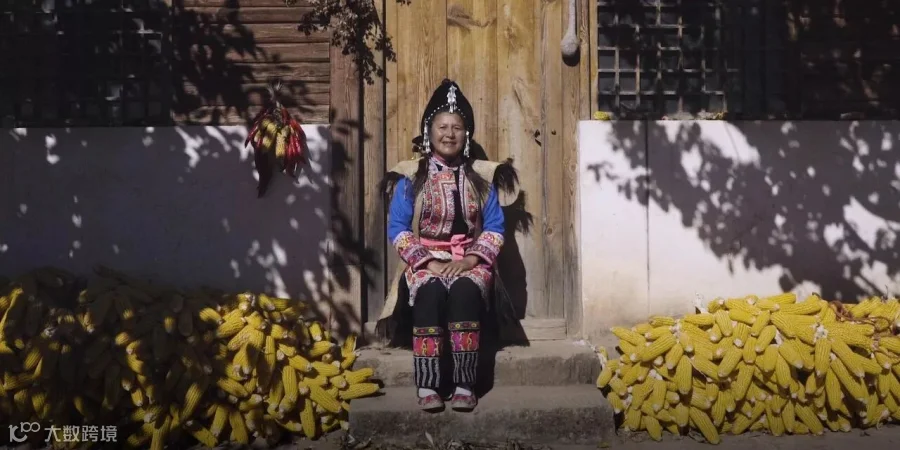
YUNNAN, Southwest China — Guo Youzhen takes a deep breath and starts singing about the origins of the universe.
She sings of Gezi, the Creator, who forged the earth and the sky from nothing. She sings of Ah Fu, whose three sons clung fast to the edge of the sky and hauled it downward to meet the earth below. She sings of the pythons that encircled the earth and divided it into uplands and lowlands, the ants that nibbled at the ground’s frayed edges until they all lay straight, and the menagerie of wild animals that applied the finishing touches.
Three pairs of boars, three pairs of elephants,
dug the soil for 77 days and nights.
They made the mountains; they made the hills.
They made the flats, and the beds that water fills.
Guo reaches the end of the verse and pauses for breath. “It’s a very long song,” she smiles. “You could sing for three days and nights, and still not reach the end.”
Big sky, small world — this is right.
Heaven and earth are well-aligned.
There are only a handful of people left who can sing the creation myths of the Yi people, one of China’s 55 official ethnic minorities, from start to finish. The myths form the centerpiece of meige, a style of sung storytelling that has been passed down among Yunnan province’s Yi communities for centuries.
Today, meige is under threat. Most master singers are middle-aged or elderly. Younger generations of Yi have adopted new ways of life, working in faraway factories instead of the fields back home, and fewer people have time to devote to the art. “Reform and opening-up has brought severe, unavoidable challenges for meige,” says Yang Fuwang, an expert on ethnic minority cultures at Chuxiong Normal University in Yunnan. “The unique environment in which it was passed down no longer exists.”
Meige is one of many oral storytelling and singing traditions in societies across the world. They are windows into the immense breadth of human experience, especially in cultures whose languages historically had no written forms, or whose people are largely unable to read and write.
Across China’s southwestern regions, where people of the dominant Han ethnicity have mingled with a panoply of ethnic minorities for centuries, folk singers often return to tunes, themes, and motifs resembling meige. Up in the northeast, the Manchu traditionally perform ulabun, singing about a great heavenly war, the origins of the region’s ethnic groups, and the biographies of revered shamans. Out near the country’s western border, the Kirgiz people perform the “Epic of Manas,” a 500,000-line poem detailing the exploits of a 17th-century war hero in his battles against the marauding peoples of Central Asia.
However, the vast majority of the world’s oral cultures now exist on the margins of mainstream society. Once incorporated into larger political states, these communities struggled to sustain their folk traditions amid the hegemonic onslaught of official languages, written texts, and education systems that value empirical approaches to history over mythological narratives.
The Yi mainly reside in four of China’s southern and southwestern areas: Yunnan, Sichuan, and Guizhou provinces, and the Guangxi Zhuang Autonomous Region. Small numbers of Yi also live in Thailand and Vietnam. Though the Chinese state classifies the Yi as an ethnic minority, this all-encompassing moniker belies the confounding diversity of this 9 million-strong group. Yi people may identify as one of 80 or so subgroups and speak any of the region’s family of Loloish languages that have more in common with Burmese than Mandarin. They may practice Buddhism, shamanism, or — in areas that hosted late 19th-century European missionaries — Christianity.
Not all Yi sing meige; the songs are the preserve of cultures native to the Chuxiong Yi Autonomous Prefecture in central Yunnan. The songs are as varied as the Yi themselves — meige singers in one village may color their versions with slightly different lyrics and inflections from those in the next valley. But one village in particular positions itself as meige’s ancestral home: Mayou, located about a four-hour drive northwest of provincial capital Kunming. A single road tethers the village to the town of Yao’an, snaking through hilly terrain past a great azure reservoir.
From June to September, Mayou’s rice paddies flush verdant as heavy rains swell the brook that splits the village in two. But during Sixth Tone’s visit in mid-November, the days sit dry and cool, the brook has dwindled to a lazy trickle, and the fields have turned a subdued blend of ocher, shorn short during the recent harvest. Courtyards, balconies, and rooftops are festooned with ears of sun-dried corn waiting to be fed to the local livestock.
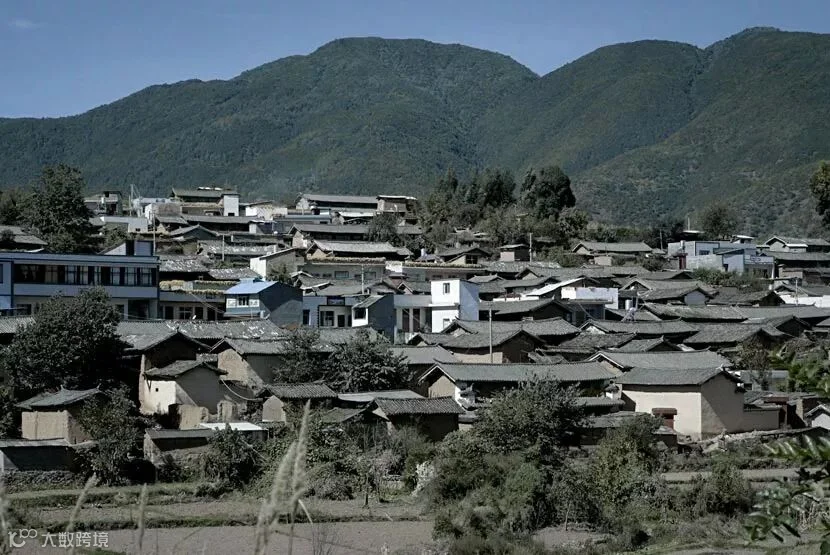 A view of Mayou Village, Yao’an County, Yunnan province, Nov. 16, 2017. Daniel Holmes/Sixth Tone
Village officials estimate that more than 95 percent of Mayou’s residents are Yi. Guo was born here in 1943, the youngest of four children. Now a spry 74-year-old with an easy smile, only her posture — she stoops slightly to the right — betrays a lifetime spent tilling the fields. She remembers childhood days helping her parents farm, which gave way to evenings when the whole family would retire to the hills above the village, light bonfires, prepare meals of buckwheat noodles and wild herbs, chat with other villagers, and sing meige songs.
“When we were young, the whole family would sit beside the fire, listening to Grandma and Grandpa sing. That was how they passed it on: I listened, and little by little, I mastered it myself,” says Guo through an interpreter, who puts her remarks into Mandarin. Nobody in Mayou can read or write Yi, and — like all the meige singers interviewed for this piece — Guo requested that Sixth Tone use her Chinese name.
Yi people in Mayou historically learned folk songs by word of mouth. Whereas the creation myth was typically only sung at marriages, funerals, and major festivals, communal singing of more casual ditties enlivened the everyday drudgery and connected younger generations to a swath of shared history. “My mother and my older sister could both sing very well,” says Guo. “We sang wherever we went, whenever we walked or took the train anywhere. When it rained, we’d sing about the rain; when the sun shone, we’d sing about that, too … For us, meige was something you sang all day, every day. You’d sing about whatever you saw.”
To see the video and read the full story, click 'Read more' at the bottom of the screen to go to the original article.
Additional reporting: Liang Chenyu; editor: Kevin Schoenmakers. Song lyrics courtesy of Mark Bender and Dong Jiacheng.
(Header image: Luo Ying poses for a photo in Mayou Village, Yao’an County, Yunnan province, Nov. 17, 2017. Daniel Holmes/Sixth Tone)
You may also want to read:
Manchu, Once China's Official Language, Could Lose Its Voice
The Virtuoso Bringing Silk Road Music to a National Audience
Feminist Folk Quartet Gives Voice to China's Migrant Workers
Want to get Sixth Tone stories delivered to your email?

Subscribe to our newsletter for a weekly roundup of the latest news and trending topics from China.
Sign up here: http://ow.ly/zgv530cPeV4 (Copy and paste the URL into your browser)