
Emergence of ‘super hospitals’ highlights urban-rural health divide.
By Colum Murphy & Fu Danni
In the emergency center at China’s largest hospital, a girl in a black quilted jacket changes her high heels for slippers. Covering a row of steel hospital seats with a blanket, she makes an impromptu bed. She stuffs her possessions underneath: a thick quilt, a thermos flask, and a box of tissues.
Twenty-six-year-old Zhao Yu has been camping out for more than a week at the First Affiliated Hospital of Zhengzhou University (Zhengzhou First), in the capital of the central Chinese province of Henan.
Zhao is here with her mother and sister-in-law to look after her alcoholic brother, who is in the intensive care unit after collapsing from intoxication. They’ve traveled 155 kilometers for treatment and have spent around 120,000 yuan ($18,500) for two surgeries. While the cost of treatment here is high, Zhao said conditions at hospitals in the family’s hometown are abysmal. “This,” she said, “is the best hospital in the province.”
A time-laspe video taken at the First Affiliate Hospital of Zhengzhou University, China’s largest hospital, in Zhengzhou, Henan province.
In rural China, most people associate bigger with better when it comes to health care, and for good reason. Outside of provincial capitals, access to medical care people can trust is limited. That’s not necessarily because of a dearth of hospitals or even of modern equipment, but instead boils down to an absence of well-qualified doctors and poor services at the local level. Large hospitals — especially “super hospitals” — act as magnets for large numbers of people who are unwilling to put their lives in the hands of medical staff at smaller hospitals and clinics. Yet it is precisely these types of smaller, community-based hospitals and clinics that the central government sees as a major pillar of its health care strategy, which aims to bring affordable health care to all of its citizens by the end of this decade. As such, super hospitals like Zhengzhou First represent a dilemma for policymakers: They meet a clear demand today, but in the long run their presence may be a hindrance to achieving a more sustainable health care system in China.
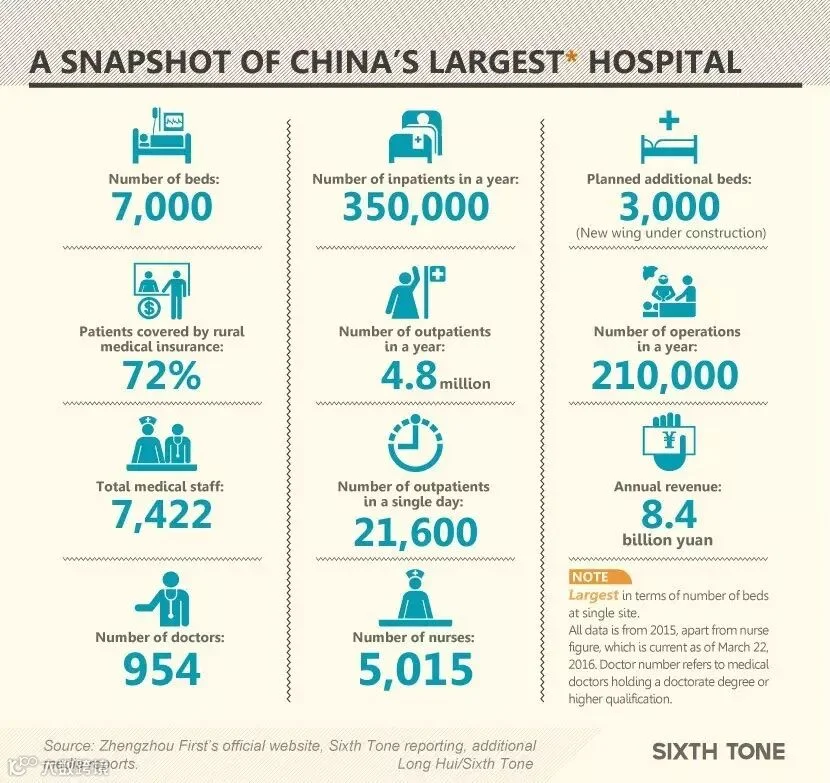
ast year, Zhengzhou First admitted around 350,000 inpatients and just under 4.8 million total patients, according to the hospital’s president, Dr. Kan Quancheng. On Feb. 15 the hospital received close to 20,000 outpatient visitors in a single day, making it one of the busiest days in the hospital’s history.
Officially, the hospital has 7,000 beds, Kan told Sixth Tone. By this standard, it’s the largest hospital on a single site in China. Around the country, there are at least 10 super hospitals — that is, hospitals with more than 4,000 beds — have popped up in recent years. Zhengzhou First sprawls over several buildings, some up to 28 floors, and treats a broad range of health-related conditions, ranging from heart disease, urinary health, lung ailments, and cancer treatment. It even has its own fire department and police station.
The rush to seek attention in super hospitals like Zhengzhou First has its roots in the historical development of health care in China. Additionally, it is also linked to a host of other factors, such as rising income and improved transportation. But all of this only provides a partial explanation for the growth of super hospitals. At their heart, super hospitals serve to underline the continued development of China along dual tracks — where large divisions between urban and rural have become increasingly pronounced.
In the decades after the establishment of the People’s Republic of China in 1949, many urban dwellers were attached to a danwei, a work unit overseen by the Communist Party, which would cover their medical costs. Strict referral systems also made it difficult for patients to seek out attention at larger hospitals. Those living in the countryside were also reasonably covered under agricultural communes that gave basic health coverage. Much of rural health care was provided by “barefoot doctors” — people with minimal training in medicine who were nonetheless capable of administering simple public health measures.
But over time, the major political and economic transformations that swept through the country, including the opening up of the economy and the shift away from central planning, saw a gradual reduction in the role of the state in people’s day-to-day lives, including their health care. “In the 1980s, when the previous rural cooperative health care system gradually decreased, a lot of rural dwellers could no longer afford their medical fees," said Cai Jiangnan, director of the Center for Healthcare Management and Policy at China Europe International Business School in Shanghai.
In the past decade, China has made significant advances in providing health insurance. For those in the countryside, measures in the form of the New Rural Cooperative Medical Scheme, introduced in 2003, meant that health care was once again affordable. This led to a drastic increase in the number of patients seeking out medical attention at big hospitals, according to Cai.
According to statistics from the World Bank, China spent just over 5.5 percent of its GDP on health care in 2014. By comparison, the United Kingdom spent over 9 percent on health care in the same year.
China has pledged to achieve affordable and high-quality health care for all of its citizens by 2020. Martin Taylor, the coordinator of health systems and health security at the World Health Organization’s China office, described the health care plan as “one of the most ambitious” in the world. “If China achieves it, that will provide lessons for the rest of the world,” Taylor told Sixth Tone in a telephone interview.
Bursting at the Seams
On a recent morning in March, Zhengzhou First appeared to be bursting at its seams. Wards accommodated beds far beyond the number for which they were designed. Corridors were also lined with beds — not gurneys — adding to the official bed count, and patients, some attached to IV drips, sat listlessly waiting for treatment.
As in the case of the Zhaos, illness in China is a family affair, and the hallways are further congested with relatives who are on hand to take care of their loved ones, absorbing some of the duties of overstretched nurses. For Zhao, this means pushing her brother from ward to ward herself. The hospital has more than 5,000 nurses, for whom shifts of more than 13 hours a day are not uncommon, according to head nurse Liu Yanjin.
But it isn’t just the nursing staff who are stretched. Guo Yihong, a senior doctor specializing in reproductive health, sees between 80 to 90 patients per half day, which equates to about four or five minutes per patient. Such rapid turnover is possible in part because Zhengzhou First is affiliated with a university. “Before I see a patient, my master’s students have already written down the patient’s symptoms and conducted a basic physical exam,” she said. “It means I can make a diagnosis quickly.”
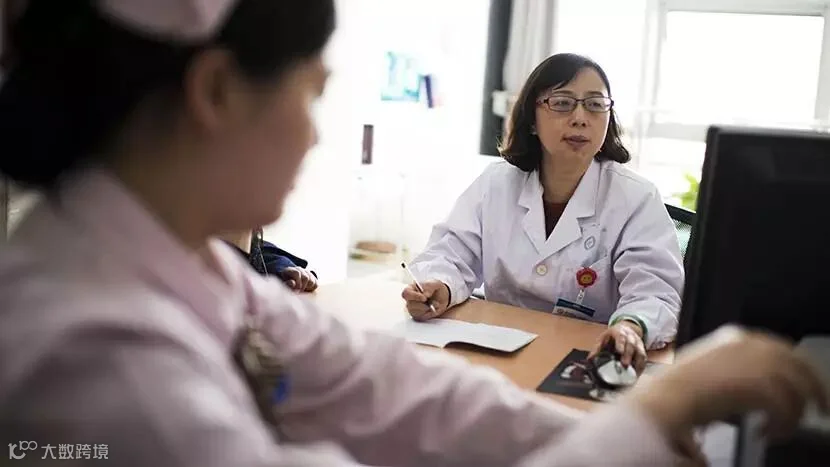
A senior doctor, Guo Yihong, in her office, in Zhengzhou, Henan province, March 24, 2016. Guo spends four to five minutes on average with each patient. She sees 80 to 90 patients per half day. Wu Yue/Sixth Tone
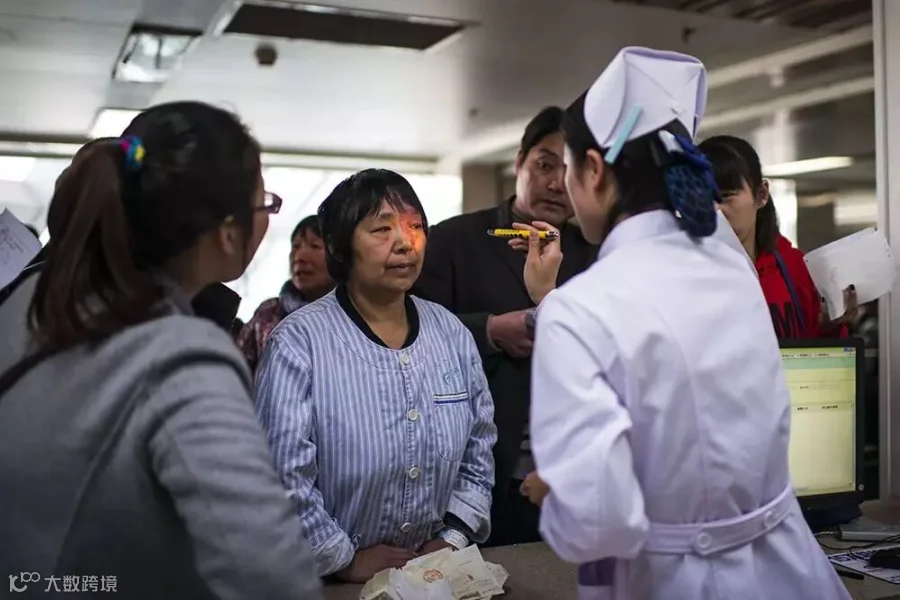
In this sea of people, privacy is swept away. A nurse shines a light into the eyes of a female patient, surrounded by crowds of people anxious to have their query answered or to be assigned an appointment with a doctor. Frustration hangs in the air, and there are tired and weary faces all around. Elsewhere in the hospital, consultations on personal issues such as infertility take place within earshot of bystanders. With crowds everywhere, the task of getting to a medical appointment or visiting a sick relative can be a logistical nightmare. On one floor scores of people push to squeeze into an elevator designed to accommodate a dozen at most while others simultaneously shove to get out. People are shouting, and someone thrusts a red plastic basket containing flowers and fruits high above the bobbing heads to keep its contents safe. In the tussle, one young woman accidentally drops her national identity card on the floor. She scoops it up swiftly before re-entering the battle to board the lift.
To continue reading click the 'Read more' link at the bottom of the screen to go to the original article.
Additional reporting by Cai Yiwen. Video and photography by Wu Yue.
(Header image:A crowd watches an eye examination administered to a patient at Zhengzhou First in Zhengzhou, Henan province, March 24, 2016. Wu Yue/Sixth Tone)