
A devastating warehouse explosion last August has put the middle-class aspirations of Tianjin’s Harbor City residents on hold.
By Shao Yuanyuan
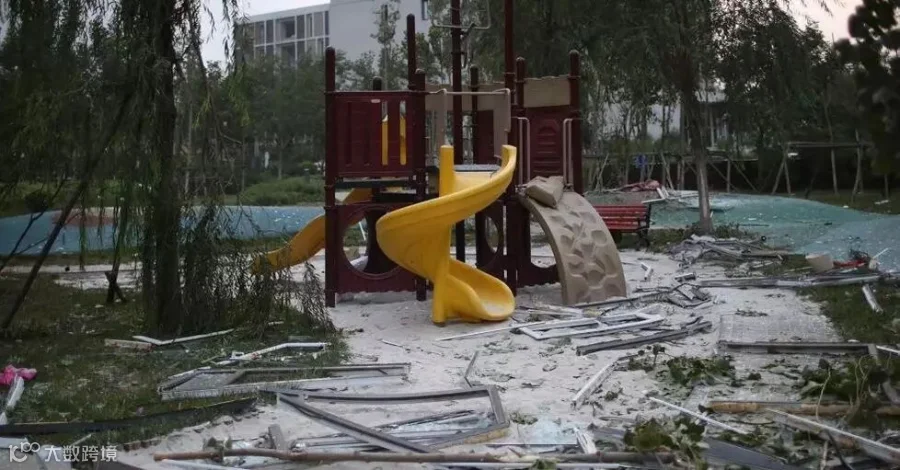
Five days after the explosion, Shu Chang returned to his apartment in Tianjin’s Harbor City.
It was like walking through a deserted landfill. The ground was covered in shattered glass and pieces of broken furniture. The buildings had been stripped of the decorative finish which originally covered their outer walls, exposing bare concrete beneath. Nearby lay the wreckage of an SUV. As Shu made his way through the compound, he found himself stepping here and there on doors that had been blown off their hinges and into the street. He was momentarily startled when one of these suddenly gave way underfoot with a loud crack.
Shu reached Building 26 — once so familiar to him — and stepped inside. The lobby was in complete shambles, though a sign in red letters reading “Welcome home!” had somehow survived unscathed. The elevator was now useless, and all along the hallways there were shards of glass wedged into the walls. Shu began the long climb up the stairs. As he turned the corner at each landing, he caught a brief glimpse of his neighbors’ front doors between the flights of stairs. Some were marked with the deep red of bloody fingerprints.
Harbor City had always been peaceful, but now it was eerily silent.
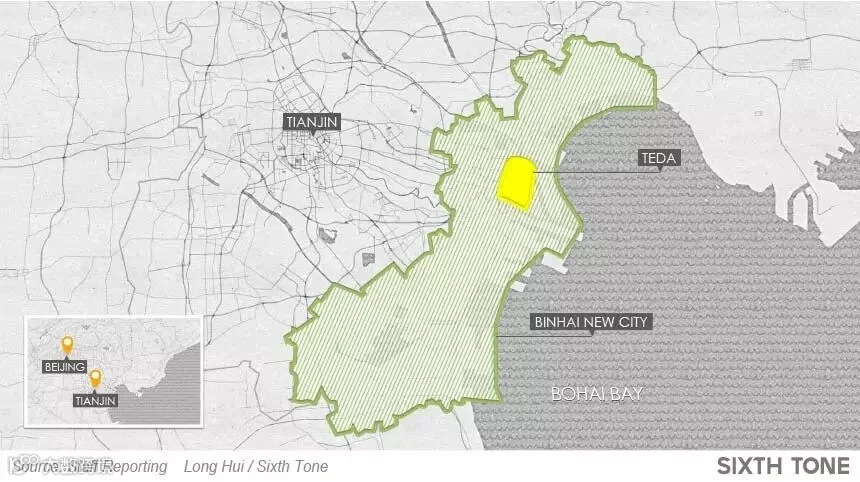
It happened half an hour before midnight on August 12, 2015, in Binhai New City, Tianjin. A shipment of ammonium nitrate exploded at Ruihai Logistics, an 11-acre logistics yard that handled hazardous chemicals. The resulting fireball billowed several hundred meters high.
Some 165 people died, and eight people are still missing. Over half of the dead were firefighters trying to extinguish the flames that had started some 40 minutes earlier. Part of the blame rests on the lax oversight of China’s chemical industry: Ruihai had long operated without the proper licenses, and the firefighters had arrived to put out what was called in as a regular fire, unaware of the dangerous chemicals being stored at the site.
Equally caught by surprise were the people living near Ruihai Logistics. Young, middle-class families had bought their own pieces of utopia in Binhai’s many gated communities. One of these, Harbor City, was an ordinary gated community in most ways: modern architecture, an abundance of green space, and shielded from the noisy, chaotic world outside. It was also located just a few hundred meters from Ruihai Logistics — too close for comfort.
On August 12, the security guards and high walls of Harbor City were not enough to protect the occupants and their middle-class dreams.
Salt Flats to High-Rises
As the Hai River makes it way downstream from Tianjin’s city center, it snakes through Binhai New City’s endless jungle of brand-new concrete, before eventually flowing past the Tianjin port and into Bohai Bay. Just a few decades ago, what would become Binhai was a vast, barren marshland — the land between Tianjin’s city and its port was too salty for anything to grow.
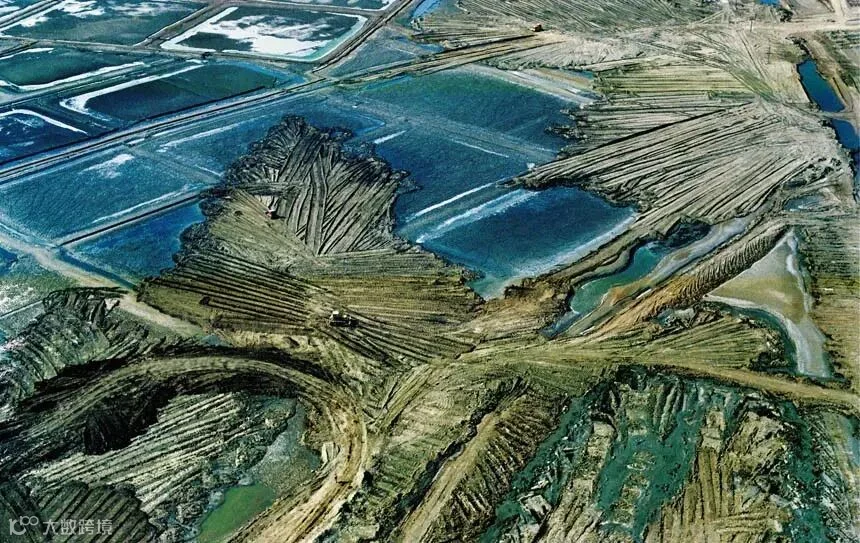
An aerial photo taken in 1988 shows early landscaping work on the mudflats that would become Binhai New City. IC
All of that was to change when, on December 6, 1984, China’s government ratified the establishment of the Tianjin Economic-Technological Development Area, abbreviated as TEDA, and later nicknamed “Taida” in Chinese. Areas like this were to pull the proverbial cart of China’s new economy. Here, the alien concepts of the free market were given free reign before they were to be unleashed on the whole country. For now, though, Taida was just large tracts of mud.
It took a while for development to truly take off. The first road sank into the ground when warm spring weather thawed the salt flats underneath, and whenever the wind blew from the wrong direction, dust from nearby Tianjin harbor’s coal depots would envelop Taida in darkness. In the first few years a disappointing number of companies had opened shop, and only some one hundred people lived in Taida — many of them hoping to leave as soon as possible.
Deng Xiaoping, China’s leader at the time, was nonetheless optimistic when he came to inspect the area in 1986. The words he uttered then, “There is great hope for the development area,” are now enshrined on a stone plaque on Dongting Road, Taida’s first north-south thoroughfare. Dongting Road intersects First Street, the first of many numbered east-west avenues. Years of successive building projects later, this strip, barely a kilometer in length, became home to all sorts of facilities, including a stock exchange, a customs office, and the world’s first golf course built on a salt flat.
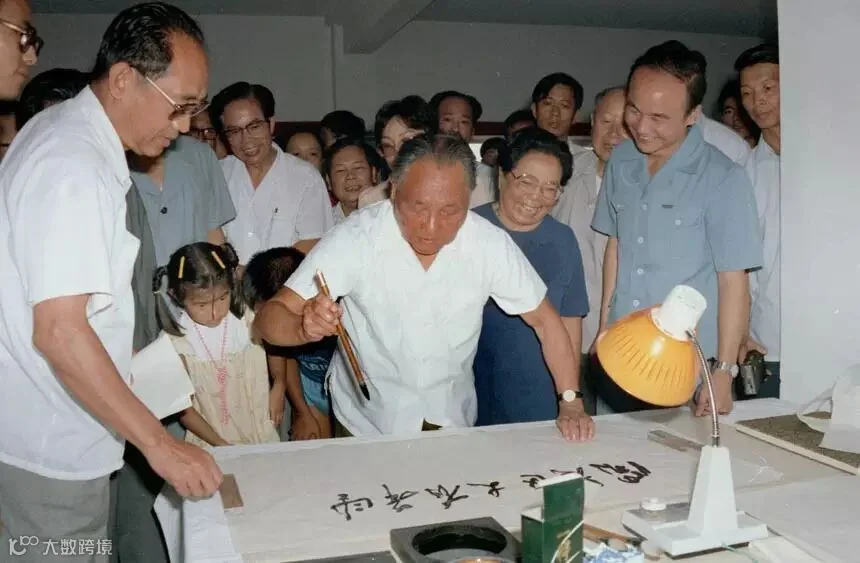
Deng Xiaoping writes “There is great hope for the development area” in calligraphy during an inspection tour of Taida, Aug. 21, 1986. Xinhua
Tianjin harbor, ideally placed to serve Beijing and much of northern China, grew alongside Taida. High salaries lured many young men to Tianjin’s cargo docks, from places like Dezhou, Shandong province, 200 kilometers to the south. Among these was 23-year-old Liu Zhai. At the time laborers needed to go through a medical check to make sure they were tall (above 1.70 meters) and strong (at least 60 kilograms) enough. Liu was tall and strong, but still he drank plenty of water before the check-up to make sure he would be heavy enough, and soon he was on a coach headed to the port of Tianjin. When he arrived, he found there was work in abundance — if not at the docks, then in construction. Liu was making three to four times what he used to earn back home. After three years his wife joined him in Tianjin, and, like many others from Dezhou, they have not left since.
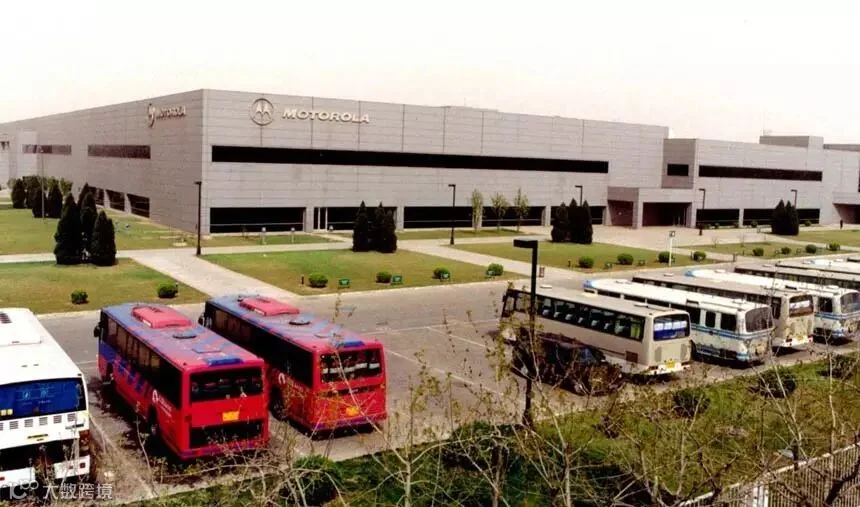
Motorola’s factory in Taida, Oct. 2002. Gu Yu/VCG
1992 was a turning point for Taida, the year wholly foreign-owned enterprises were allowed to open businesses in the area. U.S. telecom giant Motorola was the first to open a factory, and Samsung, Coca-Cola, Nestlé, and other major corporations followed in quick succession. Nevertheless, the development area was still a remote location to work in. If you managed to hail the elusive 621 bus, it would be a long three hours before you reached Tianjin’s city center.
When Taida was still in its infancy, white-collar workers sent to work in this faraway place would do whatever they could to engineer a transfer back to the city — a move they would later come to regret. When in 1995 Xiang Genghui started his job at Tianjin’s bureau of construction to work on Taida’s development, his dispatch letter said he was “to take part in the work of the revolution.” The phrasing could not have been a more inaccurate description for what the area was starting to look like. Taida, with its foreign, high-tech companies and its progressive policies, fully enjoyed the fruits of China’s economic upswing. After the turn of the millennium, landing a job in Taida became a competitive affair. A middle class — something long unheard of in China — was forming. Many couldn’t wait to join, and Xiang was glad he had never left.
When Zhao An left the military for a position as a security guard at the Warner International Golf Club on First Street, the club was still surrounded by vacant plots of land. Later, Zhao made a career change into real estate. He was always anxious that the property market in the new district was saturated — yet it would never take long for another construction site to spring up. Unlike before, when a stray golf ball would have landed on wet wasteland, errant golf balls were now making contact with the windows of neighboring high-rise apartments.
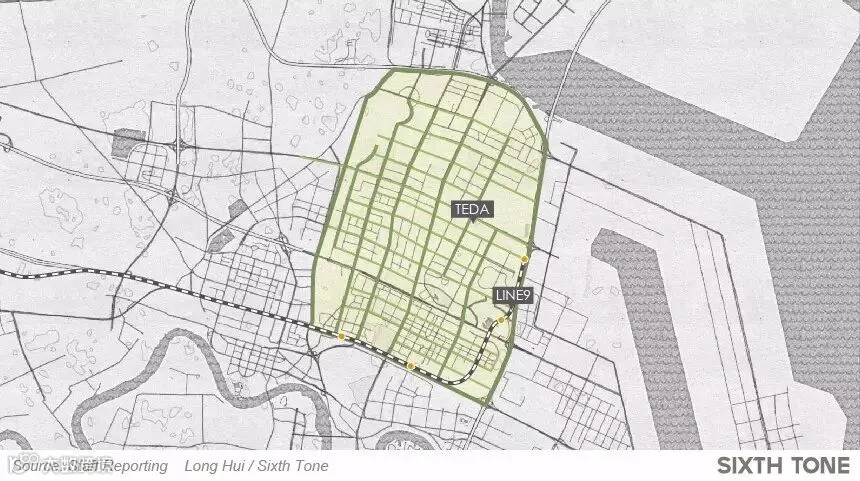
In 2004 the Tianjin subway expanded to reach Taida. Line 9 cut travel times between Tianjin and Taida to just 40 minutes, and passenger numbers soared. Jiang Ru became a conductor in 2005, and during his countless 40-minute journeys on the elevated Line 9, he was a witness to Taida’s continuous growth. The barren salt flats that had once flanked the route gradually turned into 30-story buildings as far as the eye could see.
New District Residents
Xiang Genghui had made a career at the Tianjin bureau of construction, and he was living right in the center of Taida, the area that he had helped build. He had taken out a mortgage and bought a house on First Street. The location was his wife’s idea. She liked Taida for its peace and quiet, wide roads, new apartments, and abundant greenery. In November 2009, Taida and its surrounding areas were merged to form the Binhai New District. Xiang began referring to himself as a “new district resident.” There was something magical about this term, and he could not help but feel an upwelling of pride whenever he introduced himself this way.
In addition to locals and Chinese from all over the country, many new district residents hailed from Taiwan, Hong Kong, Europe, and the U.S., giving the area an international atmosphere. Chinese who moved to the area felt like they had left China and arrived in an entirely new place, where restaurant staff would greet customers with “Hello, sir,” or “Hello, miss.” The companies that opened in Taida had also become more sophisticated. On Fifth Street, a new industrial park housed China’s National Supercomputing Center and its latest, fastest computer: Tianhe-1.
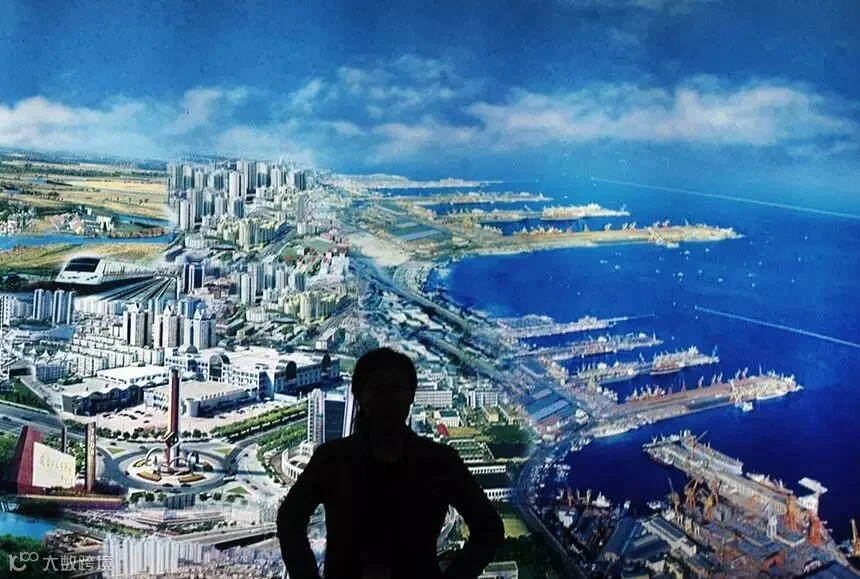
A man stands in front of a poster of Binhai New District, April 18, 2006. Xiaochunhu/VCG
The year Binhai New District opened its doors was also the year that Wen Feng graduated from Chengdu University of Technology and set his sights on making it in the big city. He had once read a biography of Deng Xiaoping, and the phrase “There is great hope for the development area” had stuck in his memory. Wen made his first trip to Taida the following year for a job interview. Afterwards, he decided he wanted to see the sea. He bought a map and estimated that it shouldn’t take too long to reach the shore. But after walking for over an hour, he had only made it to the Hai River Bridge, with the sea still nowhere in sight. His map was out of date — due to ongoing land reclamation projects, Binhai New Distrct had grown by 110 square kilometers.
Wen didn’t see the sea that day, but while he was out on his search for the shore he received a phone call saying he had got the job. Standing alone on the Hai River Bridge in the frigid March weather, Wen felt the bridge sway gently beneath his feet as a truck rolled by, dragging a cloud of swirling dust in its wake. Wen peered into the distance along the Hai River. He was convinced the sea lay at the far end.
Zhang Jie, a Tianjin native, started working as a nurse at the Taida hospital in 2007. At the time it was rare for medical students to leave Tianjin for Taida. The city was home to several top-tier hospitals, but Zhang was stubbornly insistent: She did not want her relatives living in the city to expect her help every time they wished to see a doctor. She wanted to escape to a new environment. Before long she fell in love with a colleague, Guo Shanyi, and rarely had a reason to visit Tianjin.
Guo hailed from northern Shaanxi province. There was a constant influx of people like him, who came from all over the country to Taida’s land of opportunity. Domestic migrants accounted for over 80 percent of Binhai’s population. Attracted by Taida’s supply of jobs and relatively low property prices, they made Binhai an extremely young and well-educated city. A survey in 2007 revealed that over 60 percent of the population was between 18 and 29 years of age, while people over 60 accounted for a mere 2 percent. One-third of the population had received higher education, a proportion much larger than the national average.
Signs indicating that the area was flourishing were evident wherever one looked. A succession of malls and leisure centers were opening their doors. Construction began in 2009 on the Chow Tai Fook Binhai Center that, once completed, will be Binhai’s tallest skyscraper at 530 meters. The Japanese shopping mall Aeon opened in 2010, and the high-end Taida Mall opened for business at the end of 2014. A large, middle-class neighborhood began to take root in central Binhai.
To continue reading click the 'Read more' link at the bottom of the screen to go to the original article.
(Some names have been changed in accordance with requests from persons interviewed, who feared retribution from their employers.)
(Header image: Window frames were blown to the outdoor recreation area at Vanke Harbor City, 14 August 2015. Quan Yi/Sixth Tone)