
Recent regulations state test-takers with disabilities should be accommodated, but braille papers will not be available for another year.
By Wang Yiwei
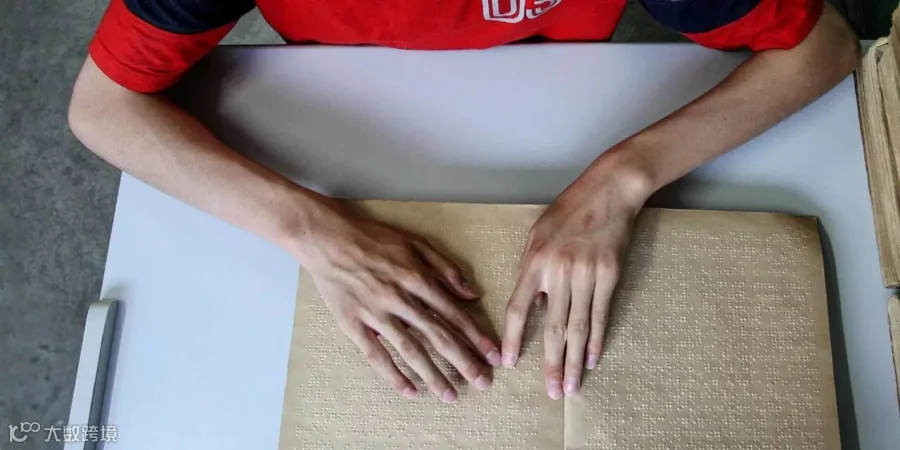
A college student sued the Ministry of Education on Wednesday, asking that students with disabilities be guaranteed the right to take national tests.
The plaintiff, surnamed Luo, is a senior year student at Changchun University (in China’s northeastern Liaoning province) who is blind. Her lawsuit stems from a lack of braille test papers, a situation that has left her unable to sit for the CET-4, a standardized English test for college students that she wants to take to apply for a master’s degree program later this year.
“If I had a choice, I wouldn’t want to bring a suit against anyone,” Luo told Sixth Tone, “but I have done everything I could and tried in every way, and that does not solve the problem.”
Luo first tried to take the test in late 2016. “When I attended the exam, and was told there were no braille papers available, it was so embarrassing,” she said. Luo and another classmate had no option but to leave the examination room, as they couldn’t read the ordinary test papers.
Luo registered again in March for the test, and sent requests to the local education bureau and to the Ministry of Education to provide braille testpapers — both of which failed to elicit replies. Luo then sent a disclosure of information request to the bureau in which she asked to see its “reasonable accommodation” policies for students with disabilities. Such policies originated in the U.S. — their purpose is to ensure that the special needs of people with disabilities are met, as long as their requests are reasonable.
But Luo’s request was denied in April on the grounds that the information she asked for “is not classified as government information.” Luo is worried she will not be able to sit for the next test, to be held in June.
In her lawsuit, Luo argues that the Ministry of Education should disclose its “reasonable accommodation” policies for CET-4 tests. Luo asked for just her family name to be used, because although the Beijing First Intermediate People’s Court has accepted the case, the date for the first hearing has not yet been set, and as such the lawsuit has not yet been made public.
Zhang Yujuan, Luo’s lawyer, told Sixth Tone that providing braille papers for students with visual impairments is a legal obligation. “The real problem is the lack of awareness and implementation in the government,” she said.
According to a law revised in 2008, national exams — including school entrance exams — should provide braille papers, electronic papers, or professional aids to people who are visually impaired. Regulations effective since May 1 also state that a disabled person has the right to apply for reasonable accommodation in national exams, and that examination institutions as well as schools should provide support as requested.
The National Education Examinations Authority, a subordinate body of the Ministry of Education, has told Luo that braille testpapers will be available June 2018, at the earliest. The authority, as well as the ministry, could not immediately be reached for comment on Thursday.
A lack of suitable test papers for the university entrance exam, the gaokao, also meant Luo was limited in her choice of undergraduate majors. “I had been dreaming of studying applied psychology,” Luo said. “I would have applied for the degree if I had the chance to take the college entrance exam.”
Luo said that in 2013 her only options were music, or acupuncture and massage. Reluctantly choosing the latter, she took courses related to psychology in preparation for a master application. A year later, in 2014, braille test papers became available for the gaokao, opening up more majors to people with limited vision.
Apart from test papers, another barrier standing in Luo’s way is the physical examination students need to undergo when applying for a master’s degree. According to the 2003 guidelines that are still in force, schools may turn down people with visual impairments for a number of majors, including applied psychology.
Zhang, Luo’s lawyer, said she had previously taken on two cases where people with disabilities were denied the rights enjoyed by able-bodied people. She settled one case, but lost the other because a government regulation was found to be in the defendant’s favor. “When the government drafts regulations, they seldom take into consideration the needs of people with disabilities,” Zhang said.
People with a visual impairment regularly take government departments to court over what they argue is unfair treatment. A teacher in the eastern province of Zhejiang won her lawsuit against the local education authority in March after she was denied her teaching qualifications due to blindness in one eye. Late last year a migrant worker in Shenzhen, southern China, brought a case to the provincial high court because his residence application had been denied on the grounds of his disability.
Compared to winning the case, Luo is more concerned about her future. “All I need is a piece of paper, a right to take the test,” she said.
Editor: Kevin Schoenmakers.
(Header image: A visually impaired student reads braille in Zhengzhou, Henan province, May 16, 2007. Shi Peng/VCG)
You may also like:
For Blind Students, Braille Exams Pave Way to Higher Education
Visually Impaired Top Student Rejected for Hunan Government Job
Didi's Uber App Overlooks Visually Impaired Users