
Stories from China’s former boomtowns
Words: Wang Yun Photos: Chen Ronghui
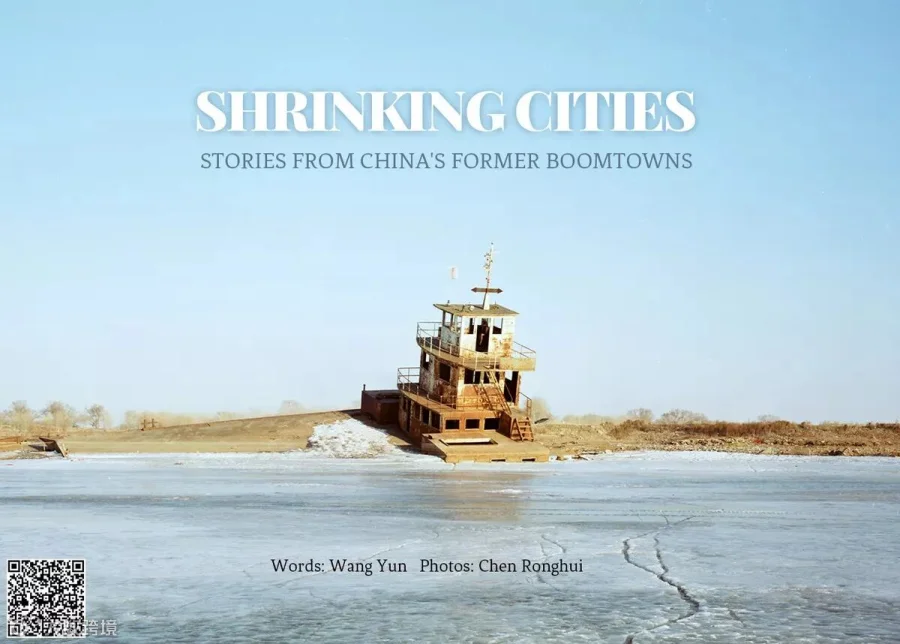
China is an urbanizing country. In the 40 years since shaking off the planned economy and launching the reform and opening-up period, hordes of country-dwellers have migrated to cities, swelling the ranks of a so-called floating population that numbers some 245 million people.
But is that the whole story?
We’re used to thinking of Chinese cities in the context of growth. But behind this statement lurks the assumption that urbanization is constant, uniform, and predictable. In reality, dying industries and shortages of opportunities are forcing people out of certain urban areas.
China’s shrinking cities have captured the attention of researchers, who applied big data techniques to a swath of the country’s urban areas in order to identify shifts in population density over a period of 10 years. Of the 654 cities they studied, 180 have shrunk in the last decade. Yet on a planning level, officials still treat these cities as though they were growing.
Much like aging and death, the decline of cities is almost a taboo subject in a country whose modern-day national myth revolves around development. But urban decline is a natural part of the life cycle of many cities, especially those that were established to exploit now-dwindling natural resources.
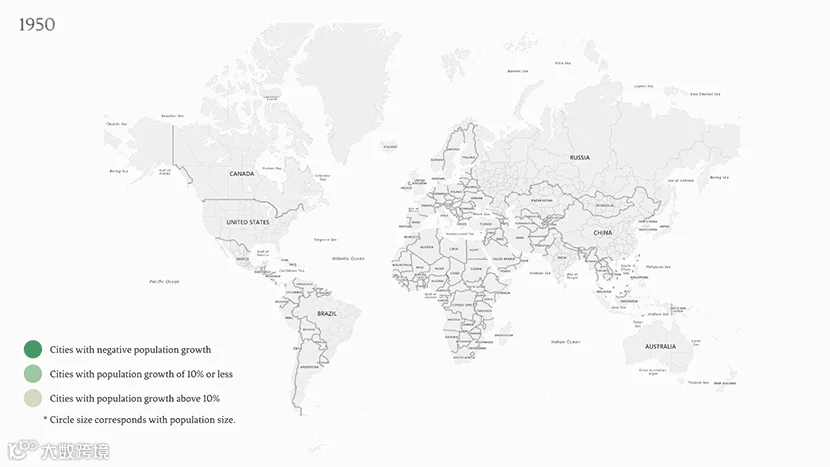 Map showing population growth of cities with at least 300,000 inhabitants (1950–2030).
(Source: United Nations Population Division, “World Urbanization Prospects: The 2014 Revision.”)
Shrinking cities in China form part of a larger global trend. Research shows that after World War II, many of the great industrial cities of Europe and North America began to decrease in size, particularly during the 1970s. By 1990, 70 percent of shrinking cities were found in industrialized nations — the majority in the United States, the United Kingdom, and Germany. With the collapse of the Soviet Union in the early ’90s, the number of such cities in Russia and Eastern Europe exploded, doubling over the course of the decade. By 2000, a quarter of all cities around the world with a population in excess of 1 million had begun to show signs of shrinking.
Globally, this phenomenon has attracted the attention of researchers and artists alike. As urban districts shrink, they offer a wide variety of material for research, including economic development, social differentiation, infrastructure construction, and even racial and class conflict. U.S. President Donald Trump, for example, won last year’s election largely by convincing white, working-class voters from the country’s postindustrial Midwest to throw their support behind him.
We wanted to go out and observe this phenomenon in China. We visited smaller, once-thriving cities that now represent broader trends of urban decline. Our goal was to identify the changes working through these cities and describe the challenges they face.
To continue reading, click 'Read More' at the bottom of the screen to go to the original interactive article.
You may also want to read:
Reflections from the Rustbelt: A Laid-off Worker's Story
Hu Line: Journey Through China's Heartland
A Farewell to Arms: The Declining Weapons City of My Childhood
Want to get Sixth Tone stories delivered to your email?

Subscribe to our newsletter for a weekly roundup of the latest news and trending topics from China.
Sign up here: http://ow.ly/zgv530cPeV4 (Copy and paste the URL into your browser)