


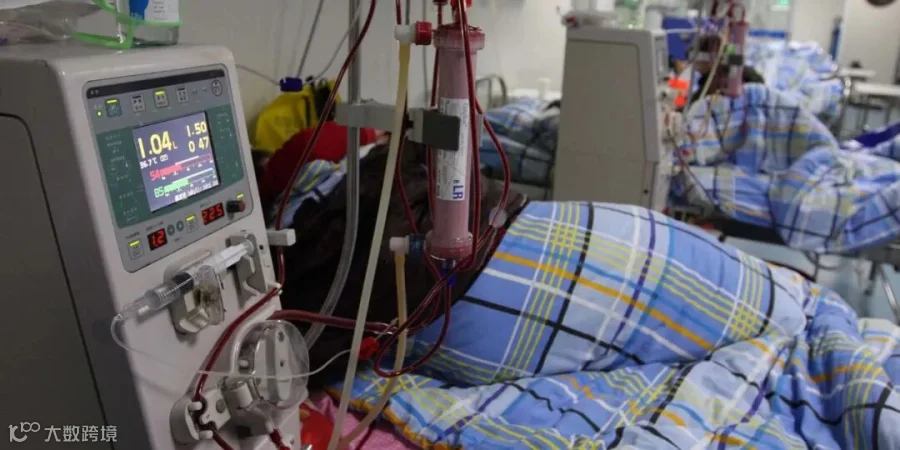
Authorities said the infections were caused by ‘negligent management’ at Dongtai People’s Hospital, but staff told Sixth Tone the hospital’s blood center continues to operate as normal
By Fu Danni

Health authorities in eastern China’s Jiangsu province confirmed Monday that 69 dialysis patients were infected with the hepatitis C virus (HCV) at Dongtai People’s Hospital due to “nosocomial infection resulting from negligent management,” according to a notice from the local government.
The first infections were detected in April, but the precise cause is still being investigated, financial news outlet Caixin reported. Dongtai People’s Hospital, founded in 1950 and affiliated with Nantong University, currently remains open.
A staff member from the hospital’s administrative office told Sixth Tone on Monday that the facility’s blood center — which provides treatments such as dialysis for patients with kidney disease — is also open and operating as normal. She refused to comment on the HCV infections, instead referring Sixth Tone to the hospital’s vice president, Yang Maocheng, whom she said was responsible for handling media requests pertaining to the case. Sixth Tone’s repeated phone calls to the number she provided for Yang went unanswered.
The infections may have been caused by staff giving multiple patients injections of heparin, an anticoagulant used in dialysis, with the same unsterilized syringes, according to an article by business news outlet Jiemian, which cited an anonymous expert familiar with the case.
Hepatitis is prevalent in China. According to the World Health Organization, the country is home to around one-third of the world’s hepatitis B carriers. Though less common, the hepatitis C virus can have similar health consequences, including liver disease that lasts only a few weeks to a chronic condition affecting the carrier for life. Over 185 million people around the world carry HCV, which accounts for around 350,000 deaths each year.
Although HCV can be sexually transmitted or passed from an infected mother to her baby, the WHO says the most common means of transmission are injecting medicine using unsterilized equipment and receiving transfusions of unscreened blood and blood products.
From 1996 to 2016, 17 cases of HCV infections were reported in China, 10 of which were linked to dialysis, according to research cited by China Newsweek. In February 2016, 26 people were infected with HCV during dialysis at a county-level hospital in Shaanxi province.
A 51-year-old woman surnamed Cheng is one of the 447,000 people in China being treated with dialysis. Since 2008, when her kidneys started failing, she has required dialysis three or four times a week in the eastern city of Hangzhou. But after noticing that her local hospital didn’t seem to be treating hepatitis patients in a separate space from uninfected patients as is required, Cheng decided to travel to one of the best medical facilities in the city — the First Affiliated Hospital of Zhejiang University’s School of Medicine — even though it takes her at least 50 minutes by taxi to get there.
“To make sure it’s safe, I have to travel three times farther, incurring high travel expenses, to the largest dialysis center in the province. The process there is standardized,” Cheng told Sixth Tone. “It’s exhausting, but (nosocomial infection) will happen sooner or later if the hospital doesn’t follow the proper protocol.”
Dialysis isn’t the only source of hospital-acquired infections to make headlines recently. Earlier this month, five newborn babies died at a hospital in Guangdong province after contracting Echovirus 11, a fecal-oral intestinal virus to which babies and people with weakened immune systems are especially vulnerable.
Cheng Ting-yi, an expert in hospital management, told Sixth Tone in a previous interview that the likelihood of hospital-acquired infection can be reduced by rethinking the layout of certain wards — a policy as simple as ensuring that infants are kept isolated from sick patients, for example.
Three top administrators at Dongtai People’s Hospital have been removed from their posts, according to Monday’s government notice, and a wider investigation into the risk of nosocomial infection is currently being conducted throughout the city.
Editor: David Paulk.
(Header image: A dialysis machine at a hospital in Loudi, Hunan province, Feb. 2, 2010. VCG)
Want to get Sixth Tone stories delivered to your email?

Subscribe to our newsletter for a weekly roundup of the latest news and trending topics from China.
Sign up here:
http://ow.ly/zgv530cPeV4
(Copy and paste the URL into your browser)