


Firstly, let me share three new findings in our latest research :
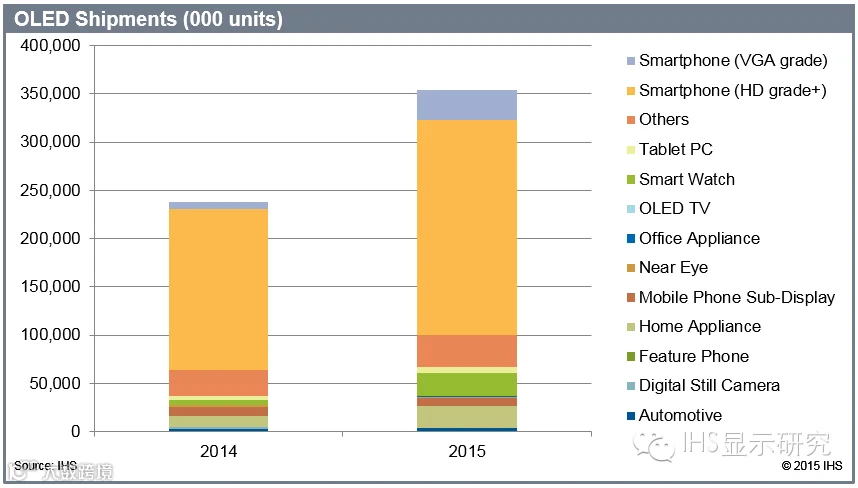
OLED shipments will grow from 237 million in 2014 to 354 million in 2015, up 49% Y/Y.
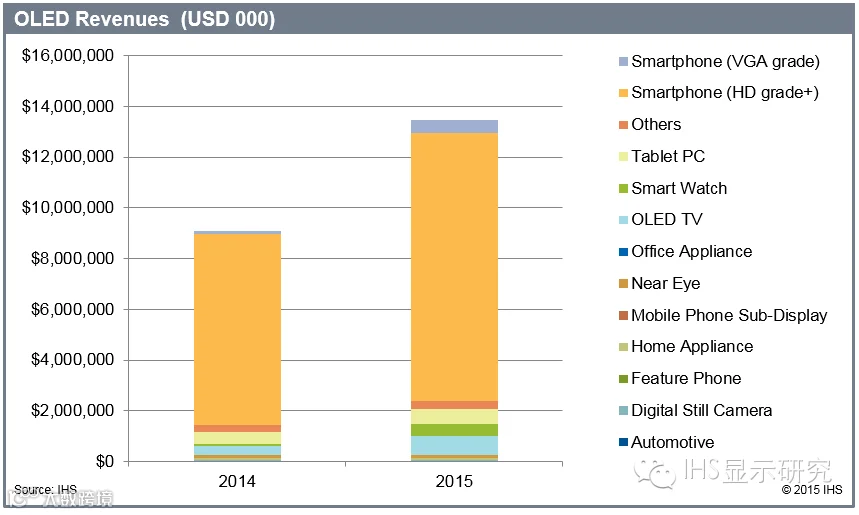
OLED revenues will grow from $9.1 billion in 2014 to $13.5 billion in 2015, up 48% Y/Y.
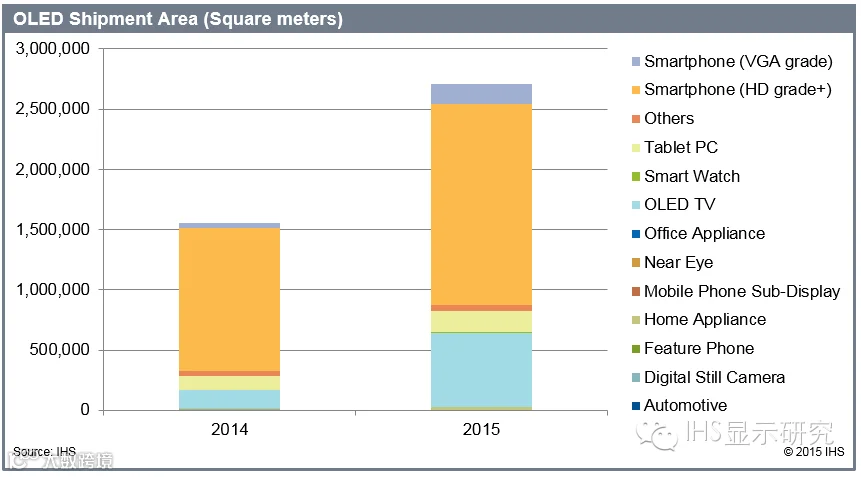
OLED shipment area will grow from 1.6 million square meters in 2014 to 2.7 million square meters in 2015, up 74% Y/Y.
While people are talking about the maturity in the consumer electronics devices and the slowdown demand growth resulting from the sluggish replacement cycle, OLED, as a new display technology, seems perform well and rapidly taking a seat in the components world.
Organic Light Emitting Diode (OLED) displays were previously seen as a controversial technology. Compared to the dominant TFT LCD technology, the cost and technology challenges of OLED were much greater. The ecosystem had not reached the same scale of LCD. There were fewer component and material suppliers, and manufacturing processes were immature. OLED also required more complicated knowledge of chemicals to produce a qualified panel.
OLED is actually a simpler structure than LCD, and its picture performance and form factor are also an improvement. OLED is slimmer and functions well in flexible form factors. The color gamut is naturally high, unlike the artificial adjustments of LCD. The contrast ratio is also great, and the response time of the picture is excellent. Because of these qualities, OLED was soon recognized as the candidate to replace LCD.
However, many display suppliers developed OLED, but then gave up due to challenges in achieving economic scale or a competitive advantage. Through the years, the obstacles to OLED development have remained to be economic scale, production efficiency, yield rate management, high cost, and lifetime of the light emitting materials. Samsung Display, dominant in AMOLED (Active Matrix OLED) technology for handheld devices, set a goal on producing OLED TV panels. However, it had to shift focus back to high performance LCD. Companies like AUO and Innolux also developed AMOLED for smartphone displays, but then changed their minds due to cost challenges, especially compared to LCD.
However, in 2015, everything changed. As observed in the OLED Display Market Tracker, this has been the most remarkable year for OLED in terms of shipments, revenues, and shipment area. OLED has started to find its niche in many applications like smartphones, smart watches, automotive displays, home appliances, near-eye virtual reality devices, and even TV. This will attract more device makers to install OLED in their products. Consumers are also becoming more aware of the benefits of OLED. As a result, display manufacturers have been putting more resources into OLED displays, especially in China, and OLED is facing tremendous growth potential. The facts, as I’ve disclosed in the beginning of this article, 2015 is a booming year for OLED.
The Samsung group has been using AMOLED as an important differentiator in its proprietary Galaxy smartphones. Samsung Display provides state-of-the-art AMOLED displays to Samsung Mobile to help the smartphone achieve outstanding color performance, on-cell touch, and slim and light form factors. Curved, flexible, and foldable features are also expected in the near future.
To expand market adoption, Samsung Display changed its smartphone AMOLED display strategy this year and started to sell to external customers. From the second half of 2015, more smartphone brands, especially in China, installed AMOLED in their devices, supported by Samsung Display. Products like Google Nexus 6P, Microsoft Lumia 950XL, Meizhu Pro 5, and the recently announced BlackBerry Priv smartphone all have AMOLED displays. We believe more brands will follow, including Huawei, HTC, ZTE, Oppo, and Coolpad.
LG Display continues to focus on OLED TV and is starting to overcome manufacturing challenges for large size TV displays with high pixel densities like 4K. As a result, 55”, 65”, and 77” OLED TVs are emerging. Tablet PC OLED panels have also had a healthy growth pattern in 2015, as more consumers are recognizing the benefits of AMOLED, such as lower power consumption, better color performance, and slimmer form factor.
AMOLED is also being applied to wearable devices and home appliance displays. The Apple smartwatch uses a flexible AMOLED, like Samsung’s and LG’s smart watches. And Passive Matrix OLED (PMOLED) is showing up more in automotive displays. OLED also shows an advantage in virtual reality and augmented reality devices, especially in terms of power consumption, near-eye performance, and contrast ratio.
We see OLED growth in the following areas in the future:
Smartphones: We have reason to believe that Apple is considering OLED as a display source for its iPhone in 2017 or 2018. If Apple did use OLED, the OLED can be a real threat to replace LCD, especially in the smartphone display arena.
Flexible or foldable: This is an important feature for OLED and will be shown in 2016.
TV: OLED scale will further expand, thanks to process improvements and production efficiency enhancements, as well as the organic light emitting materials layers improvement. We also judge that Samsung, as a leading TV brand, will rejuvenate their OLED TV development in the near future.
Smart watches
Automotive displays: The central information display in cars will feature OLED in the next couple of years.
本平台即原“DisplaySearch”官微,仍将每周推送最新的平板显示产业研究成果和研讨会资讯。欢迎再次关注!