


This article is part of a series on how Chinese people deal with death.
SHANGHAI — It’s a breezy April morning when the Hu Hang No. 17 sets out into the Yangtze River estuary, chugging through calm waves and faint sunshine. On board are nearly 200 people carrying the ashes of their loved ones.
Teng Fei, 31, cries in her seat as she hugs a bag containing the remains of her 2-year-old son, Gu Tengyang. Pasted on the bag is a photo of a little boy, smiling and holding a popsicle. Teng tells Sixth Tone that he died in February after he was hit by a truck in front of his sister’s primary school.
You can listen to an audio version of this article via “China Stories,” a SupChina-produced podcast sharing the best writing on China. Subscribe on Apple Podcasts, Spotify, or wherever you get your podcasts.
The ferry’s destination is a stretch of water near Changxing Island that the State Oceanic Administration has officially designated for sea burials. There, the river flows into the East China Sea, ensuring that ashes scatter rather than drop to the seafloor. Because there are only a handful of officially sanctioned sites in the country, the municipal government allows people from nearby cities to conduct sea burials in the waters around Shanghai. Today, 83 people from Changzhou, in neighboring Jiangsu province, will have their ashes buried beneath the waves.
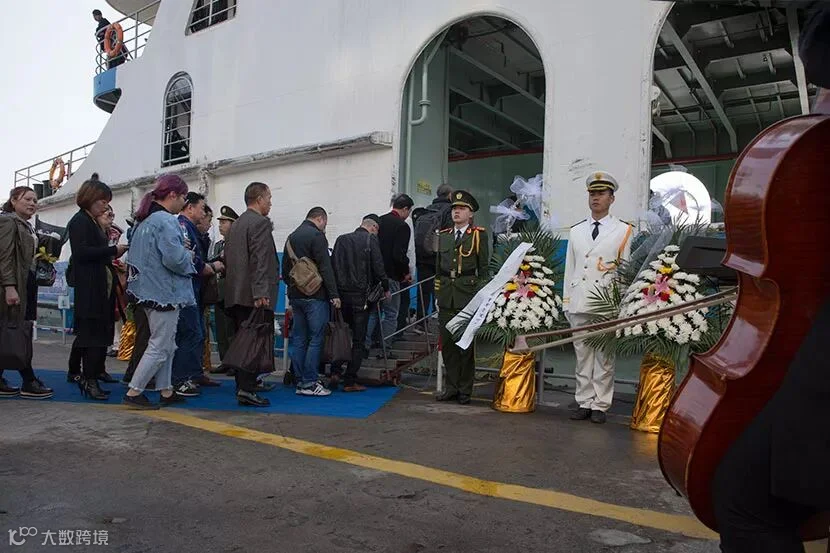 Families from Changzhou board a ferry for a mass sea burial at a dock in Shanghai, April 1, 2018. Shi Yangkun/Sixth Tone
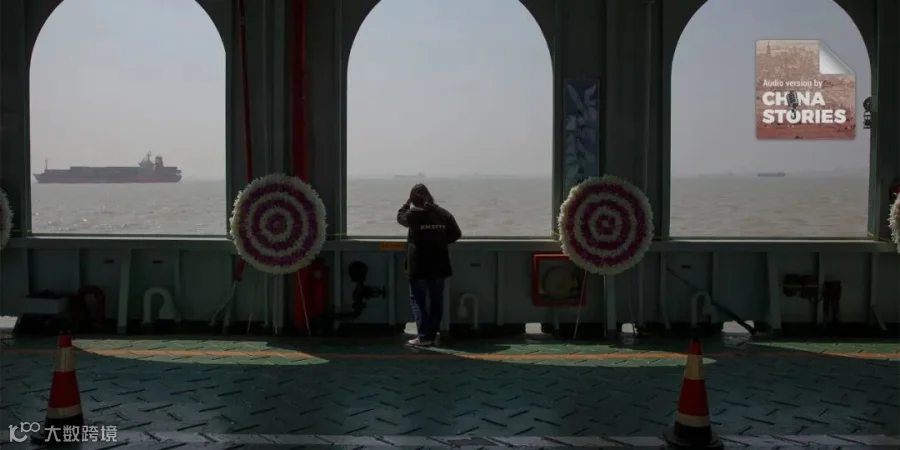
Teng bows three times to her bag before slowly scattering her son’s remains into the water below. She then walks to the stern to watch the flower petals drift into the distance. “Although I hate to part with him, I don’t want a land grave that will constrain him. I don’t want him to worry about us or this lifetime,” Teng says, sobbing. “A sea burial will set his soul free so he can be reborn quickly as another family’s child.”
Sea burials are a relatively new phenomenon in China, brought to the public’s attention by top political figures Zhou Enlai and Deng Xiaoping, who chose to have their ashes scattered at sea when they died in 1976 and 1997, respectively. In 1991, Shanghai became the first Chinese city to authorize sea burials. By the end of last year, the remains of about 40,000 people had been laid to rest in the East China Sea. Numbers are increasing every year, and currently about 2 percent of funerals are sea burials. The practice helps ensure that all city residents have a final resting place, Zhang Songjie, researcher at the Shanghai Civil Affairs Bureau’s funeral and burial management division, tells Sixth Tone. “With Shanghai’s lack of land and its large, rapidly aging population, the scarcity of land for burials is worsening every day,” he says.
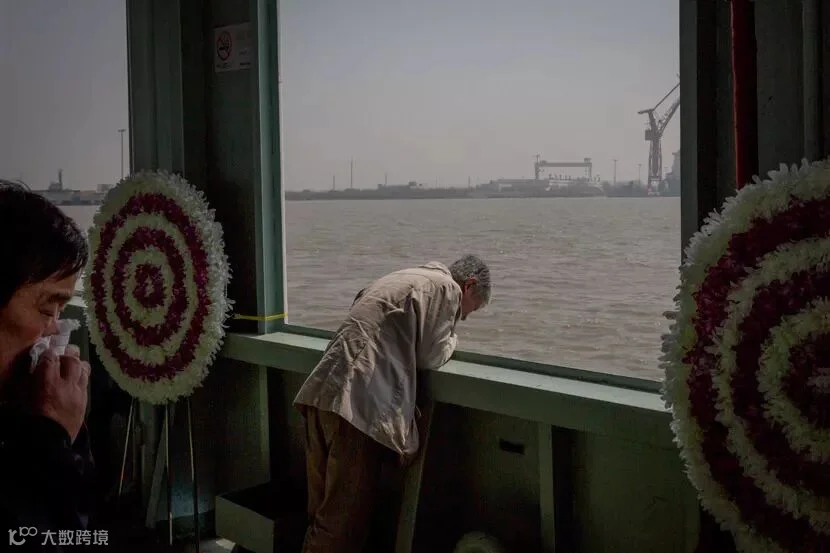 People weep after a sea burial in Shanghai, April 1, 2018. Shi Yangkun/Sixth Tone
Back in 2004, Li wrote a blog post about his family’s sea burial experience on Oldkid, a Shanghai-based online forum aimed at elderly people. The post received a lot of attention, and people curious about being buried at sea have continued to seek out Li for information. Based on their stories, Li says people usually make the choice because they don’t have a lot of money, don’t want to have a complicated traditional funeral, or have an affinity for the sea. It’s also a solution for people without children or whose children live abroad and cannot regularly tend their graves.
Still, sea burials have limited appeal to some. They can only be carried out during good weather in three months of the year, meaning that there could be half a year between cremation and funeral. Also, only a maximum of six people per family can board the boat for a burial. And, according to Liu Weibin, head of the sea burial department at the FIS, acceptance is only slowly increasing. “The elderly still mostly decide on how relatives are buried in a family, and they are not as open to the idea as younger generations,” he says. Though recently, the FIS have received many inquiries from elderly people wishing to scatter the ashes of their long-dead parents at sea.
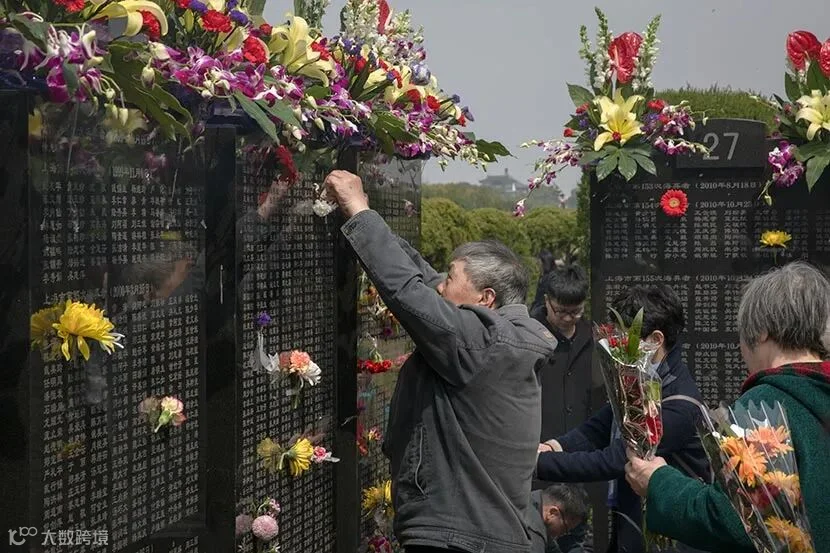
A man places flowers on a monument for people buried at sea in Binghai Ancient Garden Cemetery, Shanghai, March 24, 2018. Shi Yangkun/Sixth Tone
An important aspect of a Chinese funeral is that a dead person’s final resting place must be peaceful. To some, a sea burial doesn’t fulfill this requirement — the water is choppy and cold, and there’s no place for younger generations to pay their respects. The annual memorial at Binghai Ancient Garden is a compromise. City officials make speeches to start the ceremony, after which someone rings a bell representing peace and hits a drum representing good fortune. Instead of sprinkling liquor on the graves, as is the usual tradition, seawater is poured into a cauldron. The officials place floral arrangements on a stage, and everyone bows.
Cai, a 31-year-old Shanghai native who did not wish to use his given name, and nine of his relatives attended the ceremony at Binghai Ancient Garden to bring offerings for Cai’s mother, whose ashes he scattered at sea last year after she died of cancer. Decades ago, when the woman’s father considered a sea burial following news of Deng Xiaoping’s funeral, she had objected, saying the seawater was too cold. But when her own death approached, she was open to burial at sea. She had undergone expensive medical treatment and didn’t want to force her family to spend more on a burial plot. Cai brought flowers for her, but with no space left in front of the monument, he placed them under a tree, pointing toward the marker bearing his mother’s name.
Some 120,000 to 130,000 people die every year in Shanghai, according to the funeral and burial management division. About 88 percent of people now opt for so-called ecological burials, says Zhang, the researcher. Most are still interred on land, albeit in very small plots. This year, the city plans to promote “life crystals,” which involve turning a person’s ashes into roughly 150 tiny stones — particularly convenient when the deceased’s children live far apart and each want their own memento.
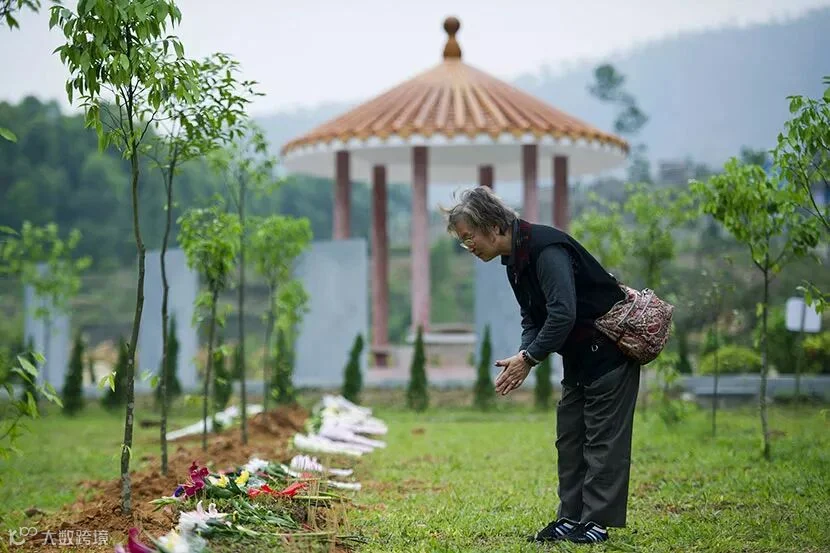 A woman bows to her relative’s remains during a tree burial ceremony in Dongguan, Guangdong province, April 24, 2014. VCG
But further inland, tree burials are slowly catching on. In Suzhou, Jiangsu province, the families of more than 80 people have signed up for tree burials so far this year. At the city’s funeral service registration desk, one Suzhou resident, a 69-year-old woman surnamed Zhang, has come to ask for more information. Before her husband’s recent death from kidney cancer, he told her he would like to be buried at sea. But, Zhang says, his siblings have opposed the idea: “They are very traditional, and they feel he suffered great hardship and needs a good final resting place.” She’ll see if her in-laws agree to a tree burial instead, which she feels still conforms to her husband’s wish for a simple funeral.
Suzhou resident Zhao Kang, 40, lost his 7-year-old son to cerebral palsy. Zhao signed up to have the boy’s ashes buried beneath a tree last month. Like Teng’s family, Zhao’s mother believes that burying young children with adult relatives will bring bad fortune. Zhao doesn’t like the idea of a sea burial, but he tells Sixth Tone that a tree burial is an acceptable compromise that still gives his son a peaceful resting place for his parents to visit.
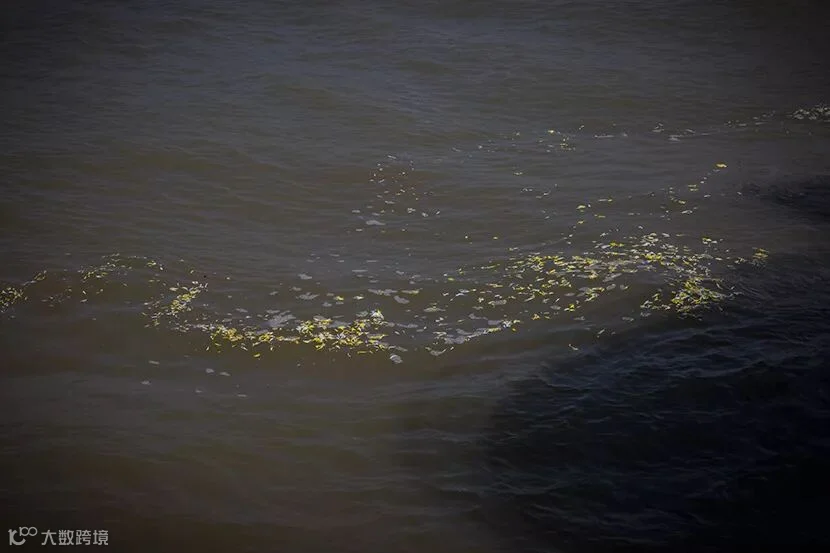 Ashes and flower petals are scattered in the sea in Shanghai, April 1, 2018. Shi Yangkun/Sixth Tone
After all 83 Changzhou families have scattered their relatives’ ashes, the boat returns to the dock in Shanghai, where buses wait to take them back to their home city. For Teng, it’s her last opportunity to say goodbye to her son. She stands on the dock for a while, watching the waves. During the trip, she posted a message to her son on social media: “It’s not lonely when 83 people are together. I hope you can be free, Little Yang.”
Editor: Kevin Schoenmakers.
(Header image: Teng Fei stares into the distance after scattering her 2-year-old son’s ashes at sea in Shanghai, April 1, 2018. Shi Yangkun/Sixth Tone)


(Copy URL and open in browser)