Corporate Net Zero Pathways:
What are the key takeaways of the 'new energy direct power supply'(新能源直供电) policies?


Following closely after Zhejiang, Hubei is now among the provinces promoting new energy direct power supply. On August 1st, the provincial government published the Opinions of the Provincial People's Government on Further Accelerating the Construction of Major Projects and Expanding Effective Investment (《省人民政府关于进一步加快重大项目建设扩大有效投资的若干意见》). The document underlines the objective to “develop creative models for new energy direct power supply (新能源直供电) and distributed power trading (隔墙售电 or 分布式发电市场化交易), via the following mechanisms:
improve market-based trading mechanism for distributed power trading
ameliorate distributed power trading mechanisms
explore and organize direct trading between new energy projects and the adjacent incremental power consumption projects
qualified power generation projects can be connected to the incremental power distribution network or the power transformer of power users.
What is new energy Direct Power Supply (新能源直供电)?
Traditionally, power supply in China can be classified in two types: direct grid supply (电网直供电), and non-direct grid supply(非电网直供电). Non-direct grid supply includes the following schemes:
self-supply with captive power plants owned by power users.
power supplied by the landlords such as industrial parks, commercial buildings, etc. The power supply can come from the landlords’ captive power plants or can be forwarded from the public power grid.
power supplied by the local incremental power distribution network, which is operated by a grid owner different than SGCC, CSG, or other independent provincial power grids owned by the states.
carry out new energy power supply via exclusive power transmission lines (专线供电) in accordance with the local conditions
build new energy captive power stations
promote the direct supply of green electricity and the replacement of coal-fired captive power plants
build a number of green power direct supply demonstration factories and demonstration parks
carry out demonstration projects with high penetration of new energy in generation, power supply (transmission and distribution), and power consumption
In combination with the incremental distribution network pilot, actively develop microgrids and DC distribution networks with renewable energy as the backbone
and expand the scale of direct application of distributed renewable energy on the power user side.
What is the implication for power users and power project investors?
New Energy Direct Power Supply is a new approach for power users to access green power, especially for high power consuming industries. Although the cost of power transmission to transfer the new energy power directly to the power user’s transformer remains to be determined on a project-by-project basis, as it depends on the distance, technical specificity, etc., it is assumed that government funds and surcharge as well as other fees (e.g. cross subsidy) may be charged to power users. Since such projects won’t involve the usage of the public power grid, it is foreseeable and reasonable that the new business model may face many hurdles, especially coming from power grid companies.
From the perspective of new energy project investors, the biggest risk could be the load stability as all power generation is supposed to be off taken by one or several nearby power users.
The aforementioned policy released by Hubei government specifies that “incremental” power consumption projects, e.g. newly constructed factories, can adopt this novel mode of power supply. New energy power supply can be directly connected to the power user’s private transformer or to the incremental distribution network. The existing power users of power grid companies are not mentioned in the policy.
In Inner Mongolia Autonomy Region (IMAR), the DRC has recently published three implementation rules and regulations:
-
Detailed Rules for the Implementation of Power generation- grid- load-storage Integration Projects (《自治区源网荷储一体化项目实施细则》). -
Detailed Rules for the Implementation of Renewable Energy Substitution Projects for Coal-Fired Captive Power Plants in the Autonomous Region(《自治区燃煤自备电厂可再生能源替代工程实施细则》) -
Detailed Rules for the Implementation of the Autonomous Region’s Wind-Solar-to-Hydrogen Integration Demonstration Project(《自治区风光制氢一体化示范项目实施细则>》

China Power Market essential definitions:
What are Power generation- grid- load-storage integration projects? (“源网荷储一体化”)
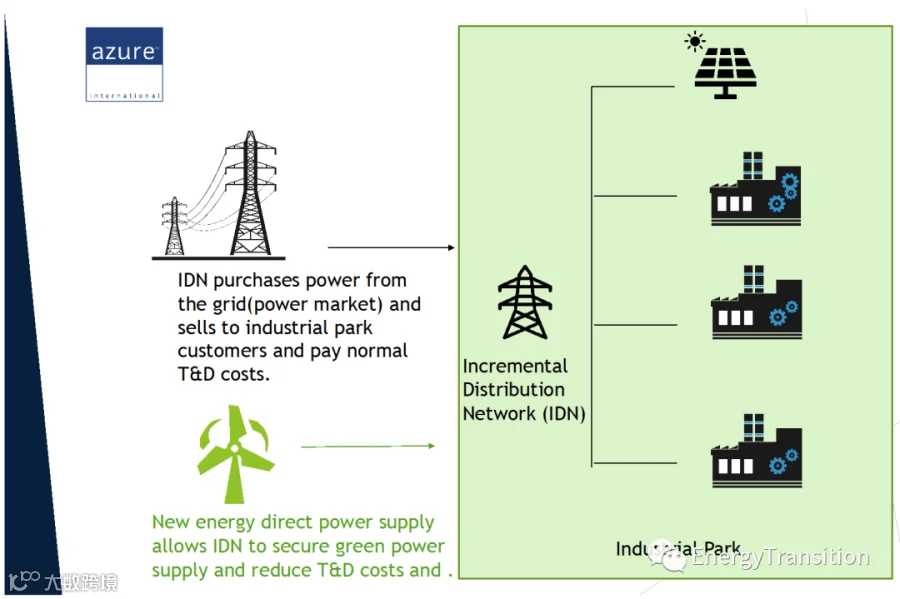
What is Incremental Distribution Network (IDN)?
-
new energy power generation shall be directly connected to the power load -
power generation capacity is designed and decided based on the power demand -
high proportion of new energy in power consumption -
projects barely sell or buy electricity to/from the public power grid except in certain circumstances.
Can the Incremental Distribution Network pilot benefit from new energy direct power supply?
Conclusion
It is still too early to judge how significantly the IDN can benefit from the new energy direct power supply as more rules and regulations on implementation will be later revealed by different provinces. Primarily, if a new energy project can bypass the public power grid and establish a direct link to an IDN (e.g. IDN in an industrial park), the new model will presumably enable IDN operators to have access to nearby grid-scale new energy power supply, instead of simply depending on the purchase from grid companies or other forms of power supply inside the industrial park. Secondly, electricity costs of the IDN could be assumed lower than the usual cost which include gridco’s T&D fees due to the simpler structure and short distance of T&D infrastructure connecting to a nearby new energy project.
Scan the QR code to follow the official account of Azure International Technology Development (Beijing ) Co.,Ltd