



In this week’s news, Sichuan is struggling to meet record power loads as it is hit by droughts, heavily impacting its hydropower output. The province is attempting to curb demand by reducing industrial production. China’s first 11 MW offshore wind turbine was hoisted in Guangdong. This coincides with the publication of China’s technology roadmap to achieve the country’s carbon emissions targets, which encourages the development of ultra-large offshore wind turbines and floating wind, among other technologies.
In its latest ‘two high industries’ policy, Shandong province vies to rectify the controversies concerning the double counting of environmental attributes. We analyze this new development in our Corporate Net Zero Pathways column.


News summary
Sichuan limits power consumption as hydro reserves hit new lows
Changjiang Nuclear Power Phase II Project's first "Zero Tariff" equipment clears customs
China's first commercial 11MW offshore wind turbine completed hoisting
China publishes its technology roadmap to achieve carbon targets
Corporate Net Zero Pathways: Shandong clarifies rules to avoid the double-counting of environmental attributes

Sichuan limits power consumption as hydro reserves hit new lows
Hit by relentless extreme temperatures and droughts, Sichuan province is facing a perfect storm. It has simultaneously reached record high temperatures, low rainfall levels, and high-power load.
Sichuan is home to most of China’s hydropower resources, which represent 80 % of the province’s installed power generation capacity. With the current drought, its dams’ output has been reduced by 50% in August. In addition, reservoir and river levels are reaching record lows.
In response, Sichuan Province issued an emergency notice requiring all power users to stop production for 6 days, from the 15th to the 20th of August. Chengdu has turned off all unnecessary public lighting, such as ad screens and downward escalators.

Changjiang Nuclear Power Phase II Project's first "Zero Tariff" equipment clears customs
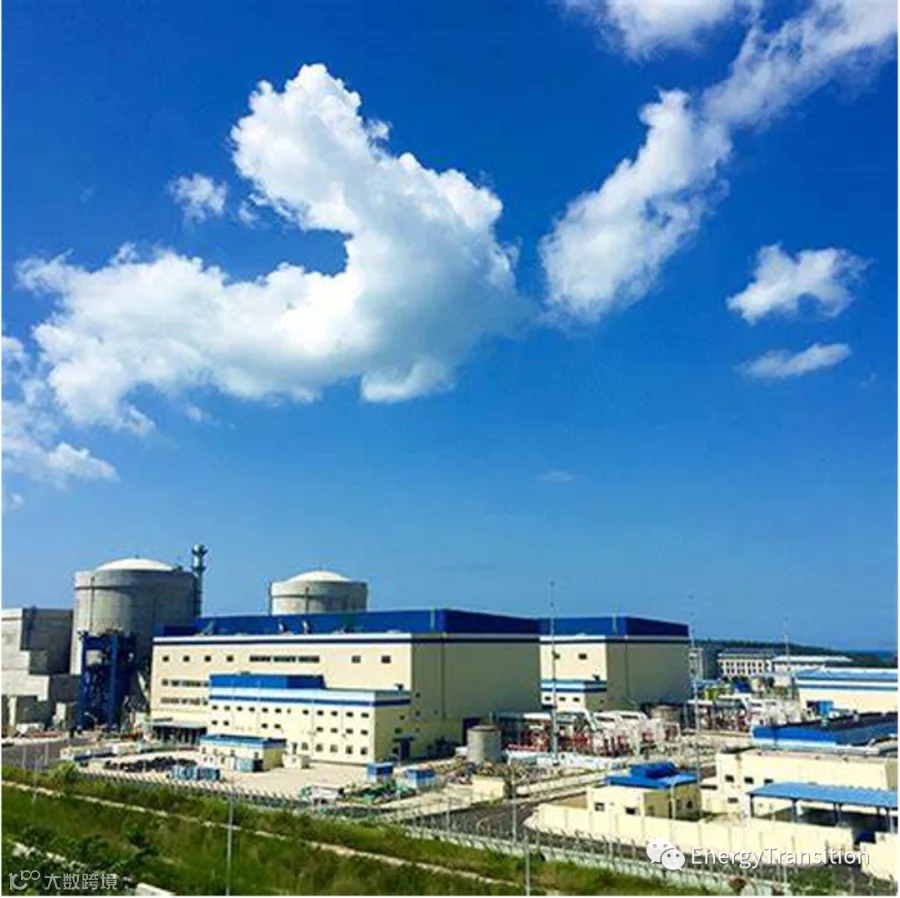
On August 11, the imported alternator equipment for the units 3 and 4 of the Hainan Changjiang Nuclear Power Phase II Project successfully obtained custom clearance. With a value of about CNY 3.6 million (USD 530k), it is the first imported nuclear power equipment enjoying the "zero tariff" tax-free policy of the Hainan Free Trade Port.
Changjiang Nuclear Power Units 3 and 4 are developed by Huaneng Group and China National Nuclear Corporation and represent a total investment of about CNY 40 billion (USD 6.2 billion).
(HINEWS)
China's first commercial 11MW offshore wind turbine completed hoisting
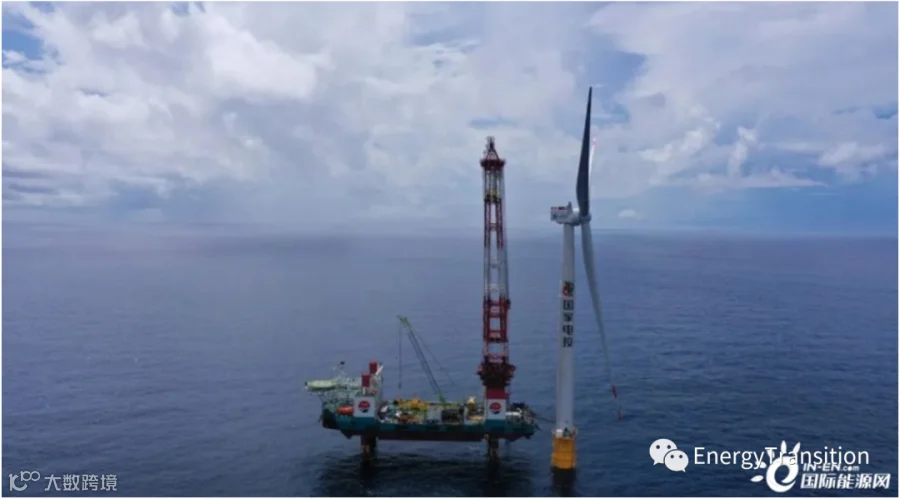
The hoisting of China's first commercial 11MW wind turbine was completed at State Power Investment Corporation's (SPIC) Jieyang Shenquan Second Offshore Wind Power Project, in Guangdong, marking China's official entry into the 11MW era of offshore wind power.
The project has an installed capacity of 502MW, composed of thirty-four 11MW and sixteen 8MW wind turbine units. Among them, the 11MW wind turbine is the EW11.0-208 unit of the Petrel Haiyan platform. It is SPIC’s first commercial-scale application of 10MW+ offshore wind units.
(wind.in-en)
China publishes its technology roadmap to achieve carbon targets
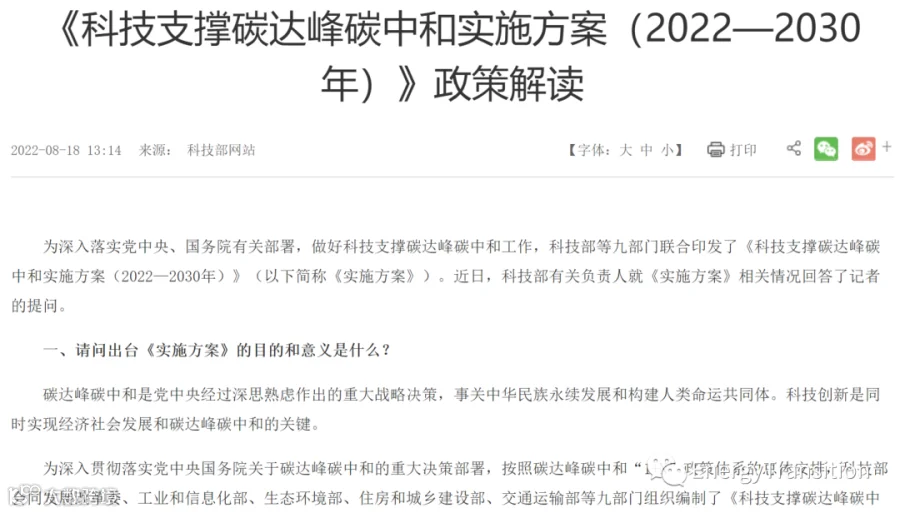
This week, nine central government departments issued the "Science and Technology Carbon Peak and Neutrality Implementation Plan (2022-2030)". The plan focuses on several aspects of the energy system such as the ‘clean’ use of coal, high efficiency renewable energy, CCUS, or hydrogen production, transport, and storage. Among others, the plan mentions renewable energy technologies such as silicon and perovskite solar cells, ultra large offshore wind turbines, or floating wind and solar.
As industry, transport, and construction represent a significant share of China’s GHG emissions, the document specifically provides recommendations for these sectors. Meanwhile, the document underlines international cooperation on science and technology innovation of low-carbon technology.
(China GOV)

Corporate Net Zero Pathways
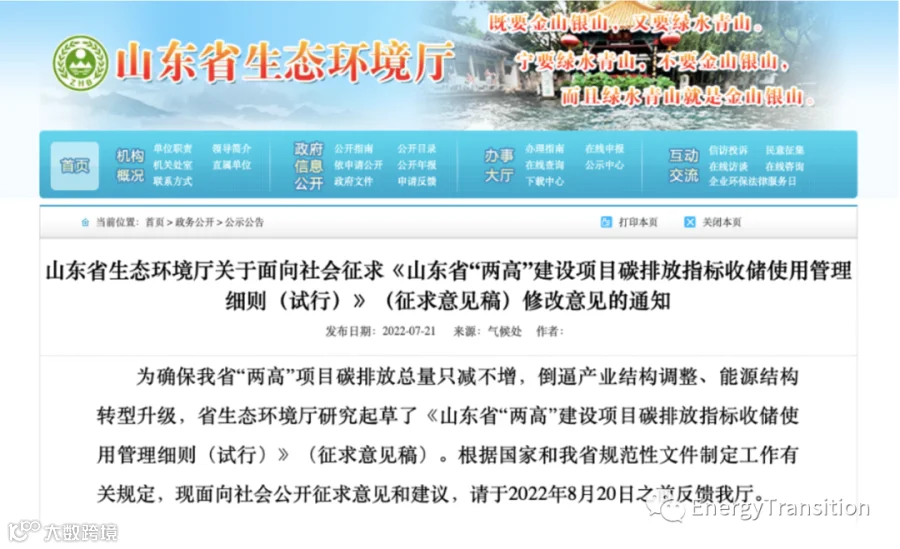
The double-counting of Chinese EACs including green electricity, GEC, CCER, VCS, etc., have long been the subject of controversies and concerns. Such concerns are believed to have been partly accountable for the suspension of the CCER issuance since 2017. While the rumors concerning the reactivation of CCER issuance is spreading, a draft for consultation of the Management Rules for the Collection, Reserve, and Utilization of Shandong “Two-High” Construction Project’s Carbon Emissions Quota (《山东省“两高”建设项目碳排放指标收储使用管理细则(试行)》) was released by the Shandong Department of Ecology and Environment (DEE) in late July.



Scan the QR code to follow the official account of Azure International Technology Development (Beijing ) Co.,Ltd