Is 2023 a bumper year for the Chinese economy? I'm afraid not. In recent years, the Chinese economy has been under downward pressure, and the economic situation will further intensify in 2023. It is expected that the economies of various regions will face the risk of severe thunderstorms.
As a global economic model, South Korea collapsed, with a comprehensive decline in the birth rate of real estate exports and a high suicide rate, ranking first in the world. What warnings does the neighboring countries in East Asia bring to us as they experience a complete collapse?
In 2023, facing the complex domestic and international environment, the downward pressure on China's economy is evident. In terms of external environment, global economic growth is slowing down, trade protectionism is rising, and China's foreign trade and investment are facing significant risks. In terms of the domestic environment, China's economy has passed the stage of rapid development driven by exports and investment. With the further deepening of Economic restructuring, the driving force of economic growth has further slowed down. At the same time, the superposition of policies on land, environmental protection, finance and taxation has increased the production costs of enterprises and reduced their profitability, thus increasing the heavy burden on enterprises.
Compared with South Korea, many people may not know that it is the only populous country in the world that has jumped from a developing country to a developed country since World War II. Note that South Korea, the only country in the world that has a low starting point and belongs to the East Asian Kulturkreis, is actually more meaningful for us than Japan, which was a great power before World War II. Therefore, the economic development model of South Korea has been studied and imitated by many Chinese economists. However, in 2023, South Korea's economy will collapse precipitously. The Miracle on the Han River in the past has become the Hanjiang trap. South Korea has brought us three warnings. Who knows that at the end of World War II, South Korea was once very poor because of the Japanese colonization. In 1960, although China was one of the least developed countries in the world, However, the per capita GDP of South Korea is even 10% lower than that of China. However, since then, the South Korean economy has made rapid progress. From 1962 to 1994, South Korea's GDP has been growing at an average annual rate of 9% for 32 years, which is even faster than China's 30 years after the reform and opening up.
By 1994, South Korea's per capita GDP exceeded $10000, which was officially included in the OECD, also known as the Developed Countries Club. In over 30 years, South Korea has transformed from an extremely backward and impoverished country to a feat of leading 50 million people into developed countries, transforming into the world's only model for advancement. Since then, the term "Miracle on the Han River" has been studied by many economists, especially China, which belongs to the Confucian Kulturkreis, but the Korean economy collapsed at a brilliant moment.
On the morning of May 25th, the Bank of Korea released its 2023 economic growth forecast for South Korea, which was further lowered from 1.6% to 1.4%. From a global ranking perspective, the total GDP of South Korea in 2021 was 1.8 trillion yuan, ranking 10th globally. However, by 2022, this ranking had dropped to 13th place, only higher than Mexico, indicating that the impact of GDP may not be as strong.
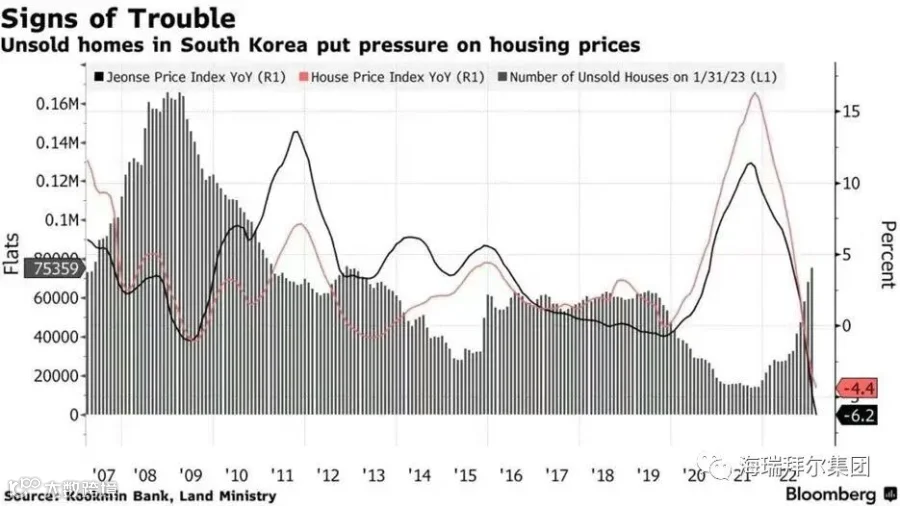
Bear takes everyone to analyze several sets of numbers. Firstly, in the past few years, real estate prices in South Korea have skyrocketed the most in the world. Since 2016, housing prices in South Korea have risen by 80% nationwide. In the most severe period of the epidemic from 2020 to 2021, despite the global economic downturn, housing prices in various parts of South Korea have generally increased by more than 40%, and housing prices in Seoul have doubled. In 2020, the price of apartments in the city center of Seoul was $22000 per square meter, which has exceeded 130000 square meters in Chinese yuan, second only to Hong Kong in terms of cost. However, the once bullish housing prices in South Korea have been experiencing a cliff like decline since last year.
According to a report by Asia Daily, housing prices in South Korea fell by 18.6% in 2023, with some craft prices in Seoul falling by 30-40%, and trading volume plummeting by over 70%. So far, South Korean housing prices have fallen for the eleventh consecutive month, setting a new record for a decline since the 2008 financial crisis.
As an export-oriented economy, South Korea is known as the canary of global trade. In the past, it used to refer to the cage of traditional Chinese medicine brought by coal miners when they went down to mines. This bird is very sensitive to toxic gases such as carbon monoxide, so as long as the canary is still singing, the mine is safe. However, in 2023, this canary in South Korea was poisoned to death. The latest data shows that as of May this year, South Korea's export volume has decreased by 15.2% compared to the same period last year. As a country that relies on exports, South Korea's trade deficit is as high as 2.1 billion US dollars, setting a record for 15 consecutive months of deficit.
Finally, let's take a look at the macro economy. Since 2000, South Korea's economic growth rate has been maintained at around 3% for a long time in 20 years. As a developed country, this growth rate is relatively good. However, this year, various parties predict that South Korea's GDP growth rate is likely to be less than 1.5%, officially entering a new era, accompanied by rapid inflation growth. According to the data released by the Statistics Korea of South Korea, inflation in South Korea in the first quarter of this year rose by 4.7% year on year. Due to soaring prices, many Korean college students without money only eat two meals a day. Young people have launched the challenge of not spending money on social activities. Riding bicycles, eating rice and rubbing drinks are not spending money. It is better not to spend money. What's more terrible is the suicide problem of young people.
Currently, South Koreans have the highest suicide rate in the world. According to data from the World Health Organization, 27 out of every 100000 people in South Korea die from suicide, with a suicide rate 3.5 times that of China. Among them, young people in South Korea with greater economic pressure have a higher suicide rate. Since 2007, suicide has surpassed other causes such as cancer and car accidents, becoming the largest cause of death among people aged 10 to 39 in South Korea. This is also a spectacle on a global scale. Why can't the South Korean economy hold up in 2023?
As one of the world's busiest countries, South Koreans work up to 2092 hours per year, ranking first among developed countries. This figure is a full 300 hours more than neighboring Japan, equivalent to an additional one hour per person per day. Even recently, the government has extended the maximum weekly working hours allowed by labor laws from 52 hours to 69 hours, with an average of 13.8 hours per day, in order to enhance corporate competitiveness, How can Koreans work so hard to stop the economic collapse?
Bear believes that there are three main reasons for this.
The first reason is the serious problem of class solidification in South Korea, which has exacerbated the national atmosphere of financial speculation and will bring endless troubles.
Contemporary Koreans in South Korea, where there are numerous chaebols, do not believe in striving to become rich. They only believe in and retaliate. From real estate to stocks to Bitcoin, wherever there is the fastest way to make money, there is the shadow of Koreans. Taking stocks as an example, in February 2022, the number of active accounts in Korean stocks for 50 million people exceeded the 60 million mark for the first time, and even some Korean elementary school students joined the stock market early on. As a comparison, China's 1.4 billion population only has 200 million stock accounts. Can you imagine the scenario of nationwide stock trading?
Stock speculation may not be fast enough to make money. In the past two years, South Koreans have kept pace with the times and focused on Cryptocurrency. Since 2017, there has been a phenomenon called Kimchi Premium in the Korean bitcoin market. That is, the price of local bitcoin in South Korea is always 10%~20% higher than the international market. South Korean young people are extremely enthusiastic about Cryptocurrency. It can be seen that generally young people in South Korea prefer to speculate in stocks and coins. Middle aged people with little capital prefer to speculate in real estate, In addition, the unique full rental housing system in South Korea has become an accelerating period of rising housing prices.
The Korean full rent model is a bit like our long-term apartment rental model. The renter pays a large deposit to the landlord, which is about 50%~80% of the house value. After paying the deposit, the landlord can rent for free. The landlord gets the tenant's commission to make money by speculating. In addition, the Korean government, nominally to reduce the burden of tenants, also provides full rent loans with an interest rate of less than 1%, further exacerbating the housing price foam.
In the era of rising housing prices, young people rent houses for free, while middle-aged landlords earn money from rising housing prices. Hello, hello everyone. However, once housing prices plummet, a series of thunderstorms will occur, not only will landlords go bankrupt and run away, but even tenants will be swept away. In fact, in April, there have been 17 tragedies in South Korea where victims of all rent fraud committed suicide.
The second reason for the collapse of South Korea's economy is that Sub-replacement fertility planted a big thunder 20 years ago.
In 2020, 12 million people were born in China, the birth rate fell to a historical low of 1.3 for the first time, and the problem of Sub-replacement fertility began to attract social attention. But for South Korea, their fertility rate had already broken through to this level as early as 20 years ago in 2001.
As this group of young people grow up, they have less access to the labor market, and Zihua's economic consequences are finally beginning to appear, which directly reflects that no one has taken over the real estate market, consumption lacks motivation, and production efficiency declines. At the same time, coupled with the solidified social class in South Korea, the pressure of economic downturn is all concentrated on young people, making them even less willing to have children. In 2020, South Korea's fertility rate had dropped to 0.78, ranking last in the world. Some population experts believe that if this continues, South Korea in 200 years is likely to become the first country on Earth to disappear naturally.
The third reason for South Korea's economic recession is the loss of economic sovereignty.
From the separation from North Korea during the Korean War in the 1950s, to the economic take-off of global industrial transfer in the 1960s, and to the Asian financial crisis in 1997, we can always see the shadow of the United States from the rise and fall of South Korea. As early as the Korean War, American capital has been deeply involved in the South Korean economy. In order to support South Korea, Dish sent US $2.15 billion in aid, equivalent to 1/6 of the Marshall Plan in Europe.
The development companies we are familiar with today, such as Samsung, Hyundai, LG, etc., all grew up with the support of American capital at that time. For example, observing the composition of Samsung's shares in South Korea, we will find that 55% of the shares are owned by foreign investors, with a considerable portion of the shareholders coming from Wall Street. During the 1980s trade war between the United States and Japan, in order to suppress Japan, the United States led a group of high-end Japanese industries to transfer to South Korea, bringing rich economic dividends to South Korea. However, what the United States can give you can be taken back.
In the past two years, due to the decline of national strength, the US government, in order to call for the return of the manufacturing industry, re targeted the Semiconductor industry in South Korea. In 2022, the Biden government passed the inflation bill to lure the return of South Korea's semiconductor production capacity through high subsidies. In 2023, the United States imposed a chip ban on China, while also strongly demanding that South Korea not sell chips to China, causing South Korean chip companies to lose their biggest market share. Under the dual influence, South Korea's chip exports in May 2023 fell 36.2% year on year, which is the tenth consecutive month of decline in South Korea's chip exports. The collapse of the Semiconductor industry directly became the trigger for South Korea's economic recession this year.
From the development of textbooks to the negative model, South Korea has only taken less than 20 years. Considering that China and South Korea are in the same Kulturkreis, and the two societies are very unique, South Korea has taught us a profound lesson.
Bayer summarized three major lessons: firstly, it is not advisable to speculate in real estate to revitalize the country. Today, we have realized that the sharp rise and fall of housing prices can bring short-term financial risks and violence problems, but perhaps more importantly, it will cause the expansion of the real estate power class and exacerbate the problem of class solidification. This will make young people lose hope for struggle and make the whole society lose the concept of hard work to become rich. This concept is toxic to the nation, so the principle of non speculation in rent must be adhered to. This is not only related to financial security, but also to the shaping of the Chinese national identity.
Secondly, for current China, the population issue is already urgent, and relevant policies must be introduced as soon as possible. In 2020, China's birth population was only 9.56 million, a decrease of 1.06 million compared to 2021. Recently, more media have judged through data such as maternal records that the birth population in China may be around 8.3 million in 2023, from 17 million to 8 million. It only took 7 years for China's birth population to halve.
Of course, we can say that the impact of population decline on the economy will not be immediately apparent. From the example of South Korea, China's economy may still have 15-20 years to maintain medium to high growth, and we still have time to tackle industrial upgrading and achieve national rejuvenation. However, 15 years may be a long time for a person, but a short time for a nation. It is obvious that we no longer have much time to waste by implementing supportive fertility policies as soon as possible to reduce the pressure on young people's lives.
The last and most important lesson is that China's economic sovereignty must be in its own hands. Since the beginning of the China–United States trade war, the voice of compromise with the United States has never disappeared among the people. Many people believe that China should submit appropriately to the United States, only in this way can our international environment be good, our exports be good, and our economy be good. Many people even argue that only countries that are friendly with the United States can become prosperous in the world, and countries that stubbornly resist American prosperity are deeply trapped in poverty.
However, the lesson of South Korea has already taught us that without sovereignty, there is no right to development. The United States will eventually take back what it has given you, making it so difficult for the 300 million people of the United States to give back to the 50 million people of South Korea. China's 1.4 billion people should not expect the United States to give us any benefits. If we choose to surrender, the outcome will only be worse than South Korea.
Fortunately, today's China still retains precious independence and autonomy, which is the foundation for us to achieve national rejuvenation. Although there will be more difficulties and obstacles on our development path for it, with it, our development limit will definitely be higher than that of South Korea.