

RoomIt by CWT的中国区酒店业务总监曲宁女士在最近一次前往中国东南部省份福建的旅行中发现了一些令人惊讶的现状。
“我从厦门搭乘四个小时大巴前往一个偏远小镇,在那里我竟然看到一家OYO酒店。更特别的是,除了OYO,我没有发现其它任何本地或全球连锁酒店。”曲女士所提及的这家酒店其实是一家发展迅速的印度加盟连锁酒店。
曲女士的经历说明了中国低线城市的住宿市场正在经历着一系列变化。目前在这些城市主要还是局限于质量参差不齐的独立经济型酒店。但是,希尔顿、洲际等著名国际连锁酒店以及华住和亚朵等大型中国品牌,已经开始嗅到商机。
然而,对于优先考虑人身安全、住宿品质以及价格稳定性还有包括提前入住、延迟退房和当天取消等在内的增值服务的差旅项目而言,在中国三四线城市寻找合适的住宿场所依然会面临许多挑战。
▋ 小城市 大契机 – 商务差旅逐步在向低线城市延展
在过去的二十年间,中国商务差旅市场增长了十倍。全球商务旅行协会 (GBTA) 称,中国的年商务差旅消费已经从2000年的320亿美元迅猛增加到了2017年的大约3,470亿美元,到2022年,预计将以年均6.5%的幅度增长。重要的是,很大一部分增长是由往返于中国中小城市差旅带动的。
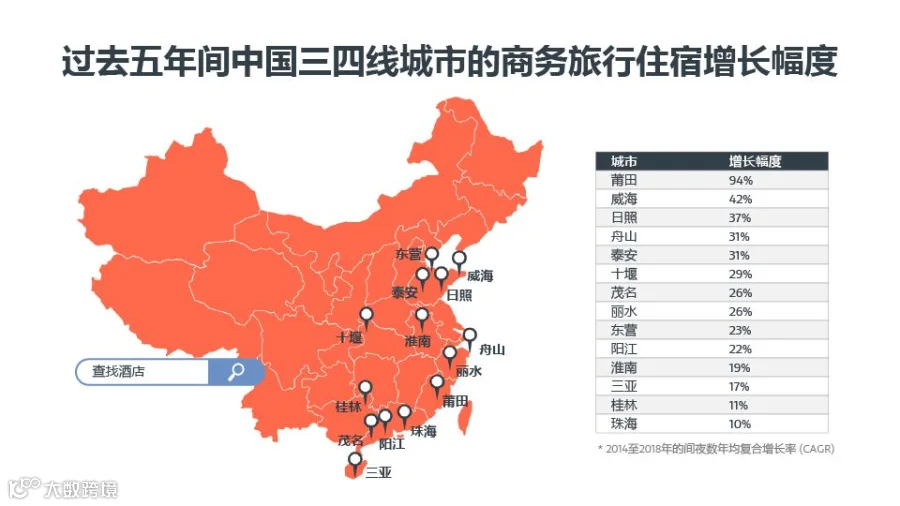
随着中国经济日趋成熟,政府已经试图将发展重点从投资主导型转向消费主导型增长。现在,中国不仅销售产品,还生产产品,从而更为激发了商务差旅需求。
中国企业和全球跨国公司越来越需要在北京、上海等传统中心城市,甚至是西安、成都和苏州等二线城市之外的地方住宿。莆田、威海和日照之类的一些三四线城市的商务差旅消费呈两位数增长。
CWT亚太区跨国销售高级总监Akshay Kapoor先生表示,“我们发现一些公司,尤其是制造和制药行业,因为选址的原因越来越需要在三四线城市寻求住宿场所。” “他们在这些城市建立了工厂和办事处,因此需要这些地方能够随时提供住宿房间。”
表面上看,住宿供应似乎不是问题。中国庞大的酒店体量已经得到了充分证明。CWT按照国家统计局数据计算的结果显示,中国的酒店房间数年平均剧增12%,已经从2013年的266万间增加到了2017年的393万间。
商业房地产服务公司JLL则表示,大规模的交叉发展已使得酒店类综合性建筑在二三线城市供应过剩。
目前,中国中小城市的酒店市场主要还是由单体酒店组成,而不是连锁品牌。这对商务旅行项目造成了一些障碍。
▋ 安全住宿 – 单体酒店可能存在安全隐患
首先,这些酒店一般无法通过广泛使用的分销渠道预订,比如全球分销系统 (GDS),因此,一些差旅管理公司 (TMC) 无法为其客户提供这些选择。
更复杂的是,许多小型酒店甚至没有接待外国游客的许可证。
在此情况下,商务游客通过其公司的TMC预订酒店时几乎没有选择的余地。最终,他们通常会直接向酒店或通过其他网站预订,而不是通过TMC。这就造成预订数据无法自动采集,他们的企业也很难在紧急情况下(重大安全风险)跟踪他们。
由于不同单体酒店的安全实践千差万别,这种安全问题变得更加复杂。连锁酒店会遵循适当的标准,但是很难确定小规模经济型酒店是否配有足够符合规范的街道照明设备或安全出口。
CWT的酒店部门RoomIt by CWT一直在致力于在中国较偏远城镇和城市为其客户增加与商务旅行相关的住宿选择。
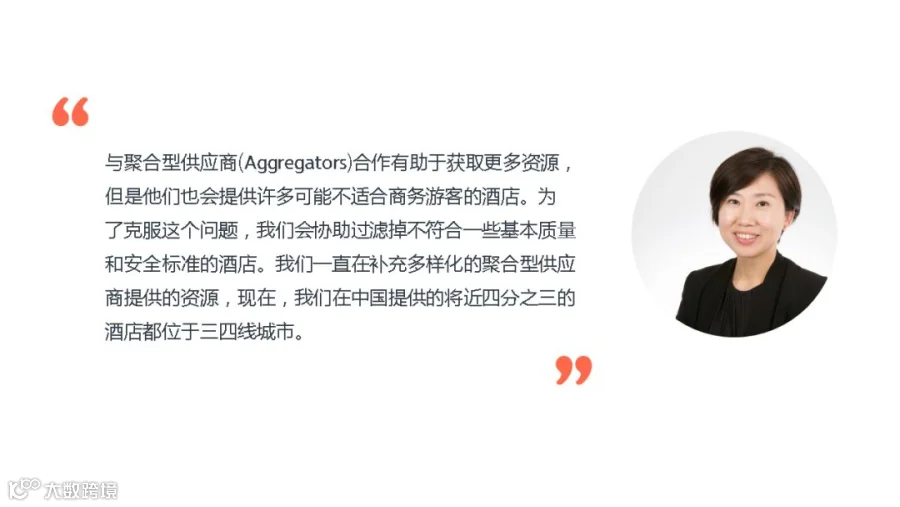
安全要求极其严格的公司,比如能源、资源和海洋领域的企业,通常会在允许其差旅员工入住酒店之前进行额外检查和现场审查。
▋ 自撞南墙-如果谈判失败
另一个障碍是谈判。企业节省旅行开支的其中一个主要方式就是与酒店商定公司协议价。企业保证在特定酒店入住一定天数,作为交换,酒店会提供低于公开价格的房价,可能还有额外的打包优惠。
与连锁酒店商定公司协议价比较容易,因为他们在许多城市都有连锁店,可能会占企业总旅行开支的一大部分。
对于单体酒店,则必须一个一个地单独洽谈。这样非常耗时,成本也高,很难利用跨越多城的交易量商定一个比较划算的价格。
此外,许多单体酒店不具备与企业客户合作的正规程序。
“此类合作通常取决于公司与酒店销售人员之间的直接关系。”CWT中国区客户管理总监赵睿女士表示,“我遇到过一些情况,公司与酒店销售经理商定了公司协议价,销售经理更换工作后,却无法兑现了。”
据赵女士介绍,他们通常没有正规的交接,酒店甚至不知道与客户签了公司协议价。还有其他情况是,酒店在旺季根本不会兑现公司协议价。

▋ 服务本土化-外国差旅员工的支付痛点
中国的数字支付非常先进。大多数酒店都支持微信、支付宝和中国信用卡支付。支付相当容易,但是也有例外:外国游客。
CWT中国区总经理钟明凤先生叙述了一次与公司时任亚太区总裁兼首席财务官去四川省一个小城市旅行的故事,也就是他们的中国商务旅行经历。他们打算付账时却发现根本没法付。
钟先生称,“他们想要付房费,但是酒店不支持国际信用卡。”
这种情况很令人恼火,但并不是无法解决的问题。只不过外国游客可能需要当地办事处帮助他们代为付账。

▋ 供需关系-更多适合差旅人员的酒店正在筹建中
不过,一切都在快速变化。酒店和旅游业研究公司STR指出,在许多省份的小城市,需求已经超过了供应。这包括安徽、广西、湖北、湖南、辽宁、四川、广东、浙江和云南地区。
这一现状将提升日均房价,也会促使连锁酒店在这些地区增开新店。
STR北亚区业务发展经理Vincci Yang表示,“目前,越来越多的国际连锁酒店,以及一些中国本土酒店集团正在考虑进军三四线城市。他们可能不会将旗下一些最优品牌拿来测试市场,但在当地市场一定会被视为高档酒店。”
例如,希尔顿已经通过旗下的9个品牌开设了将近200家酒店,筹建酒店数量多达400家。该连锁酒店表示,他们将“对不同的品牌细分市场进行战略性部署,满足各个城市的多样化需求”,希望到2025年能够运营1,000家酒店。
大型本地参与者也有许多酒店项目正在开发。例如,锦江国际集团称其筹建计划包括288家酒店和33,043间客房。同时,华住酒店集团在2018年年底宣称“有1,105家酒店正在筹建中,将创历史新高”。

CWT解决方案部亚太区高级顾问孙希涛先生指出,市场上也出现了多起合并项目,有些大型参与者收购了单体酒店,甚至还有其他连锁酒店。
印度的OYO Hotels & Homes就是一个有趣的例子,它通过租赁和特许经营模式管理一些独立经营的经济型酒店。该公司最近声称已成为中国第二大酒店集团。据称,OYO酒店(软银集团控股的连锁酒店的中国子公司)的经营范围包括320个城市,管理了大约1万家酒店和45万间客房。它还声称在今年早些时候收购了一家名为Qianyu的中国中型酒店,此举将进一步扩大其在偏远城市的影响。由于担心标准的一致性,尤其是在质量和安全方面,许多商务旅行项目依然对选择OYO的酒店持谨慎态度。
大型连锁酒店有望引进更高的可靠性和安全标准,使采购和合作变得更容易。许多连锁酒店预计还会改进数字化服务。例如,希尔顿已经发布了第一款中文手机应用程序和微信小程序。此举很有可能引起其他连锁酒店效仿。希尔顿的应用程序很快还将与支付宝关联,以支持宾客使用此应用程序上的数字密钥、在线客房入住及其他关联客房功能。
孙先生表示,“本地连锁酒店也渴望建立自己的品牌,因此,他们将专注于提升酒店设施和服务标准。”
随着中国商务旅行继续保持迅猛增长势头,酒店业将尽力提升服务质量,以应对日益增长的宾客数量。当然,企业目前依然面临一些挑战。
请点击【阅读原文】或登陆 www.carlsonwagonlit.com.cn 阅读完整文章。

Growing Pains: Accommodation Challenges in China's Smaller Cities
On a recent trip to a remote corner of Fujian province, in China's Southeast, RoomIt by CWT's Director of Hotel Suppliers for China found something surprising.
"I went to a town four hours by bus from Xiamen, and I saw an OYO hotel. I didn't see any of the local or global chains there, but I saw an OYO," said Ning Qu, referring to a property managed by the fast-growing Indian hospitality company.
Ms. Qu's experience sheds light on how the accommodation landscape in China's lower-tier cities is changing. The options currently available are still limited mostly to independent budget properties of greatly varying quality. But established international chains like Hilton and IHG, as well the bigger Chinese brands such as Huazhu and Atour, are beginning to smell the opportunity.
For the moment, though, corporate travel programs that prioritize safety and security, consistency in quality and pricing, and value-added offerings like early check-in, late check-out and same-day cancellations, still face many challenges in finding suitable accommodation options in China's third and fourth tier cities.
▋ SMALL CITY, BIG DREAMS – BUSINESS TRAVEL GROWS TO CHINA'S SMALLER CITIES
China's business travel market has grown tenfold over the past two decades. The Global Business Travel Association (GBTA) says the annual business travel spend in China increased from US$32bn in 2000 to around $347bn in 2017 – and it's expected to grow at 6.5% annually until 2022. What's important to note is that a large part of this growth is being driven by travel to and from the country's smaller cities.
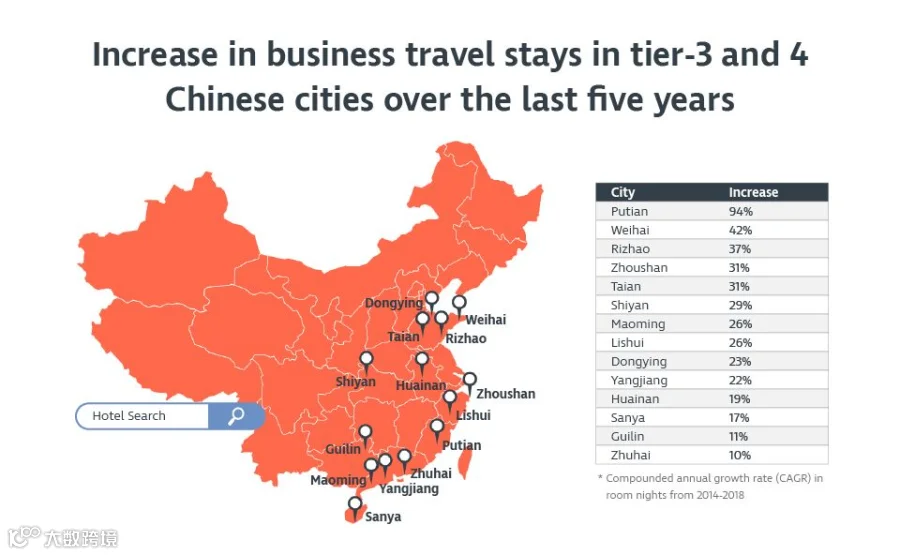
As China's economy has matured, the government has attempted to shift the focus away from investment towards consumption-led growth. It's now a place to sell products as well as make them, and that's fueling a need for business travel.
Increasingly, both Chinese companies and global multinationals need accommodation outside the traditional hubs of Beijing and Shanghai, and even beyond many of the country's secondary cities like Xian, Chengdu and Suzhou. Several tier-3 and 4 cities like Putian, Weihai and Rizhao are seeing double-digit growth in business travel.
"We're seeing companies, especially in the manufacturing and pharmaceutical sectors, increasingly seeking accommodation options in tier-3 and 4 cities because of the way they have set up their businesses," said Akshay Kapoor, Senior Director of Asia Pacific Multinational Sales at CWT. "They have established plants and offices in these cities, and so they need rooms available at all points in time."
On the surface, supply doesn't appear to be an issue. China's massive hotel pipeline has been well-documented. The country saw a 12% annual average jump in the number of hotel rooms from 2.66 million in 2013 to 3.93 million in 2017, CWT's calculations from National Bureau of Statistics data reveal.
According to commercial real estate services firm JLL, the sale of mixed-use developments that require a hotel on the property has also led to excess supply in Tier-2 and Tier-3 cities.
Still, the current hotel landscape in China's smaller cities is comprised mostly of independent properties, as opposed to chain brands. This poses several hurdles for corporate travel programs.
▋ STAYING SAFE – INDEPENDENT PROPERTIES MAY POSE SAFETY & SECURITY RISKS
For a start, these properties are usually not available through the widely-used distribution channels like the global distribution systems (GDSs) – so some travel management companies (TMCs) aren't able to offer these options to their customers.
What complicates matters further is that many smaller hotels aren't even licensed to accept foreign travelers.
This can leave business travelers with few options when they try to book their accommodation through their company's TMC. They often end up booking directly with the properties or through other websites, rather than through the TMC. As a result, the booking data isn't automatically captured, which makes it difficult for their organizations to track them in the event of an emergency – a major safety and security risk.
The safety issue is compounded by the fact that security practices at independent properties can vary widely. At a chain, there'll be standards – but it's difficult to know whether a small budget hotel has adequate street lighting or fire exits that are up to code.
RoomIt by CWT, CWT's hotel distribution division, has been looking for ways to increase the number of business travel-relevant options it can offer its customers in China's more remote towns and cities.
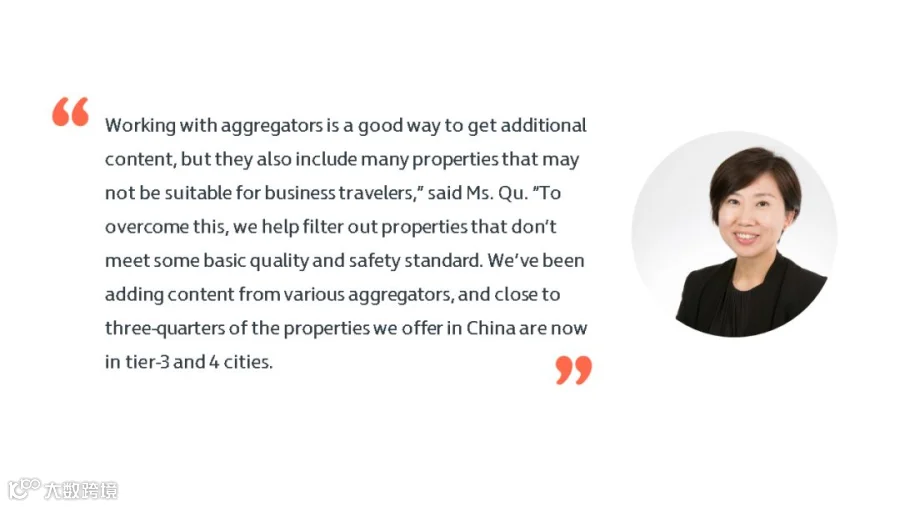 Companies with extremely stringent safety requirements, like those in the energy, resources and marine sectors, will often conduct additional checks and site audits before allowing their travelers to stay at these hotels.
▋ HITTING A GREAT WALL – WHEN NEGOTIATIONS FALTER
Another hurdle lies in negotiations. One of the main ways companies save money on their travel spend is to negotiate corporate rates with hotels. In exchange for guaranteeing a certain number of nights at a given property, hotels will offer rooms at below public rates, and might bundle in extras.
It's easier to negotiate corporate rates with hotel chains, as they have properties across many cities, and therefore might account for a bigger proportion of a company's total travel spend.
With independent properties, you have to negotiate with each one individually. This can be incredibly time-consuming and expensive – and it's also more difficult to leverage volume across multiple cities to negotiate a better rate.
Also, many independent properties don't have proper processes for working with corporate clients.
"It often depends on direct relationships between the company and hotel sales staff," said Raine Zhao, CWT's Director of Program Management for China. "I've seen cases where a company has negotiated a corporate rate with the hotel's sales manager, only to find that it disappears when the sales manager changes jobs."
Often, there hasn't been a proper handover and the hotel isn't even aware that they've agreed to a corporate rate, according to Ms. Zhao. And in other cases, hotels simply won't honor a corporate rate during periods of high demand.

▋ LOCAL CONNECTIONS – PAYING BILLS AS A FOREIGNER
Digital payments in China are advanced. Most hotels will accept WeChat Pay, AliPay and Chinese credit cards. Payment is fairly easy, but there is one exception: foreign travelers.
Albert Zhong, CWT's General Manager for China recounts a time he traveled to a small city in Sichuan province with the company's then Asia Pacific president and the CFO, both of whom were visiting China on a business trip. They expected to pick up the tab, but it turns out it simply wasn't possible.
"They wanted to pay by their credit card, but the hotel would not accept international credit cards," Mr. Zhong said.
This is an annoyance, but it's not an insurmountable problem. It just means that travelers from overseas might need support from the local office to pay the bills.

▋ SUPPLY AND DEMAND – MORE BUSINESS TRAVEL-FRIENDLY HOTELS IN DEVELOPMENT
Things are changing quickly, though. STR, a hotel and travel sector research firm, notes that there are many provinces where demand outpaces supply in the smaller cities. These include Anhui, Guangxi, Hubei Regional, Hunan, Liaoning, Sichuan, Guangdong, Zhejiang and Yunnan.
This is pushing up the average daily rates, and prompting hotel chains to expand their presence in these locations.
"More international hotel chains are looking at tier-3 and 4 cities now, as well as some local Chinese hotel groups. They might not bring their best brand, but would definitely be considered upscale in that market," said Vincci Yang, Business Development Manager for North Asia at STR.
Hilton, for example, already has nearly 200 hotels and up to 400 pipeline hotels across 9 brands. They hope to have 1,000 by 2025, by "strategically deploying different brand segments catering to the diversified needs of each city," the hotel chain said.
The large local players, too, have a lot of properties in development. Jin Jiang Holdings, for example, reportedly has a pipeline of 288 hotels and 33,043 rooms. Meanwhile, the Huazhu Group have said their pipeline was "at a record high of 1,105 hotels" at the end of 2018.

Adam Sun, Senior Consultant, Asia Pacific, CWT Solutions Group notes that there is also a lot of consolidation taking place in the market, with bigger players acquiring independent properties and even other chains.
India-based OYO Hotels & Homes, which leases and franchises independently owned budget hotels, is an interesting example. It recently claimed to have become the second-largest hotel group in China. OYO Jiudian, the Chinese subsidiary of the SoftBank-backed hospitality chain, supposedly has a presence in 320 cities, with around 10,000 hotels and 450,000 rooms under its management. It also reportedly acquired Qianyu, a mid-size hotel brand in China, earlier this year – a move which would further expand its presence into far-flung cities. Still, many corporate travel programs have been cautious in their adoption of OYO's hotels due to concerns over consistency of standards, especially around quality and safety.
The big chains will likely bring greater reliability, safety standards, and make sourcing and negotiations easier. Many chains are likely to improve their digital services too. Hilton, for example, released its first Chinese language mobile app and a WeChat mini app. Other chains are likely to follow suit. Hilton's app will soon be connected to Alipay, and guests will be able to use digital key, online room check-in, and other connected room functionalities on this app too.
"The local chains are also keen to build their brands, so they're focusing on improving the standard of their properties and their service," said Mr. Sun.
As business travel continues its dramatic growth in China, the hotel industry will do it's best to improve service and keep pace with increasing volume of guests. For now, businesses will still face a few challenges.
Please click【Read more】or visit www.carlsonwagonlit.com.cn for the full report.
关注中航嘉信微信公众平台,
完美旅程由此开始!