
高分文献速递
客户单位:浙江大学,复旦大学
期刊:Sig Transduct Target Ther
影响因子(IF):52.7

文章题目:
Targeting SKAP2 restores sperm motility and morphology through modulating mitochondrial organization and cytoskeletal remodeling
Sperm motility and morphology are indispensable for sperm-egg interaction and successful fertilization. However, the RNA splicing mechanisms in an m6A-dependent manner regulating spermiogenesis-related genes remain poorly defined, and targeted therapy strategies to restore impaired sperm motility and morphology are lacking. In this study, we identify heterogeneous nuclear ribonucleoprotein R (hnRNPR) as a critical m6A-dependent splicing mediator. Pathogenic mutations in HNRNPR cause sperm motility decline, morphological abnormality, and male infertility in both humans and mice. Mechanistically, Hnrnpr mutation disrupts m6A-dependent splicing of Skap2 pre-mRNA, thus impairing cytoskeletal structure and mitochondrial organization in sperm. Consistently, specific knockout of Skap2 in male germ cells displays sperm abnormalities, which phenocopy those observed in humans and mice with Hnrnpr mutants, unveiling a functional hnRNPR-SKAP2 axis. Leveraging these insights, we developed a therapeutic strategy to restore sperm motility and morphology, relying on extracellular vesicle-mediated SKAP2 delivery to enter the efferent ductules of the testicles, which could promote sperm cytoskeletal remodeling and mitochondrial organization. Notably, the co-culture of extracellular vesicle SKAP2 with human and mouse sperms also significantly enhanced the sperm motility. Altogether, these findings identify hnRNPR as a pivotal regulator of m6A-mediated Skap2 splicing during spermiogenesis and highlight extracellular vesicle SKAP2 as a promising therapeutic target for poor sperm quality and male infertility.
原文链接:
https://www.nature.com/articles/s41392-025-02513-3#article-info
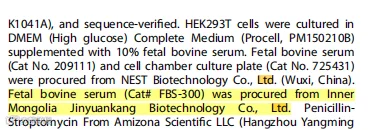
引用产品及培养细胞:FBS-300 HEK293T