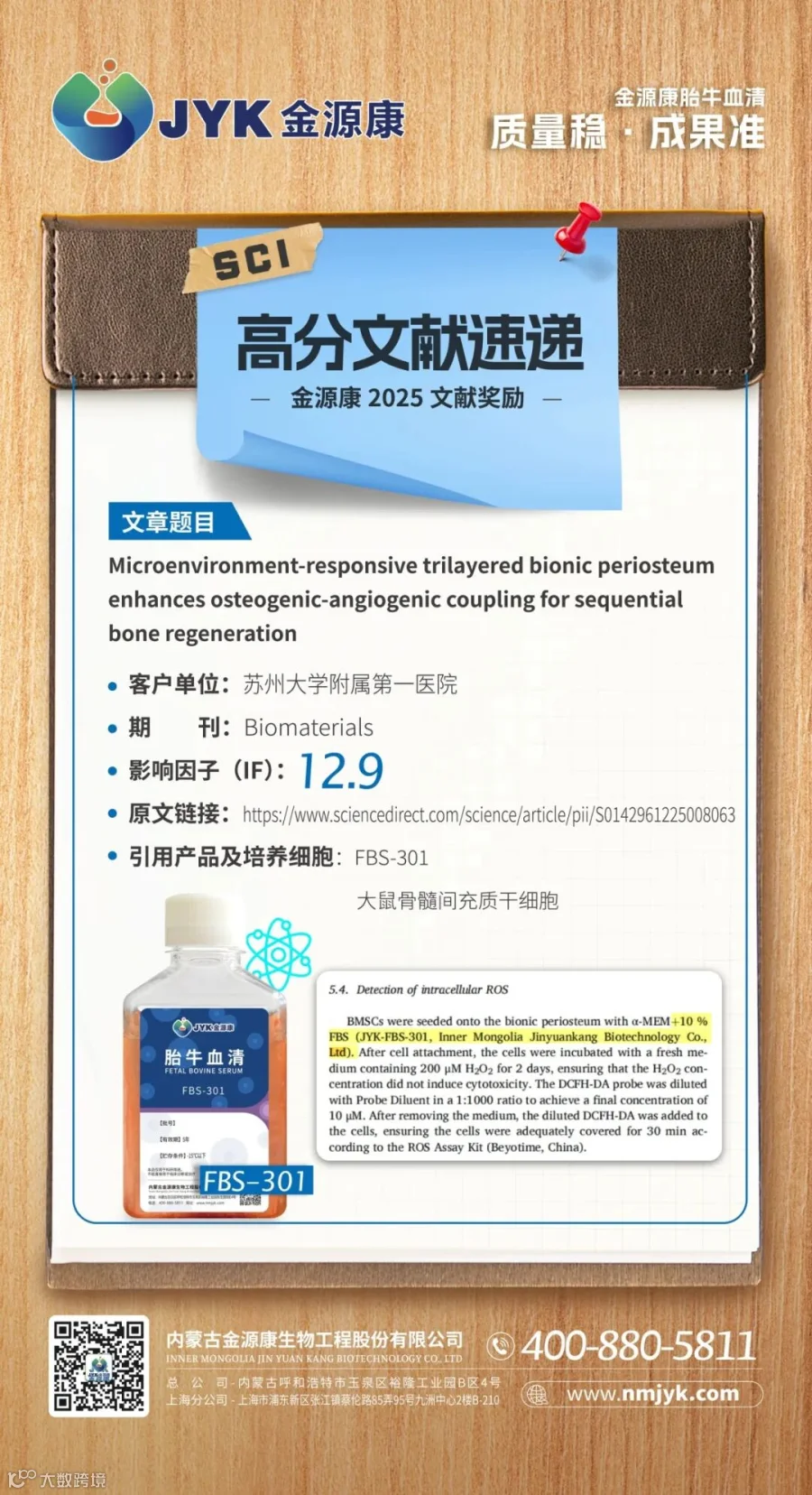

高分文献速递
客户单位:苏州大学附属第一医院
期刊:Biomaterials
影响因子(IF):12.9

文章题目:
Microenvironment-responsive trilayered bionic periosteum enhances osteogenic-angiogenic coupling for sequential bone regeneration
The treatment of severe bone defects remains a critical clinical challenge. The primary factor underlying impaired healing is the absence of periosteum and osteogenic blood vessels at the defect site. During the early stages of bone regeneration, elevated levels of reactive oxygen species (ROS) are commonly observed, which harms mitochondrial function and osteogenic effect. Here, we developed a microenvironment-responsive trilayered bionic periosteum (NMC@POB) designed to sequentially promote bone regeneration via osteogenic-angiogenic coupling. This construct features an outer layer of collagen embedded with tannic acid-cerium nanozymes (TA-Ce NMs) to scavenge ROS and restore redox homeostasis, a middle polylactic acid (PLA) layer for structural support, and an inner core of oxidized xyloglucan-loaded bone morphogenetic protein-2 (OXG-BMP2) to provide sustained osteo-inductive cues. In vitro and in vivo evaluations demonstrated that NMC@POB effectively reduced oxidative stress, enhanced mitochondrial function, and promoted coordinated osteogenesis and angiogenesis in a rat calvarial defect model. Transcriptomic analysis further revealed significant activation of the Wnt/β-catenin pathway, contributing to the upregulation of genes involved in both bone formation and neovascularization. Collectively, this trilayered periosteum offers a bionic and microenvironment-responsive strategy for orchestrated bone regeneration in challenging defect.
原文链接:
https://www.sciencedirect.com/science/article/pii/S0142961225008063
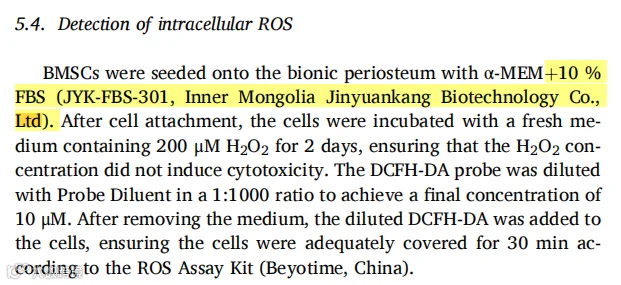
引用产品及培养细胞:FBS-301 大鼠骨髓间充质干细胞