2011年,General Assembly在纽约成立,提供技术相关的技能服务。3年后,GA项目高速发展,提供包括商务、技术、设计等至一系列指导。
尽管并非所有GA学员都与创业相关,但对GA关注度的巨大增长反映了近来纽约创业的浪潮。“纽约创业社区已经变得更加活跃,变成了一个紧密的组织,更多的公司获得了投资”
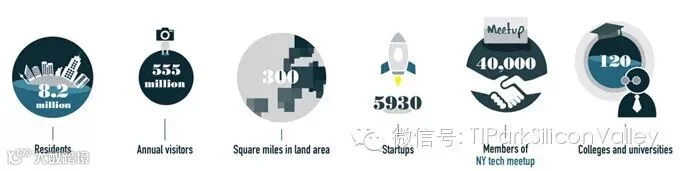
苹果公司一直以来是一个城市的财富和野心,但这两个力正越来越被引导到创业生态系统,有6000多高成长的创业企业。
另一个创业服务机构Startup Grind表示,纽约与西海岸的不同,在于“接地气”。
举办创客马拉松的机构StrategyHack,人们想创造真实的有价值的被需要的东西。
孵化器NYU Incubators,认为,纽约的创业企业尤其关注将想法实现。从长期看只有解决实际问题的公司能够生存。这里的公司更勤奋,更加专注于完成交易。为了成功他们会做一切必要的努力。忙碌是其选择公司的一个因素。
GA:纽约的与众不同在于,它总是某些行业的枢纽,例如:时尚,金融,媒体和广告
NYU Incubators,认为,这一支持结构是近来最有影响的力量。5年前,早期阶段公司获取办公空间很难。典型情况下,创业者迟早会去波士顿或者加利福尼亚,只要当他们需要开始系列融资时。但现在他们会选择逗留此处。
GA:难以相信纽约花了这么久变成一个创业枢纽。创业企业一直有,咖啡厅创业者的文化也一直有,但现在对于创业企业的空间和支持是如此之多。
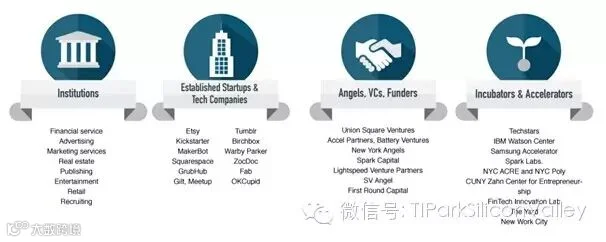
目前有超过50家孵化器和加速器以及一连串的大众的和利基的联合办公空间如雨后春笋出现。遍布曼哈顿以及其他的纽约行政区。
例如被称为“Silicon Alley”的“The Flat Iron District”,是创业的中心位置。Soho也是一个更成熟的公司(ZocDocs)及创业公司的大本营。DUMBO集聚了多家创意机构和媒体相关的初创公司。
还可以激动地发现,金融区成为越来越多创业者可以负担的地区。麦迪逊大道一些大的著名广告机构不在那了,还发现很多对冲基金,金融公司,高盛和其他机构搬走,这导致金融区的价格下降。结果,有更多创业公司搬进来。这些更新的公司不一定都是金融相关的,包括了时尚、社交媒体和硬件产品等。
创业活动如此之多。创业公司几乎没有焦点。如果看波士顿,焦点是健康技术、生物技术以及其他的。有时候你得让自己去适应环境。但在纽约不必如此。
到目前为止,在Bill de Blasio做市长期间,纽约第一次成立了 first chief technology officer首席技术官。
还设立了Digital.NYC数字化纽约网站!!针对科技的官方数据网站,上面有创业企业和投资者数据、职位空缺、事件和高科技公司的交互式地图。这一网站由市政府指导,IBM赞助和承办(主机托管),gust公司开发。对于早期创业生态系统,这是一个前所未有的资源,使社区的每一个成员可以探索和获取创业资源及信息。
在2009年形成,是第一个由市主办的项目,当时办公空间如此之贵以至于大学不得不与市政合作。NYU旗下有三个孵化器,每个有不同重点并位于不同社区。Varick Street 关注移动,安全和云。 DUMBO关注社交和数字媒体还有很多硬件公司。 MetroTech campus发展方向是清洁技术。
在专利和技术方面,纽约不如旧金山。GA发现大量的金融、法律和媒体的专业人才,他们很聪明并且习惯于长时间工作。但有时,尤其是对创业公司,工程师和其他技术专家短缺。
虽然联合办公空间和孵化器使创业公司更容易找到办公空间,从而留在纽约。但曼哈顿的空间费用及其他成本依旧是一项挑战。高的居住成本导致高的工资预期。
另一个注意点,要关注质量,而不仅是数量。成立公司很容易,但大部分人没有意识到创业是很困难的事情。
NYU’s incubators更关注毕业成功率,而不是增加入孵数量。每六个月检查一轮,过去3年只有120家毕业或者是存活。
纽约市本身的活力和吸引力可能是其最大的资产
风投Ventrock合伙人说,纽约是人均野心最高的城市。
在资本的获取方面,认为两年半前是一个转折(2012年中)。当时在投资金额上纽约超越波士顿。波士顿有时候出现更大额的交易,因为生命科学公司。但是以单个公司为比较,纽约公司得到更好的投资。
纽约超越波士顿这件事,产生了许多浪潮,使得更多人认为,创业公司在纽约也可以获得资金,许多创始人被激励。
原文:
Back in 2011, General Assembly opened its first location in New York City to provide residents a place to gain technology-related skills such as front-end web development. Fast forward just three years, and GA’s programming has actually quadrupled to a point of offering a wide range of business, tech and design instruction.
Though not all students in the courses are launching or involved in startups, the immense growth of and interest in GA is reflective of the recent surge in New York’s startup scene, according to Anna Lindow, general manager of campus operations and education at NYC’s General Assembly.
“The New York startup community has gotten more vibrant, bigger,” Lindow says.“It’s become a tight knit group…and a lot more companies have received funding.”
New York City now ranks just behind Silicon Valley in terms of total venture capital dollar spend. The Big Apple has always been a city of great wealth and great ambition. More and more, though, both forces are being channeled into the startup ecosystem, which is nearly 6,000 companies strong and growing.
Peter Crysdale, NYC director of Startup Grind, a monthly event series in which he interviews startup founders, says what sets New York’s startup community apart, particularly from the West Coast’s, is how “grounded” it is.
“There’s really no pretense,” says Crysdale, who also founded StrategyHack, which runs hackathons for marketers. “It’s this idea that people are in it to create real companies and real, valuable things that are needed.”
Steven Kuyan, associate director of NYU Incubators, too, says, compared to the entrepreneurs in other startup cities, New York’s entrepreneurs have an especially pronounced drive and desire to make their ideas work.
“Only the companies that are solving real problems survive in the long term,” he says. “That’s because there’s more of a hustle here. I know everyone talks about New York and its hustle, but it’s true. The companies are more diligent, more focused on closing deals. They’ll do whatever is necessary to succeed.”
This hustle is one quality that Kuyan looks for when selecting companies, especially as the environment becomes more competitive. This latest wave of tech growth is different than the first wave of startup activity in the 1990s in that a fuller ecosystem is building on New York City’s inherent gifts.
Lindow says what’s unique and cool about New York is that it’s always been a hub for several industries: fashion, finance, media, and advertising, to name a few.
“So startups are generally extensions of these,” she says. “You have Warby Parker in the fashion space. In media there are publisher tools like NewsCred …They’re very reflective of New York fields.”
Now, too, an array of organizations are providing entrepreneurs with advice, connections and pitching opportunities. Kuyan considers the building up of this support structure the most influential recent force. More than five years ago, it was “next to impossible” for an early stage company to secure office space. The typical pattern was that founders would run off to Boston or California as soon as they needed to begin serious fundraising. Now they’re sticking around for good, he says.
“It’s hard to believe that it took this long for New York to become a startup hub,” Kuyan says. “It’s always been entrepreneurial and always had a culture of coffee shop entrepreneurs. But now there are so many spaces and support for startups.”
Currently there are more than 50 incubators and accelerators and a flurry of general-interest and niche coworking spaces popping up all over Manhattan—and even in the other New York boroughs. To an extent, there’s no place that startups are not in New York, Crysdale says. Yet, some clusters exist.
The Flat Iron District, which is referred to as Silicon Alley, is the “most central location for startups,” Lindlow says. Soho also is the home base for more established companies like ZocDocs along with newer startups, and DUMBO is a gathering point for a number of creative agencies and media-related startups.
Crysdale says he’s been excited to see the Financial District emerge as a place where startups can increasingly afford to locate.
“A lot of the big ad agencies that used to be famous for being on Madison Avenue are no longer there,” he says. “We’ve actually seen a lot of hedge funds, financial firms, Goldman Sachs and others move away from the Financial District to Madison Avenue. It’s caused a lot of the prices for the Financial District to go down.”
As a result, more startups are moving in. These newer-stage companies are not always focused on the financial sector, either. Just as they are citywide, startups tend to run the gamut from fashion to social media to hardware products.
“There’s just so much activity happening that there’s really no focus of startups,” Kuyan says. “If you look at Boston, there’s health tech, biotech and then some others. To an extent, you have to be a square peg fitting into a round hole. But not in New York.”
Many startups will literally sit next to companies that are in entirely different industries. This provides a great opportunity to have “almost this trade of information” across sectors, Kuyan says.
Lindow also attributes some of the startup boom to the city government.
“The government has been incredibly supportive in New York, especially during the Bloomberg administration,” she says. “They’ve done grants, competitions, tax credits, help with rent. There’s even been city sponsored public-private incubators. All of this is a big asset.”
So far, with Bill de Blasio as mayor, the first chief technology officer in New York’s history was put in place, and the city launched Digital.NYC, the official online destination for the tech sector. The site has a database with profiles of virtually every city-based tech company and investor, a continuously updated list of job openings and events and an interactive map of tech companies. City leaders directed Digital.NYC, IBM is sponsoring and hosting the platform and Gust built it.
“It is an unprecedented resource for an early-stage ecosystem, empowering every member of the community to explore and engage with the wealth of startup resources and information that have made New York City the world’s fastest growing digital hub,” Gust CEO David S. Rose said, in announcing the launch of Digital.NYC.
NYU’s incubator model took shape in 2009 and was the first city-sponsored startup project in New York. Kuyan says, at the time, office space was so expensive that the university had to partner with the city. The three incubators that NYU runs each have a different emphasis and are situated in different neighborhoods: Varick Street is concentrated on mobile, security and cloud infrastructure. The incubator in DUMBO focuses on social and digital media with a handful of hardware companies. And the MetroTech campus is entirely geared toward sustainable clean technology.
When it comes to talent and skills, New York City is not San Francisco. That means a different class of startup founders. At General Assembly, Lindow says she sees an abundance of professionals coming from finance, law or media. They’re smart and accustomed to working long hours. Yet sometimes, especially as startups age and gain traction, there can be a shortage of engineers and other technical specialists to hire.
Even though coworking spaces and incubators have made it easier for startups to find office space and, hence, to stay in New York, real estate and the overall expense of being in Manhattan are ongoing challenges.
Lindow says the high cost of living creates high salary expectations as well.
“There are amazing high-paying jobs so getting people to switch away from that can be hard,” she says.
Another point of caution in New York’s budding startup community, in Kuyan’s mind, is ensuring that the measure of success isn’t so much based on the sheer quantity of startups launching, as it’s been, but on the quality of these companies.
“It’s so easy to start a company…and becoming a startup founder has also become such an illustrious thing,” he says. “The problem with this is most people don’t realize just how difficult it is. This happens everywhere, but in New York, because it’s so connected and so available, people particularly underestimate the difficulties.”
Instead of maintaining a goal of solely increasing the startup funnel, Kuyan says he tries to stay focused on the success rate of startups coming out of NYU’s incubators. Every six months he evaluates companies to determine whether they’re progressing and hitting enough milestones to stay. As a result, just 120 companies have either finished the intense three-year program or are on track to.
The vibrancy and appeal of New York City itself might be its greatest asset. So many people dream of residing in the metropolis that the prospect of being in New York is a major draw for startup team members, Lindow says.
Of New York, Nick Beim, a partner at venture firm Ventrock, wrote earlier this year, it “has arguably one of the highest concentrations of ambition per capita of any city in the world.”
“Given its unusual concentration of people, industry, talent and ambition, it is one of the greatest creative centers the world has ever seen in both the business and cultural fields,” he added.
In terms of access to capital, Crysdale cites two and a half years ago as a turning point. At that time New York surpassed Boston in total dollars invested in startups. Boston sometimes gets bigger-ticket deals, because of its life science companies, but on a per-company basis New York startups are better funded.
“That made a lot of waves,” he says, of New York beating out Boston. “It pushed a lot more people to say, ‘Frankly there’s money to be made in startups’…A lot of the founders are super motivated. Now there’s also a bit of a mentality of ‘Why wouldn’t I launch a startup?’”
(原文来源:1776 翻译:清控科创创业研究部)