
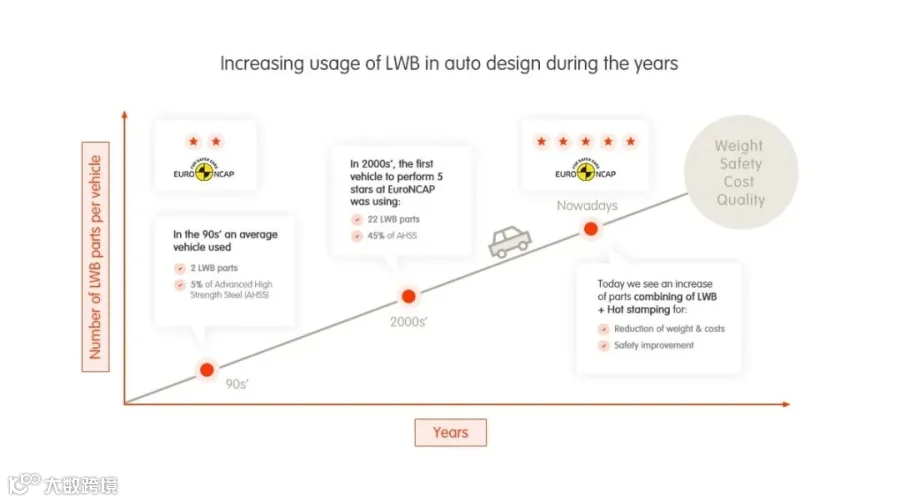
Over the past decades, fuel efficiency and safety as well as environmental concerns have driven the automotive industry to continuously reduce the weight of the body in white of vehicles. The main tasks are to improve fuel efficiency and reduce emissions while improving the overall structure of vehicles for passenger comfort and safety. In order to take the necessary steps to help reduce weight and costs, technical alternatives in materials have been proposed and used for parts in the car body, but none have shown the versatility of steel.
Various grades of steel, such as high strength steels, coated steels and drawing quality grades, continue to offer a greater spectrum of solutions to automotive requirements than any competing material.
The weight of steel versus alternative materials, however, remains an area of concern for product engineering.
This is why the tailor welded blanks concept, which consists of two or more separate blanks combining the best properties offered by different steel grades, has proven to be an efficient design solution to reduce the weight of the vehicle.
It allows the engineers to “tailor” the blank so that each of the steel’s best attributes –such as thickness, strength, coating, etc.- is located precisely where it is needed within the parts. This process not only reduces the weight of the finished part, but it can also be used for part integration, eliminating many reinforcements and stiffeners.
Example of weight reduction in the case of a floor panel:
Floor panels in cars are made of tailor welded blanks mainly in order to reduce weight, but also to allow significant cost reduction. Two concepts usually exist depending on the position of the gearbox for rear or front wheel drive. Either the reinforcements are integrated with the tunnel area by means of two longitudinal weld seams in the case of the central panel or they overlap the area of the closing plates for cross members in a rear floor panel by means of one or two transversal weld seams. In another design, the dash panel function can be integrated with a tailor welded blanks solution by using two sub-blanks with a transversal welded seam.
FiG.1-Two floor panesl in tailor welded blanks of different configurations
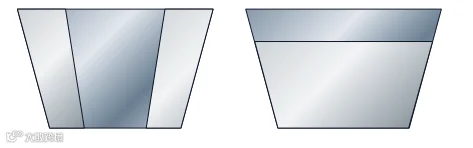
The weight saving is not only due to the reduced thickness of the base blank plus the reinforcement, but also to the global thickness reduction of both blanks resulting from the stiffness contribution of the continuous weld. The concept of a tailored welded blank can usually achieve a thickness reduction up to 13% compared to a monolithic post-assembled structure with overlap. In the case of a tailored welded blanks solution for a tunnel with two longitudinal weld seams. The weight reduction on the blank can reach about 17% for the blank and 15% on the finished part. In total, this gives a weight reduction of more than 3kg/vehicle.
Fig.2—Comparison of weight and stiffness of ULSAB BIW between tailor welded blanks and a conventional monolithic solution
Compared with the reference (basis 100 in weight and bending stiffness). The use of tailor welded blanks results in:
>13% weight saving for the same stiffness.
>17% increase in bending stiffness for the same weight.
A second contribution of the continuous weld is the fact that the overlap between the blanks, which is needed for spot welding, is not necessary. This offers an additional weight advantage for the laser weld line of about 0.235kg per weld line (thickness 1.0mm, overlap 20mm, weld line 1500mm)(see Fig. 3.)
Fig.3- Laser tailored blanks avoid overlapping weld seams

There are still a lot of other parts in the body in white where weight reductions are possible, as for example the body side inner. Studies within ArcelorMittal show an overall weight reduction potential of about 35 kg. However, the weight reduction achieved depends ultimately on the level of function integration and thus early co-engineering.
FIG. 4- Shock tower
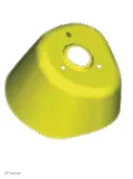
Example of weight reduction in the case of the shock tower:
Shock towers in cars are mainly used with a very high thickness or an additional reinforcement on the top of the tower. This area of the part needs to be thick in order to support the high loads induced by the front suspension. Using a patchwork solution for this part not only offers better in-service behavior due to reduced play between the two main parts, but also offers a considerable weight reduction potential of up to 25% (depending on the design of the part). This can result in a weight reduction of about 1.5kg/vehicle.
Source:ArcelorMittal
扫描以下二维码,关注GONVVAMA微信公众号,了解最新资讯
Scan below QR code to access GONVVAMA WeChat, and stay up to date with the latest news and events in GONVVAMA.