



本文章转载自DC RAINMAKER博客。
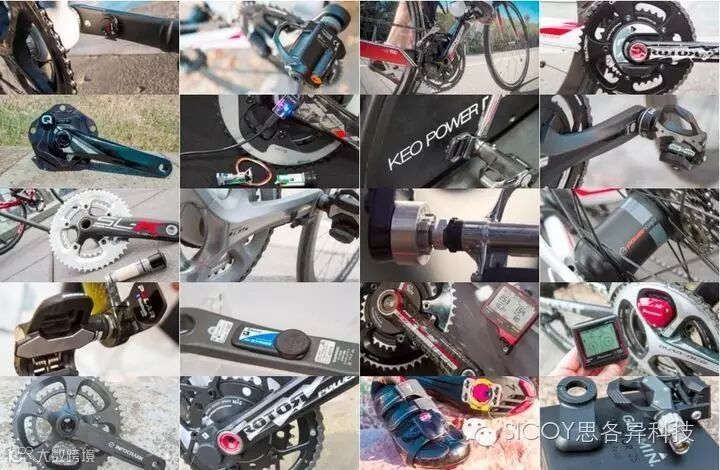
Once again, it’s time for the annual power meter buyer’s guide. It’s mind-boggling how quickly a year has come and gone, and just how many more entrants are now on the scene. Last year at Eurobike and Interbike we saw new brands announced – like 4iiii and WatTeam, and this year we’ve seen those brands start shipping or being on the verge of shipping.
We’ve also seen both new and existing brands dramatically drop the price bar to power meters. For example, Quarq, PowerTap and Power2Max have all substantially cut prices – here’s an entire post on the massive pricing war that’s going on. And yet previously unknown companies have announced products with plans to drop those prices further.
Just to illustrate that, here’s what’s new since last year: 4iiii Precision now shipping, Favero bePRO, PowerTap P1, PowerTap C1, Look dual ANT+/BLE units, Pioneer left-only solution, ROTOR INpower, Ashton Instruments, Dyno Velo, PowerPod.
The goal of this post is NOT to give you a final answer that says ‘this is the power meter to buy’. If there’s anything I want to change in the industry it’s the mindset that there is a single perfect power meter for every consumer. Thus, if you ask someone for “the best power meter”, and they give you any answer other than “it depends”, don’t trust that person. That person should be asking you your specific use case, bike placement limitations, and how much you want to spend.
The cycling market has many unique use cases and thus you’ll need to take into consideration your specific requirements. For example, it’d be silly to go out and buy Garmin Vector if you’re looking to put it on a mountain bike. And similarly, it’d be silly to buy a PowerTap hub if you currently have HED H3 wheels, since it wouldn’t fit there.
Note that I’m not going to cover why you’d use a power meter here, nor how to use it. For those, start here with these posts. Instead, I’m just going to focus on the products out in the market today, and those coming down the road.
Finally, remember that power meters tend to be about as fiery as politics and religion. So keep in mind this is just my view. There are certainly other views out there (all wrong of course), but this comes from my perspective of trying out all the products below and hearing feedback from literally hundreds of people per day. There are no doubt edge cases I can’t easily cover in a single readable post, but I think I’ll cover 99% of the people out there. The remaining 1% can consider a donation of gold and/or expensive rocks for my further thoughts.
With that, let’s dive into things.
POWER METER PLACEMENT:
Before we start diving into the brands, features and functionality, we should probably talk about placement. The reason being that unlike a bike computer that works on just about every bike on the planet, power meters actually have more limitations than you might think. Some limitations are straight technical (i.e. it won’t fit), and some are preference based (i.e. I don’t like it). In either case, for most people this section will help narrow down the selection a bit.
Let’s just briefly ensure we’ve got everyone on the same page as far as where these things all go, starting with the below photo and using the text after it as a guide.
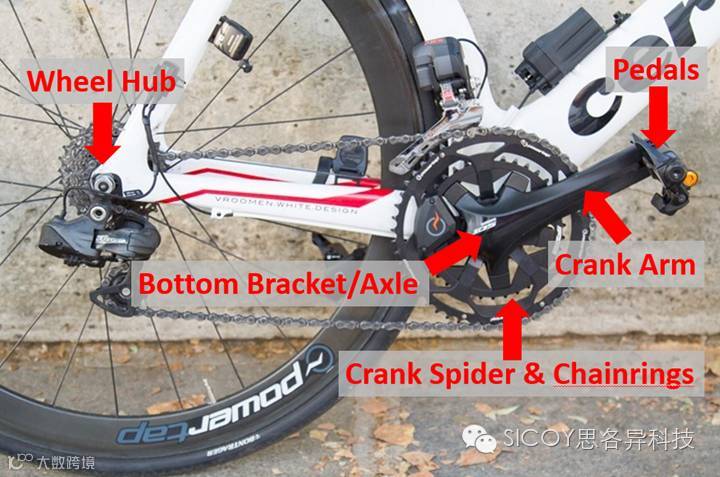
As you can see above, we’ve got five main areas we see power meters placed today:
1) Rear wheel
2) Crank spider
3) Crank arms
4) Pedals/Cleats
5) Bottom Bracket/Axle (not visible, behind tip of arrow)
There are tangential products on other areas of the bike (like handlebars), but none of those currently on the market actually have strain gauges in them. Thus they are more estimations (albeit some highly accurate) than actual force measurement devices. So for much of this post I’m keeping the focus on what’s known as “direct force power meters” – which are units that measure force via a strain gauge of some sort. And finally, I’m not going to talk about companies that have gone out of business (i.e. Ergomo), or products that haven’t been made in a long while (i.e. Polar chain power meter). Not that I’d recommend either anyway at this point.
Back to my photo-diagram, I want to expand out the crank area a bit and talk specifically to that. Here’s a quick cheat-sheet of which products are where (I’ve added a single-line item for non-direct force options):
Rear Wheel: PowerTap hubs
Crank Spider: Quarq/SRAM, Power2Max, SRM, PowerTap C1
Crank Arms: Rotor, Stages, Pioneer, 4iiii, WatTeam
Pedals: Garmin, PowerTap P1, Polar/Look combo, bePRO Look-only option, Xpedo
Cleats: Brim Brothers
Bottom Bracket: Ashton Instruments, Dyno Velo, ROTOR INpower
Non-direct Force Power Meters: PowerPod, LEO, iBike
In the case of left-only variants of some of those products (Polar/ROTOR/Garmin), it’s still the same placement, just on the left side instead of both sides.
更多信息,请点击阅读原文。