
Optimally resolve dim populations with brighter options for the blue laser. BD Horizon Brilliant™ Blue 515 (BB515) is brighter than FITC, and BD Horizon Brilliant™ Blue 700 (BB700) is a brighter alternative to PerCP-Cy™5.5.
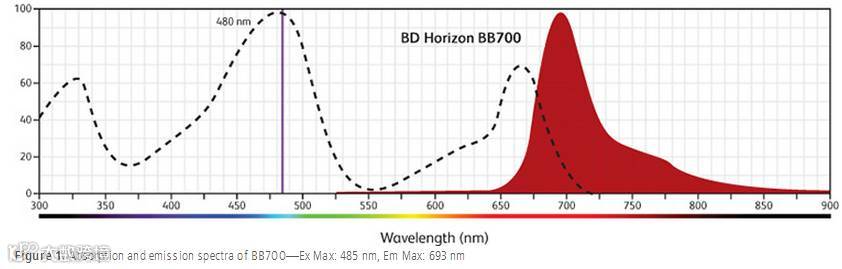
A brighter alternative to PerCP-Cy5.5
BB700 was developed as a brighter alternative to PerCP-Cy5.5, making it better suited for resolving dim populations. Figure 1 shows the absorption and emission spectra of BB700. Figure 2c shows how a dimmer dye such as PerCP-Cy5.5 could underestimate the CD279 expression, while a bright dye such as BB700 is able to fully resolve the CD279+ cells, leading to more accurate results. Having an additional bright dye for the blue laser expands the choices available for resolving dim populations.
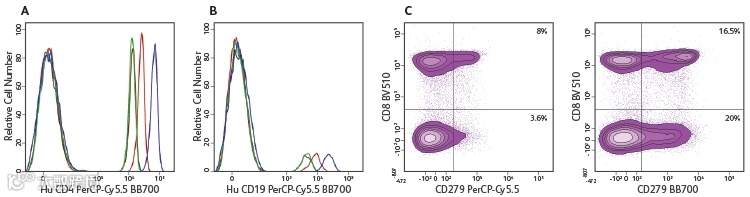
Figure 2. (A) Lysed whole blood stained with Hu CD4 BB700 (clone SK3, BD Biosciences, blue), PerCP-Cy5.5 (clone SK3, BioLegend, green), PerCP-eFluor® 710 (clone SK3, eBioscience, red) or PerCP-Vio®700 (clone REA623, Miltenyi, brown) using the manufacturer’s recommended volume per test. (B) Lysed whole blood stained with Hu CD19 BB700 (clone SJ25C1, BD Biosciences, blue), PerCP-Cy5.5 (clone SJ25C1, BioLegend, green), PerCP-eFluor® 710 (clone SJ25C1, eBioscience, red) or PerCP-Vio®700 (clone REA675, Miltenyi, brown) using the manufacturer’s recommended volume per test. (C) Peripheral blood mononuclear cells (PBMCs) were stained with CD279 PerCP-Cy5.5 or BB700 and CD8 BV510. Data shown is gated on CD3+ cells.
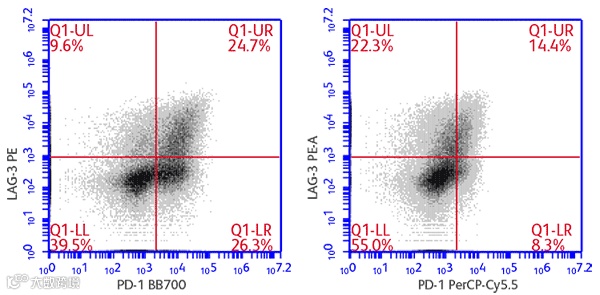
Figure 3. Human PBMCs were stimulated with anti-CD3 and anti-CD28 for 72 hours and stained with PE Mouse Anti-Human LAG-3 and either BB700 (left plot) or PerCP-Cy5.5 (right plot) Mouse Anti-Human PD-1. The cells were also stained with BD Via-Probe™ red nucleic acid stain for live/dead cell discrimination. The two-color dot plots showing correlated expression of PD-1 vs LAG-3 were derived from gated-events characteristics of BD Via-Probe red– live cells.
Spillover advantages to optimize panel design
BB700 has less cross-laser excitation on the 405-nm and 561-nm lasers compared to PerCP-Cy5.5, resulting in less spillover into multiple channels, making BB700 more useful for multicolor panels (Table 1). With an excitation max at 485 nm and emission max at 693 nm, BB700 can be excited by the blue laser (488 nm) and detected in the same filter as PerCP-Cy5.5 (for example, 695/40 nm).
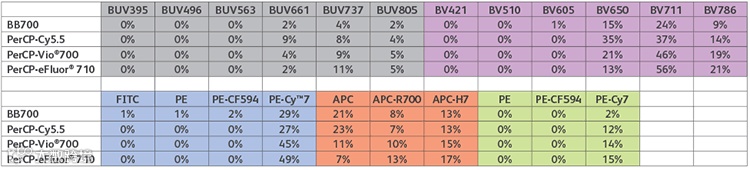
Table 1. Human CD4 reagents conjugated to various fluorochromes run side by side for a spillover comparison
All data was collected on a BD LSR Fortessa™ X-20 system. To collect data across the most channels, the data from the UV, violet and blue lasers came from one instrument and the data from the red and yellow-green lasers came from another instrument. This table is meant to show a relative comparison between the dyes, since spillover values obtained can vary depending on the filter used and photomultiplier tube (PMT) voltage.
Compatible with standard surface and intracellular staining protocols
BD Horizon BB700 is compatible with standard buffers used in surface and intracellular staining protocols. When cells are stained prior to the permeabilization step in the presence of strong alcohol-based buffers such as BD Phosflow™ perm buffer III, PerCP-Cy5.5 staining is no longer detectable. However, BB700 is compatible with BD Phosflow perm buffer III, making it an ideal choice for intracellular staining conditions (Figure 4).
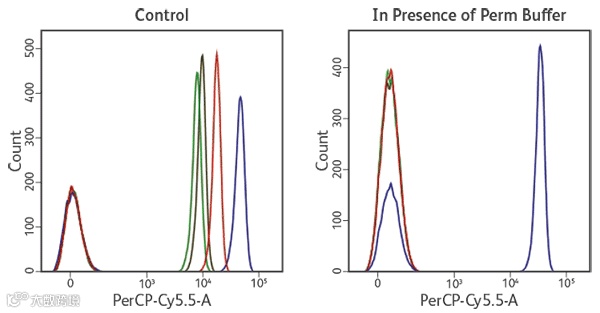
Figure 4. Lysed whole blood was stained with Hu CD4 BB700 (clone SK3, BD Biosciences, blue), PerCP-Cy5.5 (clone SK3, BD Biosciences, green), PerCP-eFluor® 710 (clone SK3, eBioscience, red) or PerCP-Vio®700 (clone REA623, Miltenyi, brown) using the manufacturer’s recommended volume per test, washed, incubated with BD Phosflow perm buffer III, washed and run on a cytometer (right). The only reagent that shows staining is CD4 BB700, due to its compatibility with the permeabilization buffer. As a control, lysed whole blood was stained with the same reagents but not incubated with BD Phosflow perm buffer III (left).