Step 6 in Dyeing and Finishing: Sealed with Shaliang Juice Six Times and Sun-Dried
The Essence of Dyeing and Finishing: Six Immersions and Six Sun-Drying Sessions Weave the Legend of Xiangyun Sha
The legendary hue of Xiangyun Sha is rooted in the ancient and intricate cycle of 'sealing with Shaliang juice' and 'sun-drying'. This process is not mere mechanical repetition, but a precise art form born from the collaboration between artisan experience and natural forces. After the initial sprinkling of Shaliang juice, the base silk is tinged with a light reddish-brown, but this is only a surface adherence. To allow the essence of the Shaliang to penetrate every single fiber and every interwoven point requires undergoing the crucial 'sealing with Shaliang juice' process.
Initial Penetration: Establishing the Foundation by Sealing with Shaliang Juice
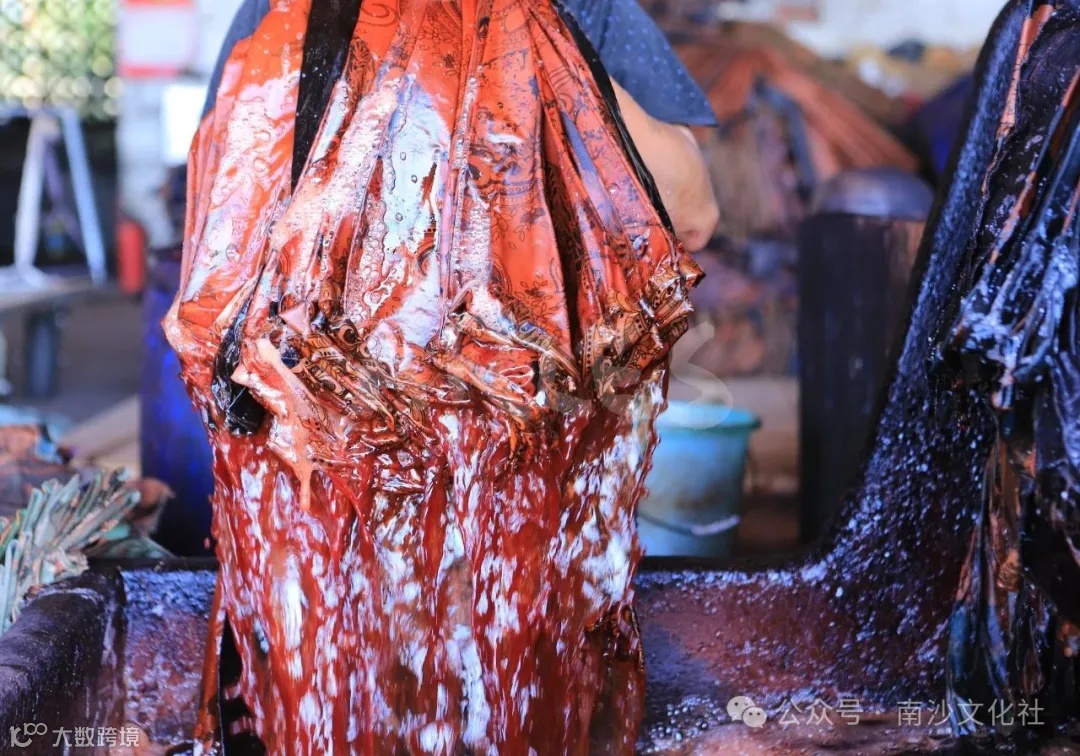
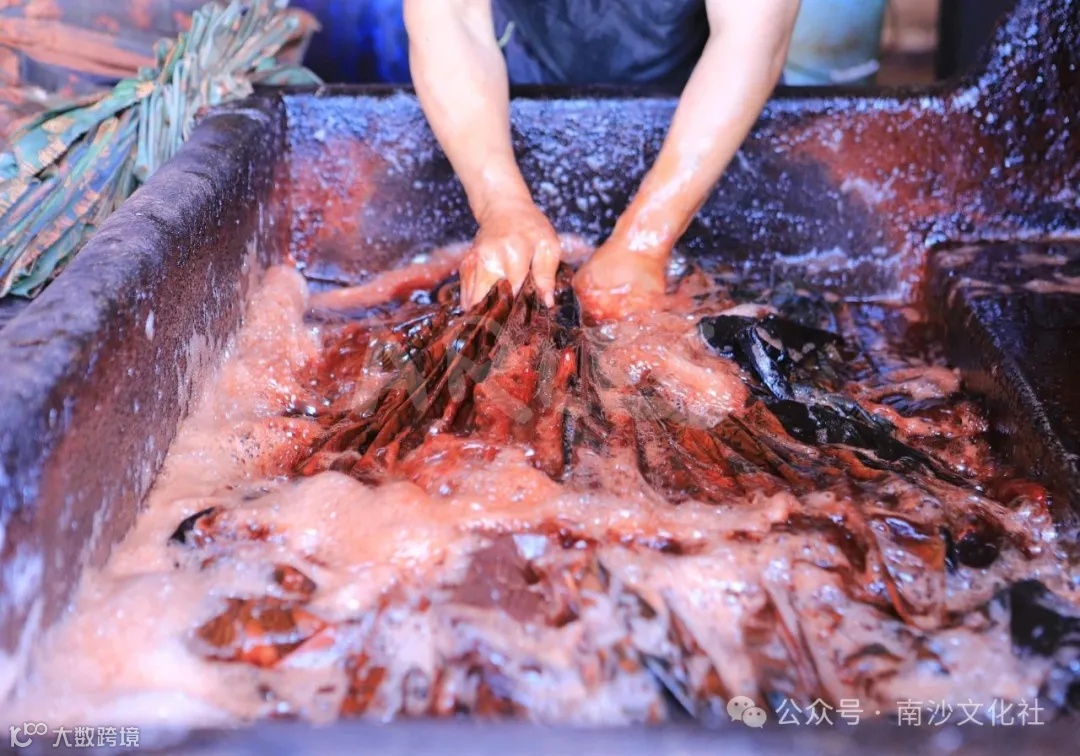
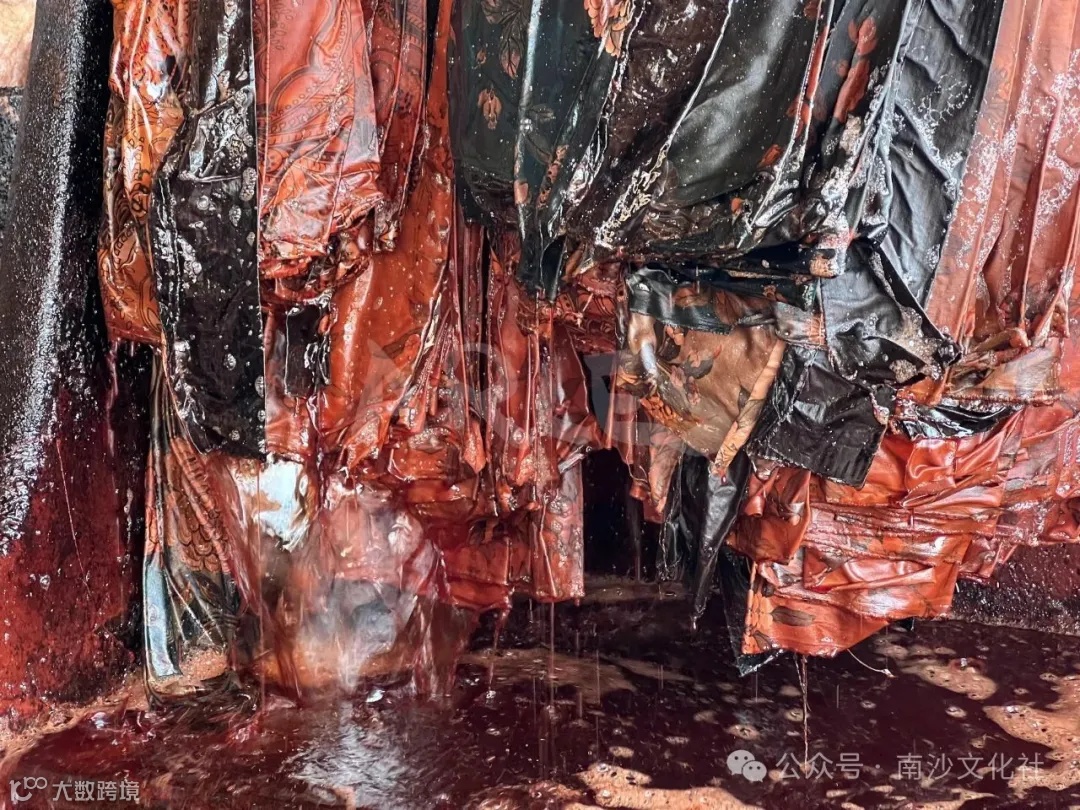
The artisan immerses the initially dyed and sun-dried base silk into a special dyeing vat, using a Shaliang liquid of 'three-pass water' concentration for dip-dyeing. The hands must constantly turn and agitate the silk to ensure it fully absorbs the dye, producing a characteristic 'gurgling' sound between the fabric layers. The core of this step is to ensure uniform coloring of both the fibers and the interwoven points. The artisan must apply steady pressure and knead the silk, carefully observing the depth of the color and extending the immersion time for lighter areas. Although manual operation makes absolute uniformity difficult, excessive color variation would directly affect the final jet-black lustrous effect. After thorough immersion, the silk is draped over bamboo poles to drain any excess liquid, which is then collected and reused.
Secondary Setting: Sun-Drying for Color Fixation
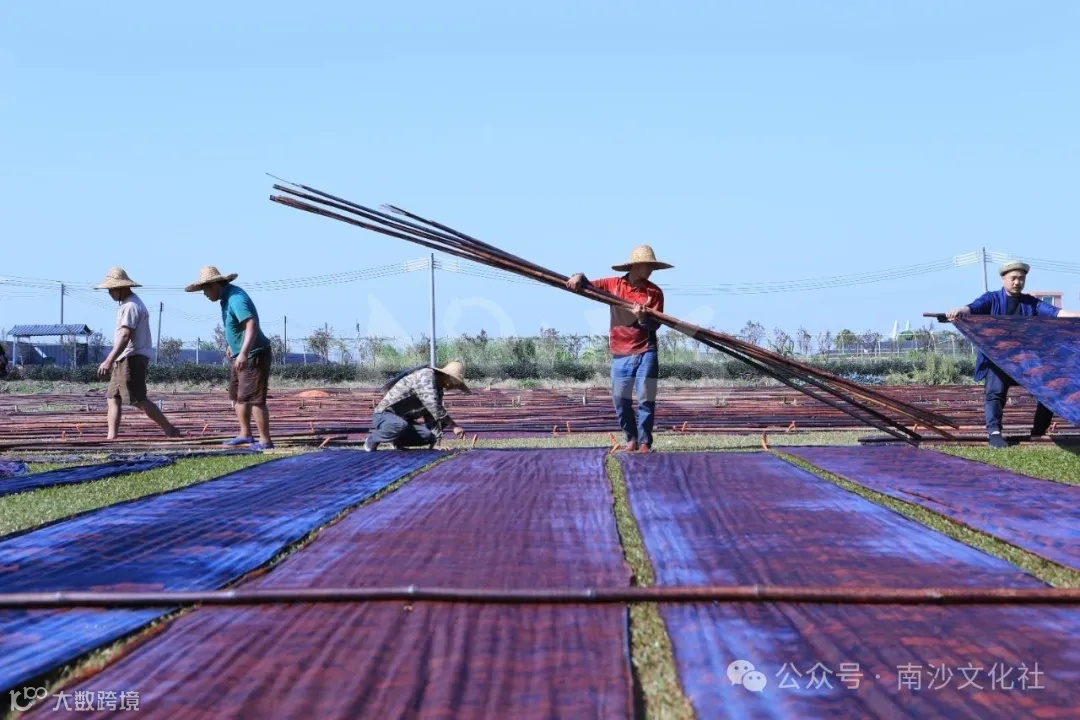
The secondary sun-drying process is similar to the first; however, the base silk, having undergone initial nailing and stretching for setting, is now less prone to edge curling. Workers spread it flat on the grass, using a broom made of palm leaves to gently sweep away any bubbles formed by the Shaliang juice. Arrays of bamboo poles are then used to weigh down the edges. At this stage, the sun-drying field resembles a vibrant orange-red ocean, particularly striking against the backdrop of the green grass. According to technical data, if the brightness and saturation of the undyed white silk are considered 0%, and the finished Xiangyun Sha is 100%, then after the first dyeing, sun-drying, and drying cycle, approximately 20% of the final product's characteristics are achieved, laying the foundation for the subsequent gradual dyeing.
Experience-Based Dye Adjustment: Re-Sealing with Shaliang Juice
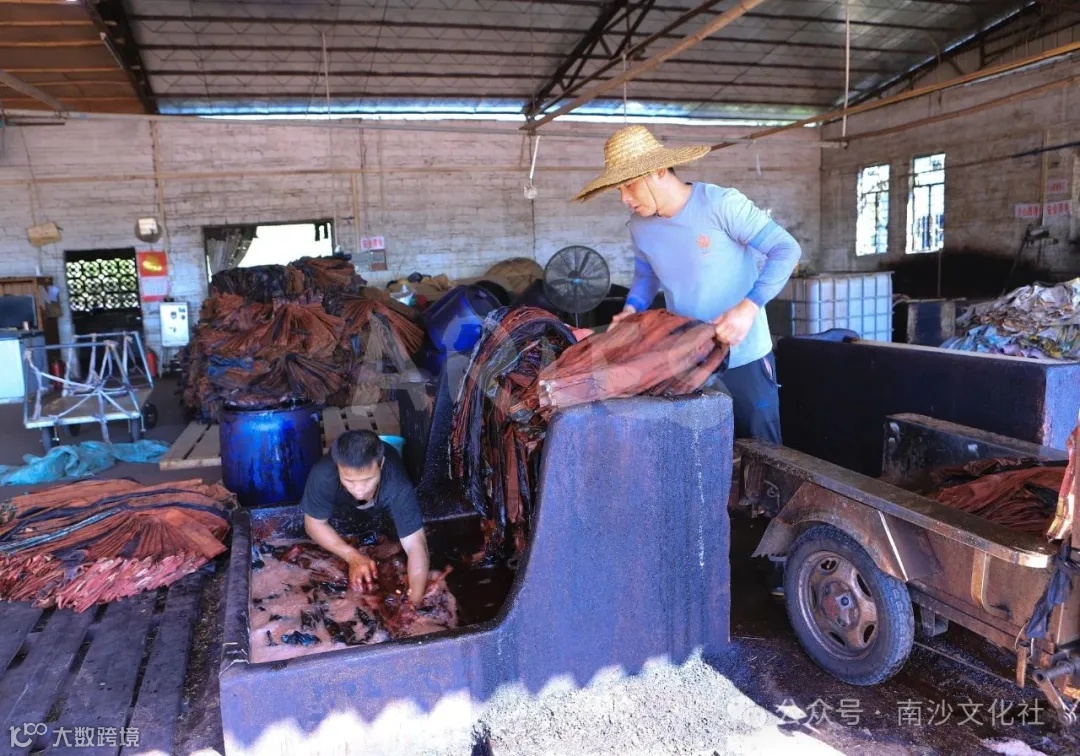
Before the second sealing with Shaliang juice, the artisans make precise adjustments to the dye concentration based on the results of the first dyeing and sun-drying cycle. Typically, a 1:1 ratio of 'three-pass water' Shaliang liquid to clear water is used. If the color development from the first sun-drying was insufficient, less water is added; if it was excessive, more water is added for dilution. This subtle judgment is entirely based on passed-down experience and is often a collaborative effort between a master and apprentice standing at opposite ends of the dyeing vat. After the dye liquid is poured in, workers press the base silk into the vat, repeatedly turning it to ensure it becomes fully saturated with the Shaliang juice. To enhance penetration, the master and apprentice may even tread on the silk with their bare feet. Years of this labor stain their hands, feet, and even their clothing a deep brown-black, becoming a silent testament and physical imprint of their craftsmanship.
Tempered by Scorching Sun: The Efficacy of Repeated Sun-Drying
Upon completion of the second dyeing around 10 a.m., the base silk is spread out on the drying field again. The sun is intense at this time, with heat waves shimmering. Although the workers wear long sleeves and straw hats, their sweat still drips between the silk and the grass. The strong near-noon sunlight causes the silk to dry quickly, fixing and enhancing the color. When the workflow is tight, two to three cycles of dyeing and sun-drying can be completed in a single morning. This high-intensity labor continues until the midday break, and at least two more cycles must be completed in the afternoon.
Cyclical Progression: The Rhythm of Six Cycles
The subsequent sealing with Shaliang juice and sun-drying follow the same fundamental logic: the artisans assess the results of the previous cycle and dynamically adjust the concentration of the Shaliang liquid for the current one (often using a diluted mixture of 'three-pass' or 'two-pass' liquid). The silk is turned for thorough immersion and then exposed to the scorching sun. This cycle is repeated six times in total. The key lies in the gradual nature of the dyeing: the color must build up steadily, with the brightness and saturation progressively increasing from around 20% to 100%. Any hasty advancement—such as using highly concentrated Shaliang liquid to reduce the number of steps—will result in a final product that is dull, thin, lacking the glossy, oily texture, and devoid of the rich, deep black foundation. This is precisely the flaw in some inferior modern "Xiangyun Sha" products, which causes significant damage to the traditional craft.
Traditional Xiangyun Sha adheres to the principle of six immersions and six sun-drying cycles. However, to meet the demands of new product development—whether seeking deeper intensity or lighter shades—the number of sealing cycles can be appropriately adjusted. Each round of dyeing and sun-drying represents both harmony with nature and the perseverance of the artisan, ultimately transforming plain silk into an Oriental treasure of shimmering elegance.

NALANGE CHRONICLES
Editor-in-Chief: Wang Xuan
Photographer: Xiao Tie
Calligrapher: Zhi Ming
Costumes: WURAY MIRACLE, YUNSHA STAR RHYME
Dedicated to promoting Xiangyunsha silk as China’s intangible cultural heritage.
Email: 1399229194@qq.com