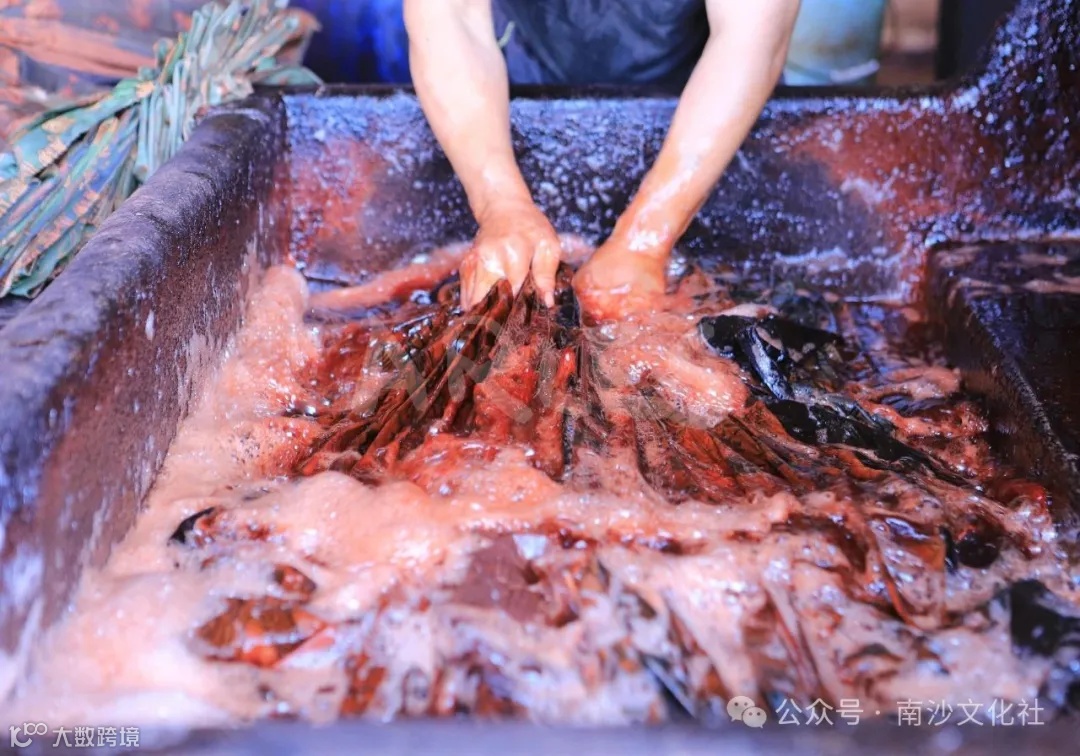
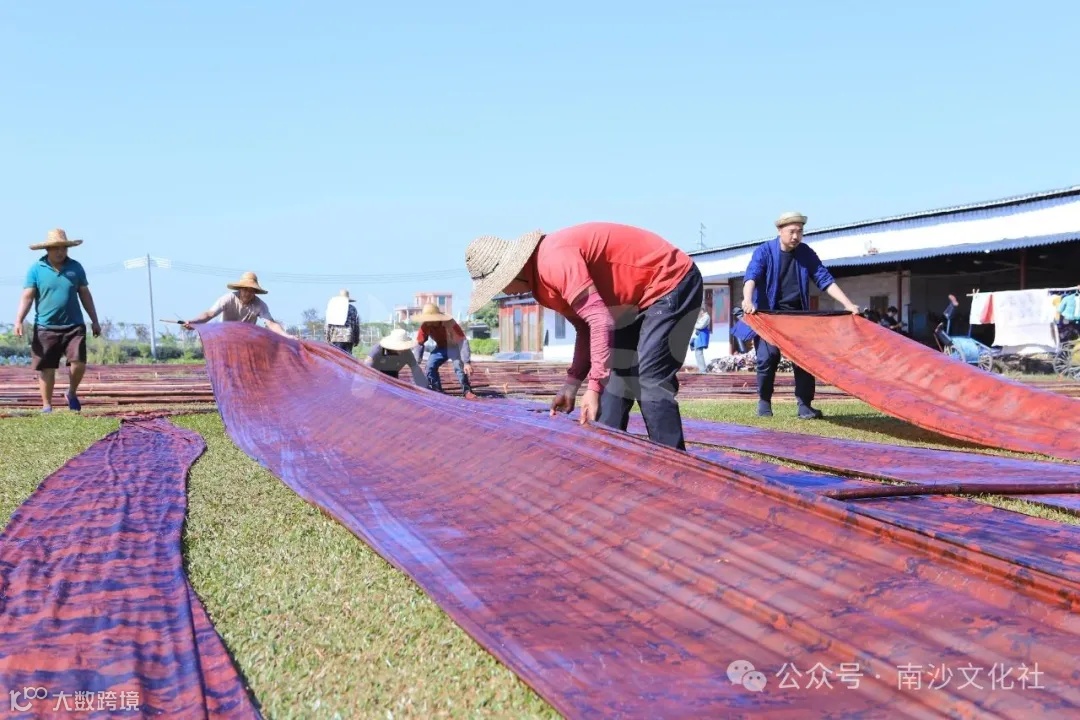
Step 9 in Dyeing and Finishing: Apply Liangshui Seal Twelve Times and Sun-Dry
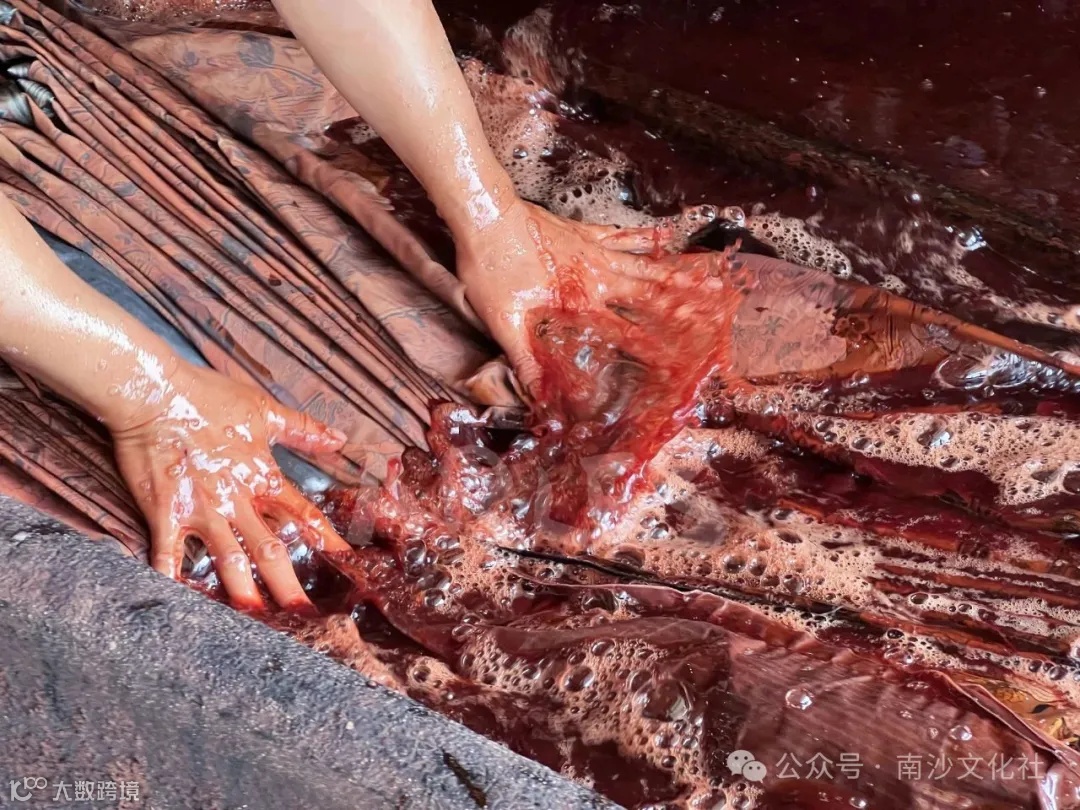
The gauze silk is soaked and sun-dried 12 times using the "Four Water Passes" method. The operational steps are the same as those in Step 6 of the dyeing and finishing process. As this has been shared previously, it will not be repeated here. You can click the image below to view the original post for details.
What is "Four Water Passes"?
"Four Water Passes" (also known as dreg water) refers to the dye liquid with the highest concentration of Shuliang (a type of tuber). It is typically used for the first dyeing of raw silk fabric. Workers toss the Shuliang tubers into a grinder while simultaneously channeling water into the machine via a hose connected to a nearby faucet. A large wooden barrel is placed at the slurry outlet. Once the grinder is started, a brown-red Shuliang juice, still containing dregs, flows into the barrel. When the barrel is full, workers pour its contents into a sedimentation tank, adding a specific proportion of water. This initially extracted Shuliang juice is left to settle for 24 hours. It is then filtered through a mesh screen into a filtering tank. Once the storage tank is filled with the Shuliang juice, it is transferred using barrels or a pump, passing through a bamboo sieve, into the first "water pass" tank—this is the "First Water Pass." Subsequently, more water is added to the sedimentation tank to further soak and filter the Shuliang dregs. The resulting liquid is similarly pumped through a bamboo sieve into the second "water pass" tank, and this liquid is called the "Second Water Pass." Following this sequence, there are also the "Third Water Pass," "Fourth Water Pass," and "Fifth Water Pass."

NALANGE CHRONICLES
Editor-in-Chief: Wang Xuan
Photographer: Xiao Tie
Calligrapher: Zhi Ming
Costumes: WURAY MIRACLE, YUNSHA STAR RHYME
Dedicated to promoting Xiangyunsha silk as China’s intangible cultural heritage.
Email: 1399229194@qq.com