



柔性支架的类型
Types of Flexible Support Structures
1
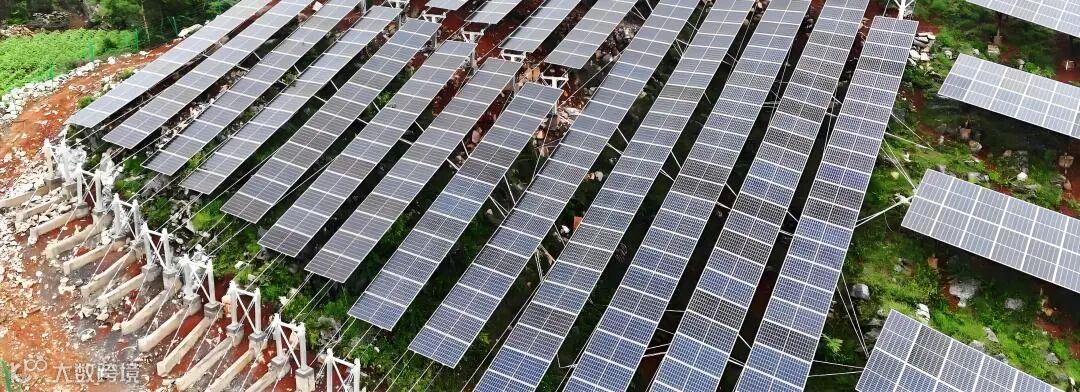
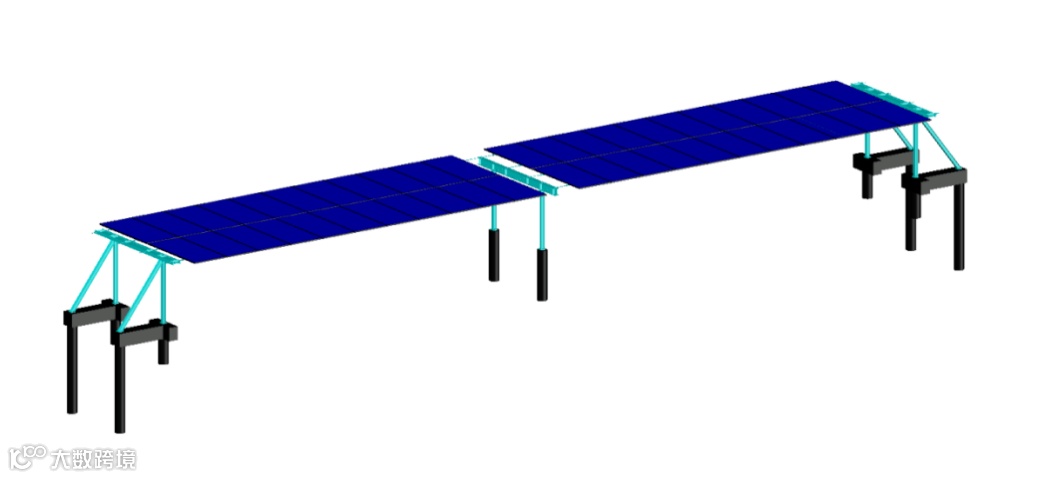
单层悬索结构一般由梁柱组成的主钢架、斜拉、索体等主要构件组成,索体为两道平行于组件平面的拉索,使用索体代替一般受拉构件。组件支承索张拉完成后经由钢梁端部的锚具固定,通过张拉设备使支承索获得应力刚度,用于支承组件,依靠端部斜拉形成自平衡体系。
The single-layer suspension structure generally consists of a main steel frame made of beams and columns, stay cables, and the cable body. The cable body includes two parallel cables aligned with the component plane, replacing the usual tensile members. After tensioning the support cables, they are anchored at the ends of the steel beams using anchors, providing the cables with stress rigidity to support the components. This forms a self-balancing system through the end stay cables.
优点:形式简单、受力模式单一、地形适应性强、施工效率高。
Advantages: Simple form, single-force mode, strong adaptability to terrain, and high construction efficiency.
缺点:采用全柔性体系,结构整体刚度弱,在风压或风吸力作用下,易产生较大变形,难以实现更大跨度。
Disadvantages: Being a fully flexible system, the overall structural rigidity is weak, making it prone to significant deformation under wind pressure or suction, limiting its ability to achieve larger spans.
适用条件:
跨度:≤20m基本风压:≤0.5kN/m^2,超过0.5kN/m^2宜设置防风装置。
Applicable Conditions:
Span: ≤ 20m, Basic Wind Pressure: ≤ 0.5kN/m². If the wind pressure exceeds 0.5kN/m², windproof devices should be installed.
应用场景:
1)沙漠、鱼塘、农棚、停车场等平地
2)坡度陡峭的山地
Application Scenarios:
1) Flat areas such as deserts, fish ponds, agricultural sheds, and parking lots.
2) Steep slopes in mountainous regions.
双层索桁架结构
Double-Layer Cable Truss Structure
双层索桁架结构由梁柱组成的主钢架、斜拉、索体以及索体间的刚性撑杆组成,索体由两道平行的上弦索与一道曲率向上的下弦索构成。与单层悬索结构相比,多了承重索和刚性撑杆,通过张拉索体获得应力刚度形成自平衡体系。
The double-layer cable truss structure consists of a main steel frame made of beams and columns, stay cables, the cable body, and rigid braces between the cables. The cable body comprises two parallel upper chord cables and a lower chord cable with an upward curvature. Compared to the single-layer suspension structure, it includes an additional load-bearing cable and rigid braces, forming a self-balancing system by tensioning the cable body to achieve stress rigidity.
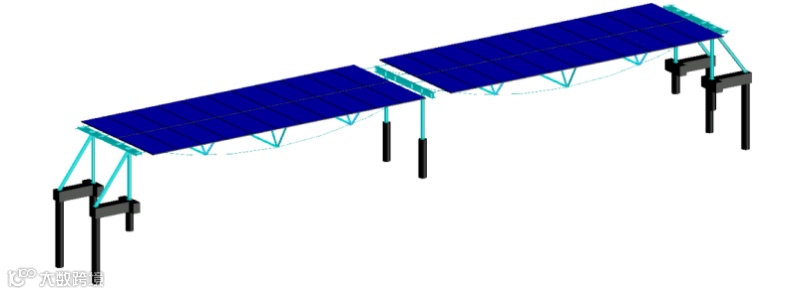
优点:索体张拉后由锚具固定于支承结构上,组件支承索用于支承组件,承重索抵抗向下的竖向荷载,结构具有较大的刚度和抗变形能力。
Advantages: After tensioning, the cable body is anchored to the supporting structure, with support cables for supporting components and load-bearing cables resisting downward vertical loads, providing significant rigidity and deformation resistance.
缺点:未设置稳定索,风吸力由组件支承索承担,结构对风吸力较为敏感,不宜用于大跨度结构或基本风压较大地区。
Disadvantages: Without stabilizing cables, the structure is sensitive to wind suction, making it unsuitable for large-span structures or areas with high basic wind pressure.
适用条件:
跨度:20m~30m基本风压:≤0.5kN/m2
Applicable Conditions:
Span: 20m ~ 30m, Basic Wind Pressure: ≤ 0.5kN/m².
应用场景:
1)河道、鱼塘、停车场等平地
2)坡度平缓、高差较大的山地索桁架结构,因其跨度较大,为保证结构面外稳定,通常做成联排形式,设置面外稳定索,防止发生面外失稳。
Application Scenarios:
1) Flat areas such as riverbeds, fish ponds, and parking lots.
2) Gently sloping mountainous areas with significant elevation differences. Due to its larger span, the cable truss structure is typically arranged in parallel rows with out-of-plane stabilizing cables to prevent out-of-plane instability.
三层索桁架结构
Triple-Layer Cable Truss Structure
三层索桁架结构由梁柱组成的主钢架、斜拉、索体以及索体间的刚性撑杆组成。与双层索桁架相比,索体增加了稳定索,形成曲率相反的上下弦结构,稳定索用于抵抗风吸力作用。
The triple-layer cable truss structure consists of a main steel frame made of beams and columns, stay cables, the cable body, and rigid braces between the cables. Compared to the double-layer cable truss, the cable body includes stabilizing cables, forming an upper and lower chord structure with opposite curvature. The stabilizing cables are used to resist wind suction.
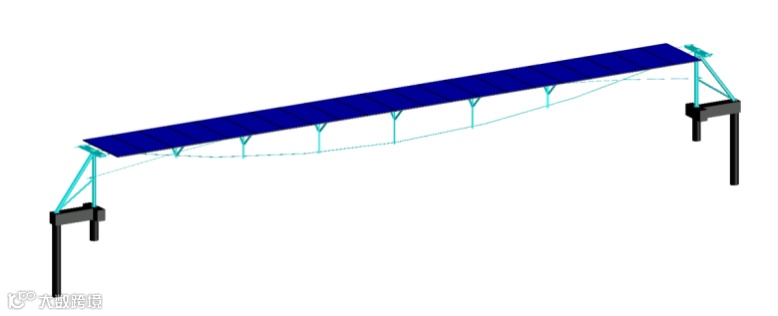
优点:承重索抵抗向下的竖向荷载,稳定索抵抗向上的竖向荷载,结构面内与面外刚度均由预拉力提供,具有良好的刚度和形状稳定性。
Advantages: The load-bearing cables resist downward vertical loads, while the stabilizing cables resist upward vertical loads. The rigidity and shape stability within and outside the plane are provided by the pre-tensioning, ensuring good structural rigidity and stability.
缺点:结构形式较复杂,三层索均需施加预拉力,张拉过程较繁琐,为避免预拉力施加过程中支承构件产生过大的弯矩和变形,需严格把控施工工序和施工质量。
Disadvantages: The structural form is more complex, requiring pre-tensioning for all three layers of cables. The tensioning process is complicated, and construction processes and quality must be strictly controlled to avoid excessive bending moments and deformations in the supporting members during pre-tensioning.
适用条件:
跨度:20m~60m基本风压:适用范围广
Applicable Conditions:
Span: 20m ~ 60m, Basic Wind Pressure: Suitable for a wide range of conditions.
应用场景:
1)污水厂、水库、滩涂等大平地
2)坡度缓、高差大、跨度大的山地
Application Scenarios:
1) Large flat areas such as sewage treatment plants, reservoirs, and tidal flats.
2) Gently sloping mountainous areas with significant elevation differences and large spans.
张弦结构
Tensile String Structure
张弦结构是由梁柱组成的主钢架、斜拉、刚性上弦、索体及刚性撑杆组成。索体为承重索,与三层索桁架相比,无稳定索。上弦采用刚性结构,下弦采用柔性拉索,在预应力作用下,撑杆对上弦起到弹性支承作用,以改善上部结构的受力状态,从而形成自平衡体系。
The tensile string structure consists of a main steel frame made of beams and columns, stay cables, a rigid upper chord, the cable body, and rigid braces. The cable body acts as a load-bearing cable, and unlike the triple-layer cable truss, it does not include stabilizing cables. The upper chord is rigid, and the lower chord is a flexible cable. Under the action of prestress, the braces provide elastic support to the upper chord, improving the stress state of the upper structure and forming a self-balancing system.
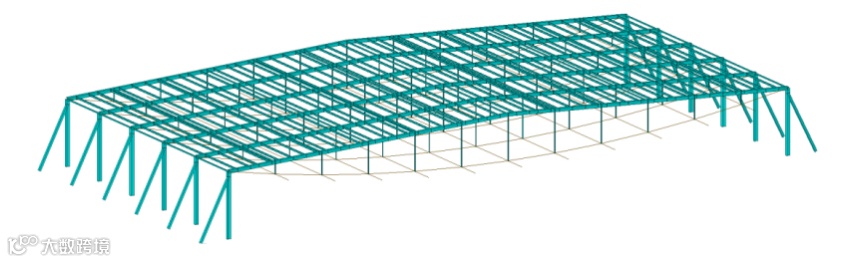
优点:用撑杆连接上部压弯构件和下部受拉构件,通过施加预拉力,使上部结构产生反挠度,提高了上部结构的承载能力与抗变形能力。
Advantages: By connecting the upper compression members with the lower tension members using braces and applying pre-tensioning, the upper structure gains reverse curvature, enhancing its load-bearing capacity and deformation resistance.
缺点:相对于其他柔性体系,结构整体用钢量较高;属于平面型受力体系,存在面外失稳问题。
Disadvantages: Compared to other flexible systems, the overall steel consumption of the structure is relatively high. It is a planar force system with potential out-of-plane instability issues.
适用条件:
跨度:30m以上基本风压:适用范围广
Applicable Conditions:
Span: Over 30m, Basic Wind Pressure: Suitable for a wide range of conditions.
应用场景:
污水厂、厂房、矿坑等平地
Application Scenarios:
Flat areas such as sewage treatment plants, factories, and mines.
|
||||||||
点击蓝字,关注我们