大数跨境

汪国秀教授EnSM综述:柔性锂金属电池研究进展-复合锂金属负极&固态电解质

汪国秀教授EnSM综述:柔性锂金属电池研究进展-复合锂金属负极&固态电解质 科学材料站
2020-05-03
1
导读:本文综述了柔性LMBs的最新研究进展,重点介绍了具有高柔性和高安全性的复合Li金属负极和固态电解质的设计。
Available online:1 May 2020
悉尼科技大学

导读

近年来,柔性锂金属电池(LMBs)因其具有高能量密度被认为是下一代柔性、耐磨电子器件的理想电源。然而,由于锂枝晶的生长,使用金属锂负极不可避免地会造成安全隐患。本文综述了柔性LMBs的最新研究进展,重点介绍了具有高柔性和高安全性的复合Li金属负极和固态电解质的设计。首先简要介绍了柔性LMB及其相关的负极和电解质。接着,详细介绍了柔性复合锂金属负极的制备方法,包括传统的电沉积方法发展到热浸镀和机械轧制方法。介绍了固态电解液在可成型陶瓷、聚合物和杂化电解液方面的最新进展。本文还对高能量密度柔性锂硫电池和锂氧电池进行了全面的综述。最后,提出了先进柔性LMBs的未来发展趋势、挑战和应用前景。

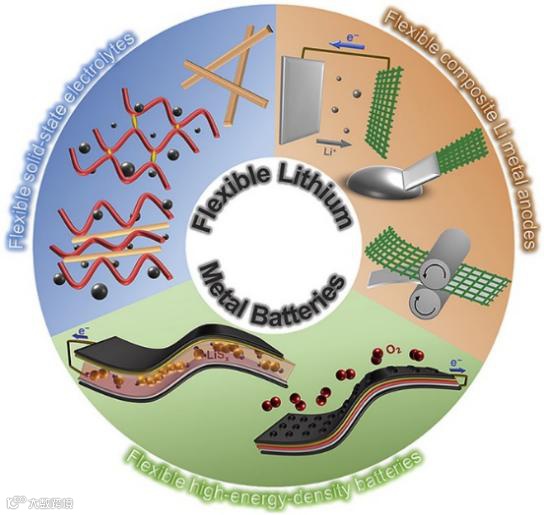
1. 柔性锂金属电池中的柔性复合锂金属负极,固态电解质和高能量密度电池示意图

关键词

柔性锂金属电池,复合锂金属负极,固态电解质,软质锂硫电池,柔性锂氧电池

背景简介

1.   锂金属负极优缺点
锂金属是锂电池的理想负极材料,因为它具有最大的负电势(相对于标准氢电极为-3.04 V)并且是最轻金属(当量重量M = 46.94 g mol-1,比重ρ= 40.53 g cm− 3),因此有助于设计具有高能量密度的储能系统。
缺点之一是由于内部短路导致的严重安全问题,这种内部短路与在Li金属负极的剥离/镀覆过程中形成的苔藓样Li枝晶有关。另一个问题是,通常使用的无支撑的” Li金属负极Li沉积过程中存在几乎无限的相对体积膨胀,从而导致固体电解质界面(SEI)层的机械稳定性差,库仑效率低和寿命缩短。

2.固态电解质优缺点、应用条件
固态电解质(SSE)被认为是柔性LMB中的一种有潜力的发展方向,它具有高环境安全性,强大的机械性能,良好的化学稳定性可塑性,宽电压适应性可满足对高能量密度和安全性的需求。但是,SSE的室温离子电导率很差(<10-5 S cm-1),并且与电极的浸润性
因此,将其应用于柔性LMB中时需满足以下条件:
1)在室温下将离子电导率提高到10−4 S cm-1
(2)平滑SSE与金属Li负极之间的界面,以确保低阻抗的锂离子传输;
(3)增强机械柔韧性和韧性,以防止SSE破裂,以及在剥离/镀覆过程中防止树枝状晶体腐蚀。

3.一些可能的解决方案来克服SSE的固有缺点
(1)制造纳米纤维或纳米线形陶瓷电解质以提高柔韧性;
(2)在固体聚合物电解质中使用交联方法或/和构建单离子导电聚合物,以提高离子电导率和耐树突性;
(2)通过构造陶瓷-聚合物混合电解质来平衡陶瓷和聚合物电解质的特性。

文章介绍

近日,悉尼科技大学汪国秀教授团队在在国际知名期刊Energy Storage Materials上发表题为“Recent progress on flexible lithium metal batteries: Composite lithium metal anodes and solid-state electrolytes”的文章。博士生王时健和熊攀老师为本文共同第一作者。
作者回顾了具有高能量密度、安全性的柔性LMBs的最新进展,包括柔性复合Li负极的合理设计,柔性SSE和实际应用。首先,介绍了基于柔性支架的柔性CLMA制造方法的发展历程。在此基础上,重点介绍了近年来用于无枝晶Li金属负极的可塑SSEs的研究进展。最后,讨论了通过使用可塑的SSEs和CLMAs实现的一些灵活的能量存储系统,例如Li-S电池和Li-O2电池。还讨论了该领域的挑战和前景,以供将来研究。

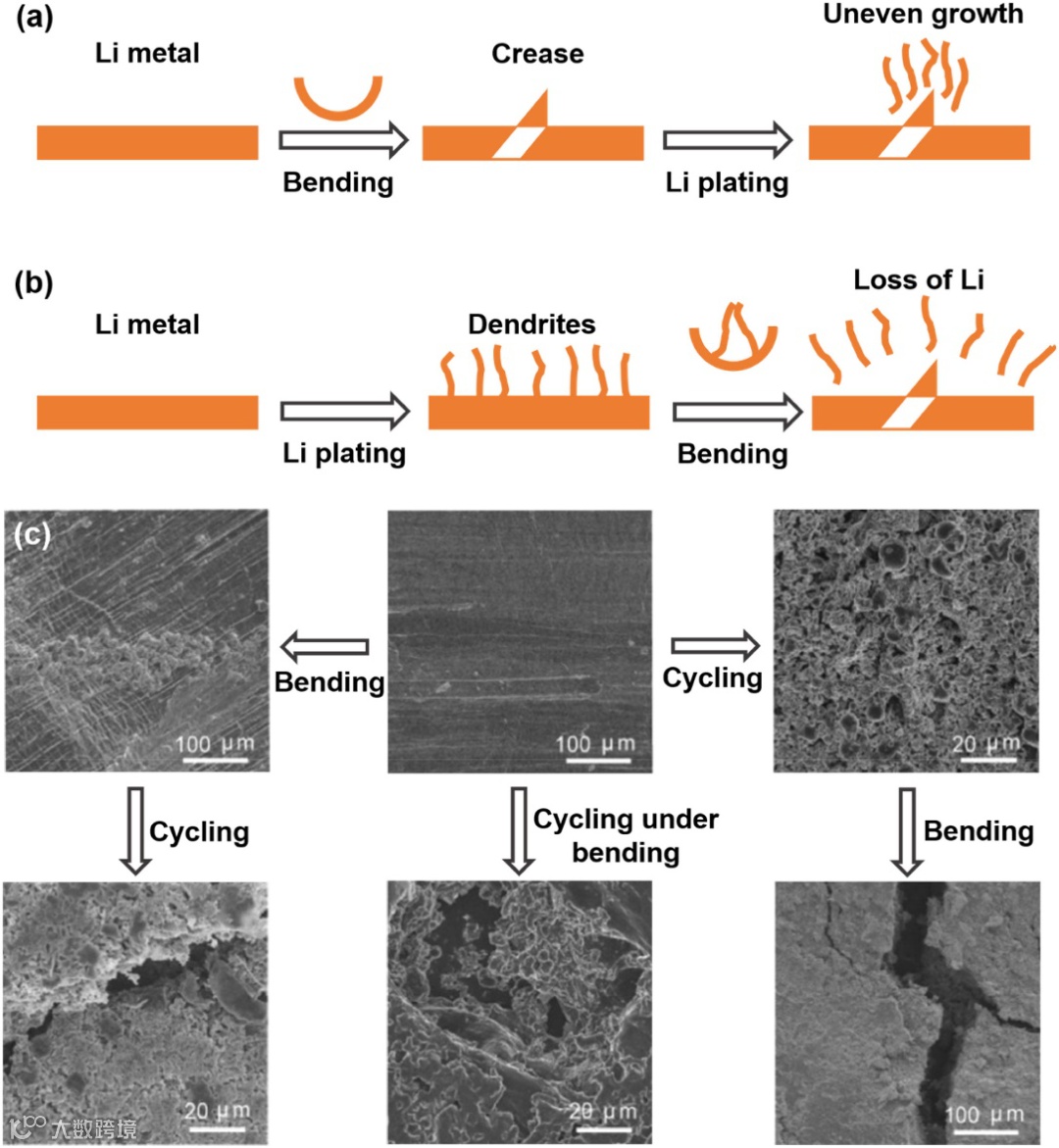
图2.形貌特征
Bending aggravates dendritic growth on Li metal anodes.
(a) Schematic illustration of the mechanism about the uneven growth of Li dendrites associated with a bending-plating process.
(b) Schematic illustration of the mechanism about the formation of “dead” Li (loss of Li) associated with a plating-bending process.
(c) Representative SEM images of Li surface at the initial stage, within a bending-plating cycle, within a plating-bending cycle, and after cycling under bending conditions. Reproduced with permission.
 
3. 电沉积法制备柔性CLMAs
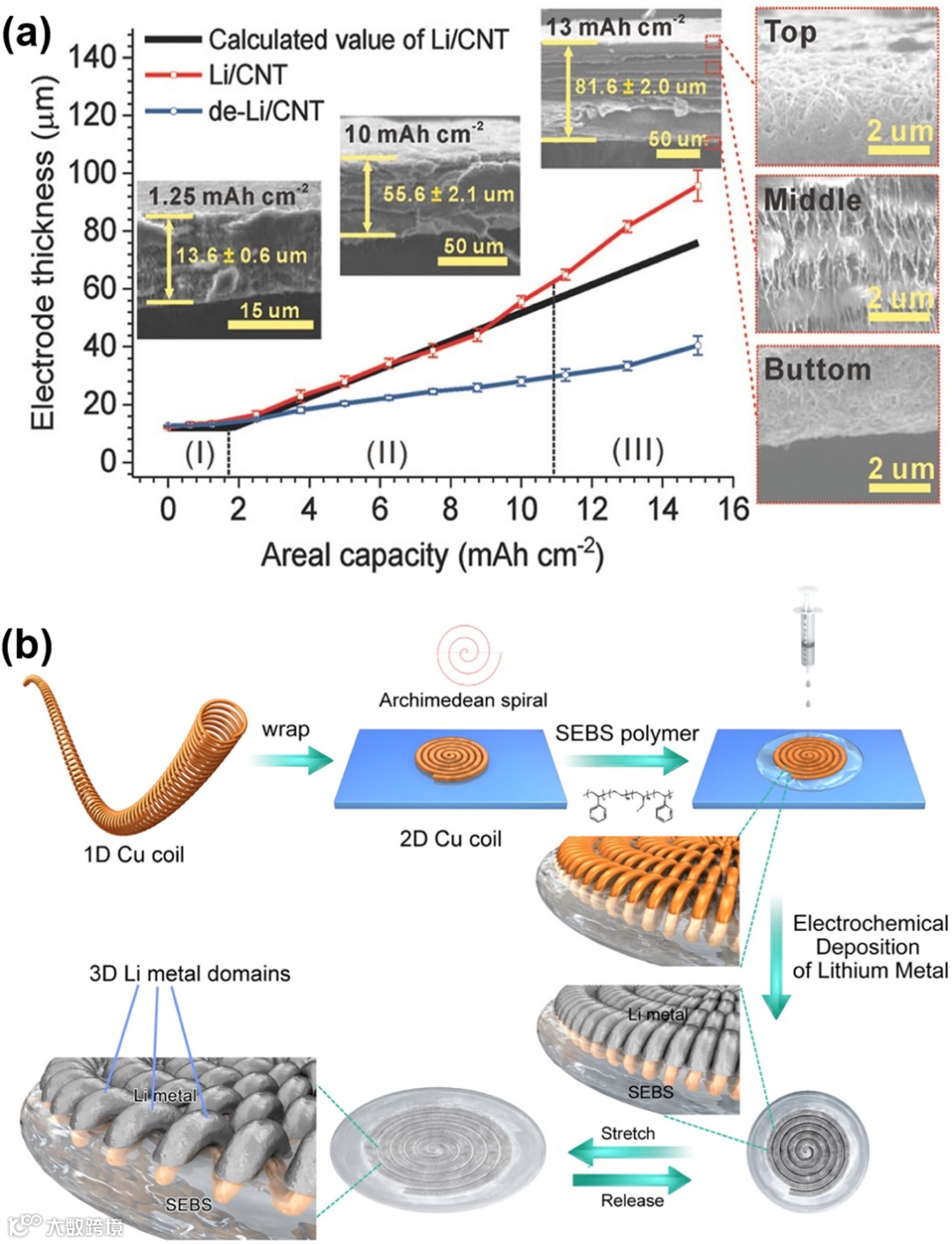
Fabrication of flexible CLMAs by electrodeposition methods.
(a) The relationship of electrode thicknesses of Li/CNT and de-Li/CNT with different Li loadings. Reproduced with permission.
(b) Schematic of the synthesis about the stretchable Li/Cu coil electrode. Reproduced with permission.
 
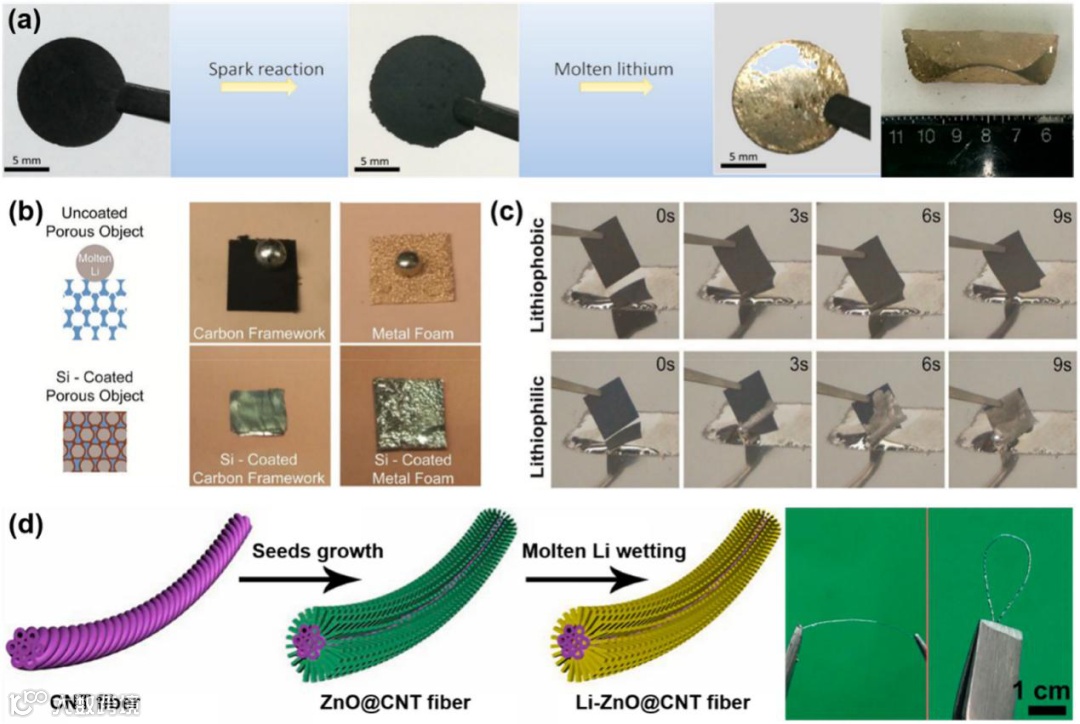
4. 热灌注法制备柔性CLMAs
Fabrication of flexible CLMAs via thermal infusion methods.
(a) Schematic illustration of the synthesis for the Li/MXene/rGO composite anode, and the photograph of the rolled Li/MXene/rGO composite anode. Reproduced with permission .
(b-c) Li wetting ability of various porous materials with and without the Si coating, and time-lapse images of Li melt-infusion process for lithiophilic and lithiophobic materials. Reproduced with permission.
(d) Schematic of the fabrication process for the Li–ZnO@CNT composite anode, and digital photos of the Li–ZnO@CNT fiber under straightening and bending conditions. Reproduced with permission.
 
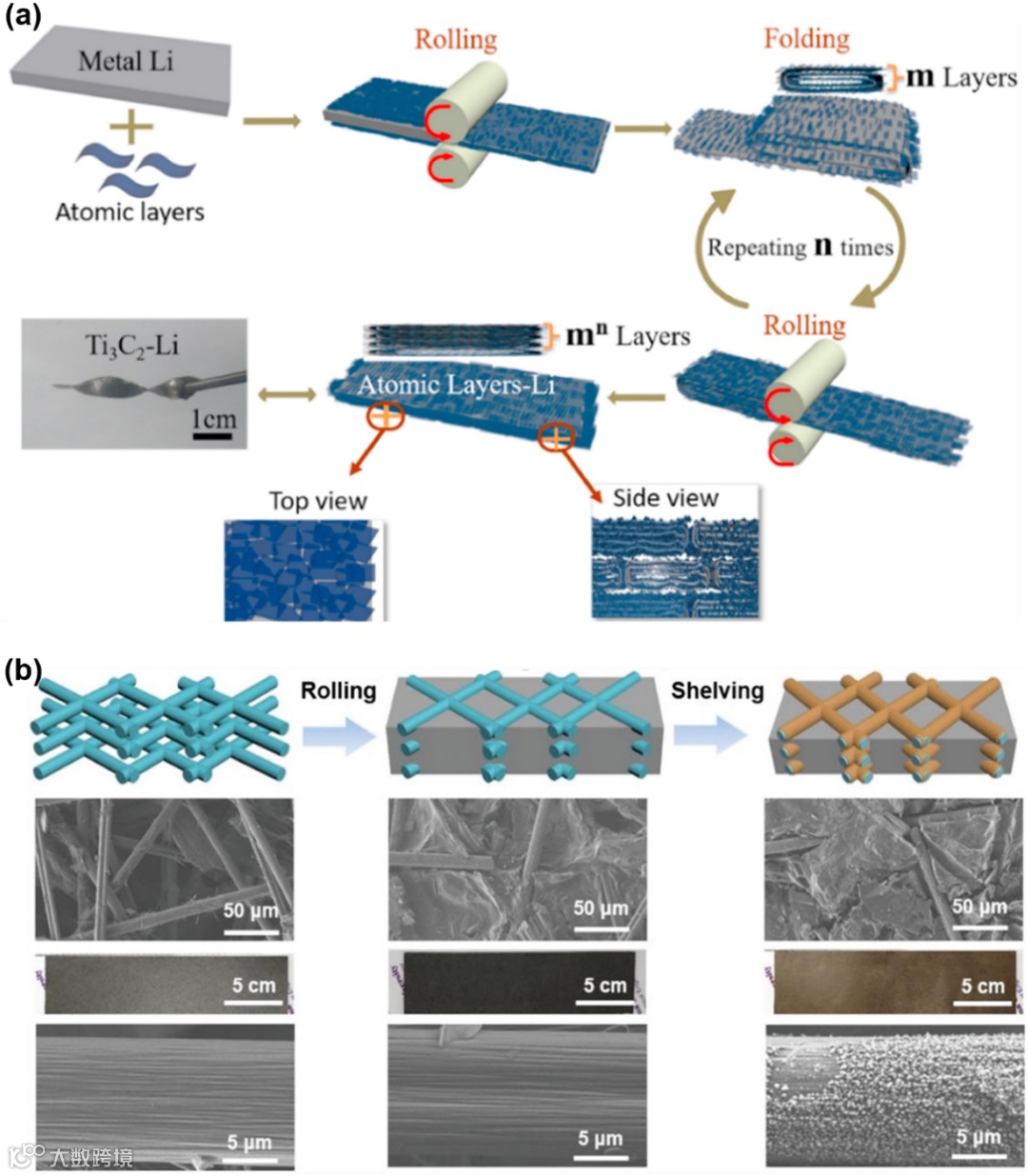
5. 用机械轧制法制造柔性CLMAs
Fabrication of flexible CLMAs through mechanical rolling methods.
(a) Schematic of the synthesis of Ti3C2 MXene-Li composite films. Reproduced with permission.
(b) Schematic illustration for pristine CF, initial Li/CF composite anode, and Li/CF composite anode shelving for 72h with the formation of LiC6 layers, and the corresponding digital and SEM images. Reproduced with permission.
 
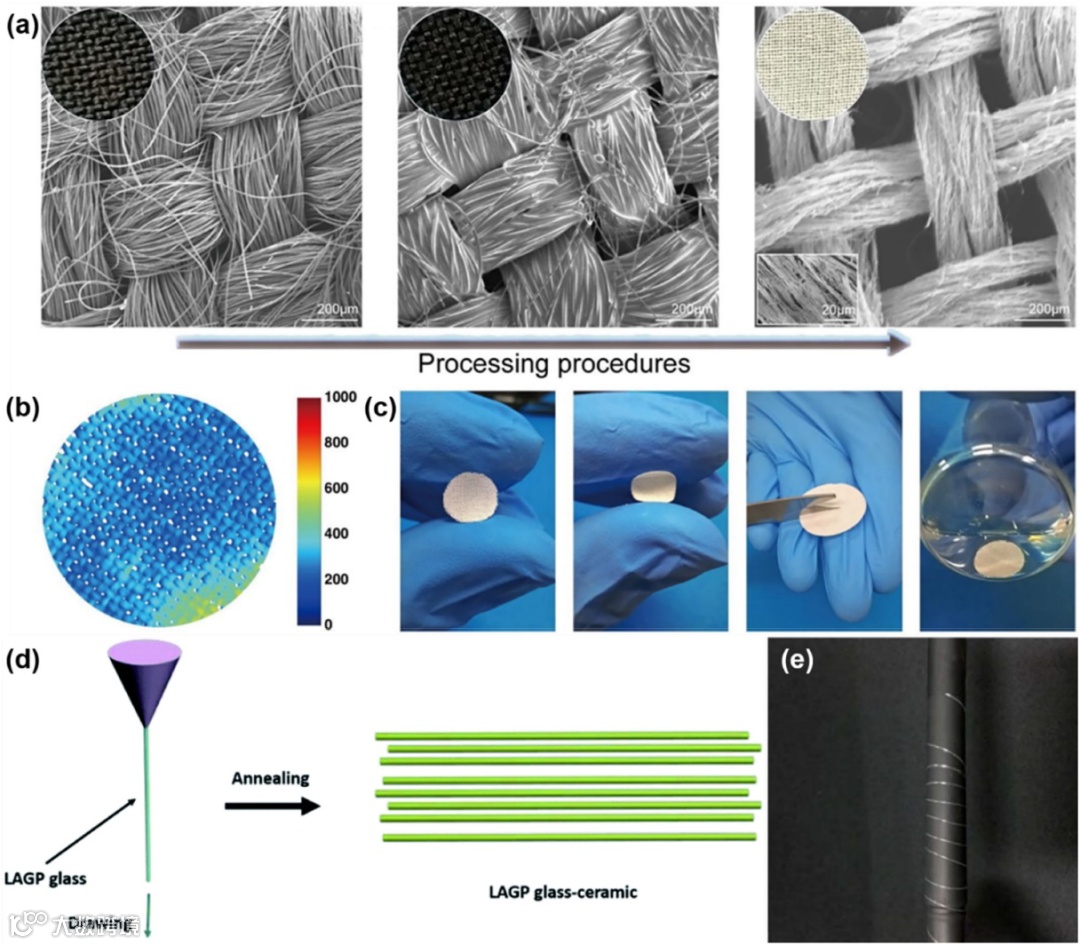
6. 柔性CEs的制造
Fabrication of flexible CEs.
(a-c) Schematic of the fabrication process for flexible CEs using a cellulose template with corresponding digital and SEM images, from a pretreated textile template to a template impregnated with the precursor solution, and finally to a ceramic textile converted from the precursor solution impregnated template; reconstructed model of garnet textile flatness uniformity, generated by 3D laser scanning; flexibility, workability, and solvent tolerance of the garnet textile. Reproduced with permission .
(d-e) Schematic illustration of the synthesis for LAGP glass-ceramic fibers, and optical image of glass-ceramic fibers sample (10mm) rolled on a pencil. Reproduced with permission.

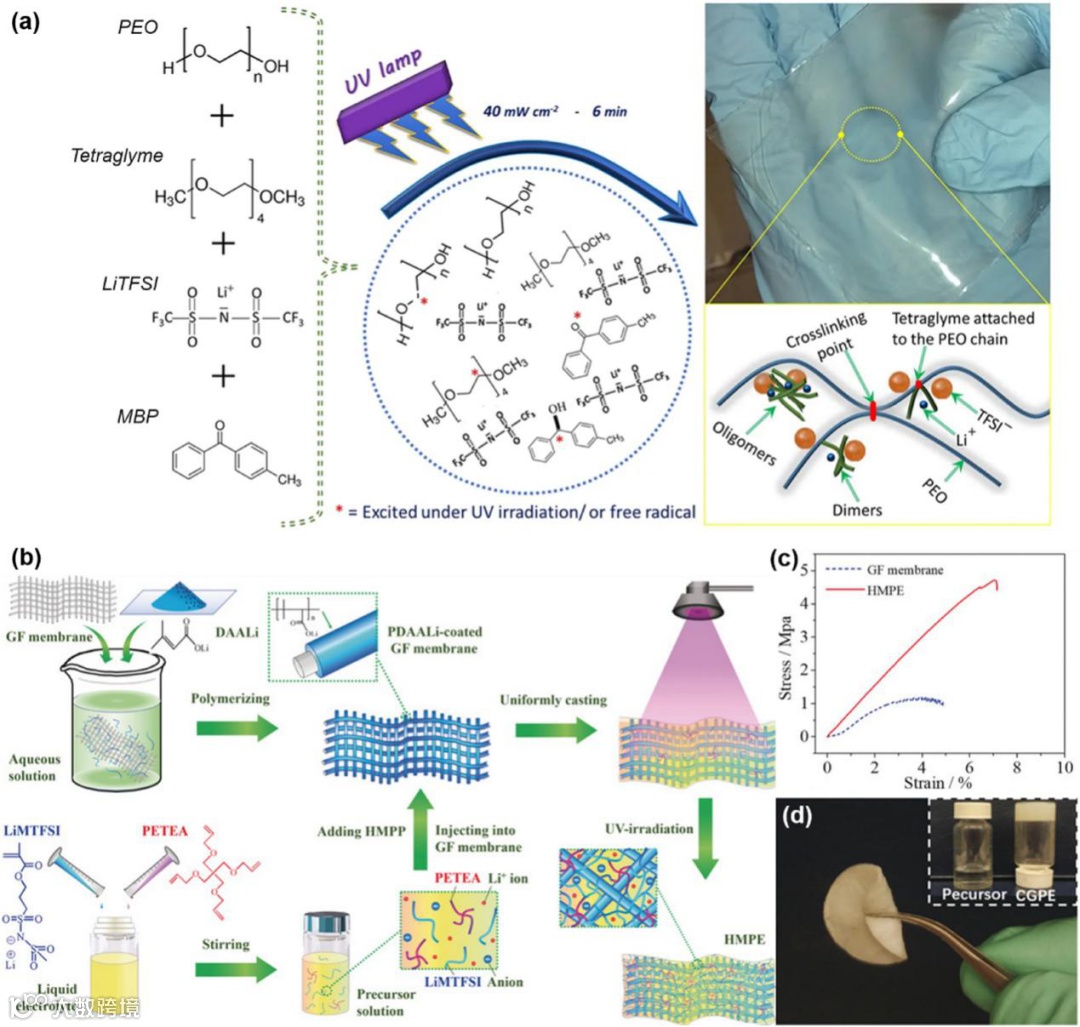
7. 柔性SPE的制造
Fabrication of flexible SPEs.
(a) Schematic illustration of the preparation of a cross-linked solid polymer electrolyte with the assistance of UV curing, and the photograph of the obtained electrolyte film, in which PEO chains interconnect with hypothesized branched clusters of tetraglyme oligomers. Reproduced with permission.
(b-d) Schematic illustration of the preparation of HMPE; stress-strain curves of the pristine GF membrane and HMPE film; and optical images of HMPE film (inset corresponding to the precursor solution and the CGPE). Reproduced with permission.,
 
图8. 用零维陶瓷填料制备HCPEs
Fabrication of HCPEs with 0D ceramic fillers.
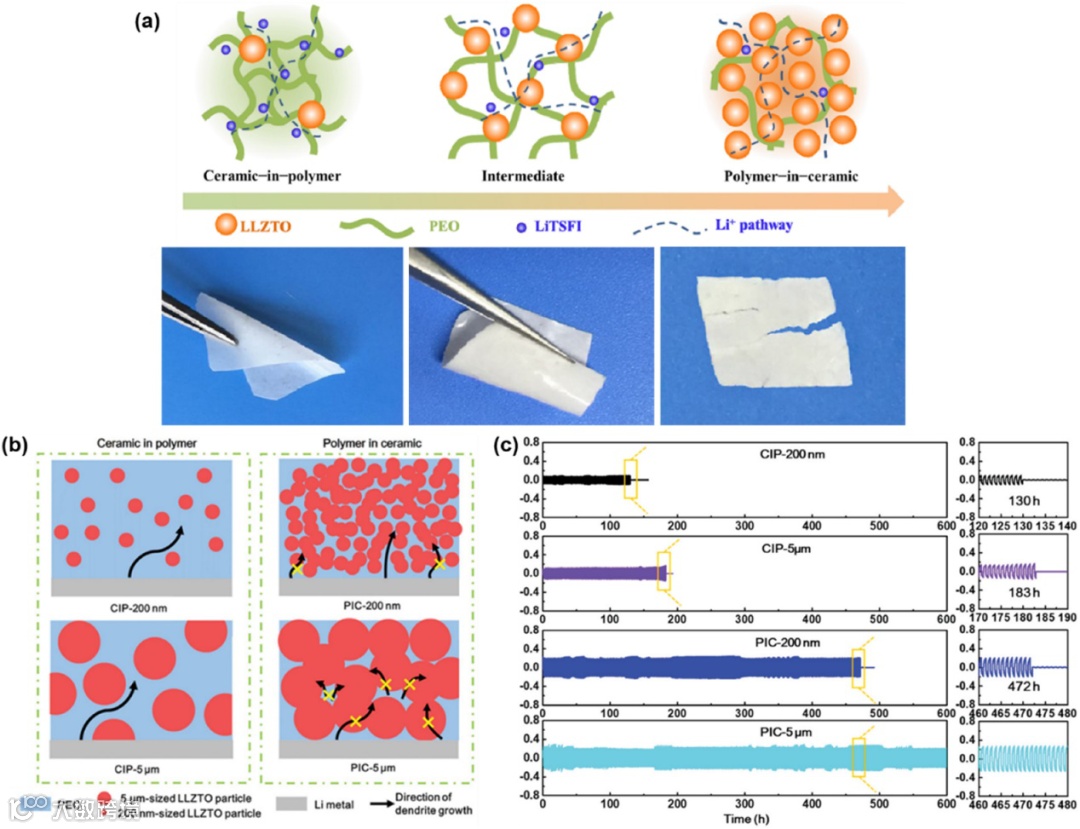
(a) Schematic illustration for “ceramic-in-polymer”, “intermediate”, and “polymer-in-ceramic” types of PEO-LLZTO hybrid electrolytes and the corresponding flexibility. Reproduced with permission [91]. Copyright 2018, Elsevier.
(b-c) Schematic illustrations of possible dendrite growth in four HCPEs; and the corresponding voltage profiles of Li–Li symmetrical cells with these hybrid electrolytes. Reproduced with permission.
 
图9.用一维陶瓷填料制备HCPEs
Fabrication of HCPEs with 1D ceramic fillers.
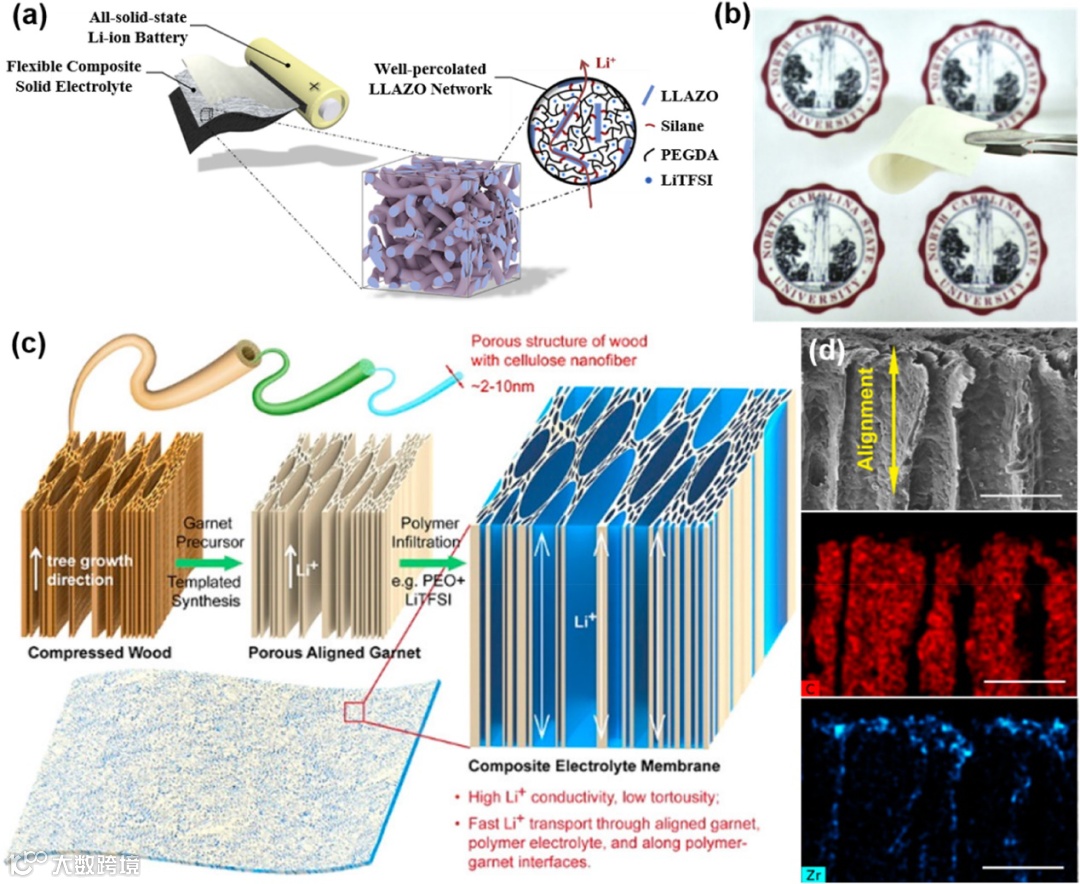
(a-b) Schematic of the s@LLAZO-PEGDA hybrid electrolyte with fast and no tortuous Li conductive pathways, and the digital image of bendable s@LLAZO-PEGDA film. Reproduced with permission.
(c-d) Schematic of the fabrication process of multi-scale aligned mesoporous garnet membrane incorporated with polymer electrolyte, and SEM and EDX images of aligned garnets throughout with completely and uniformly infiltrated PEs. (Scale bars=100μm). Reproduced with permission.
 
10. 二维陶瓷填料制备HCPEs
Fabrication of HCPEs with 2D ceramic fillers.
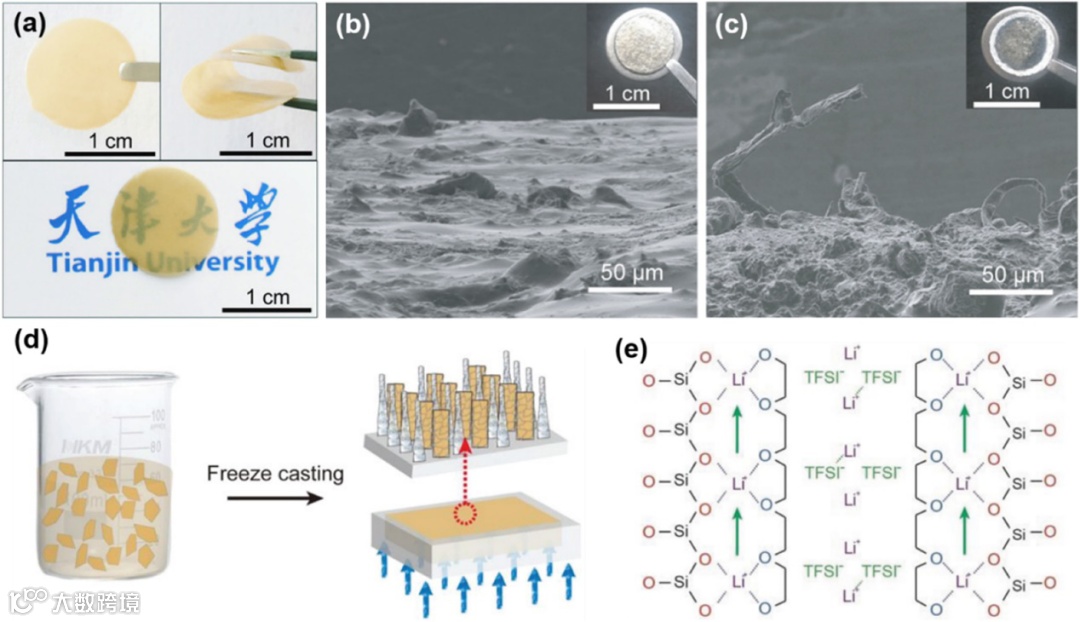
(a-c) Photographs of the PEO/LiTFSI/VS hybrid films, cross-section SEM images of Li electrode surface on PEO/LiTFSI SPEs with and without VS, after the test for a half month (with inset digital photos of Li electrodes). Reproduced with permission.
(d-e) Schematic of a freeze casting method for the preparation of the vertically aligned VS-supported hybrid ceramic-polymer electrolyte, and the corresponding mechanism schematic of Li+ transport. Reproduced with permission.
 
11.柔性Li-S电池
Flexible Li–S batteries.
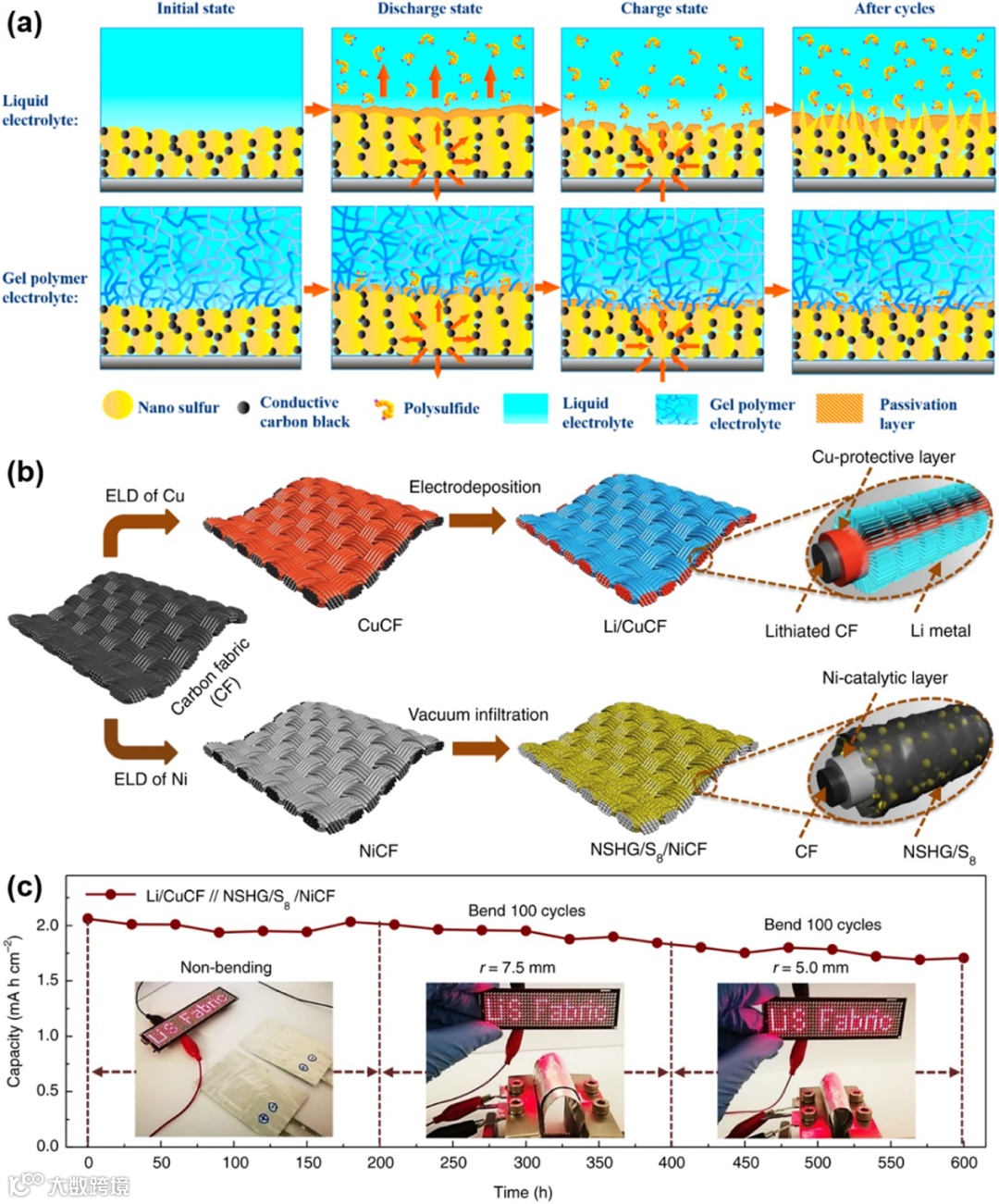
(a) The immobilization mechanism for polysulfides in PETEA-based PEs, compared with liquid electrolytes. Reproduced with permission [167]. Copyright 2016, Elsevier.
(b-c) Schematic of the fabrication process and a design principle for the flexible Li/CuCF composite anode and flexible NSHG/S8/NiCF cathode, and the bending tolerance testing of the Li–S pouch cells at various bending radius of (i) r=∞, (ii) r=7.5mm, (iii) r=5.0mm. Reproduced with permission.

12.柔性Li-O2电池
Flexible Li–O2 batteries.
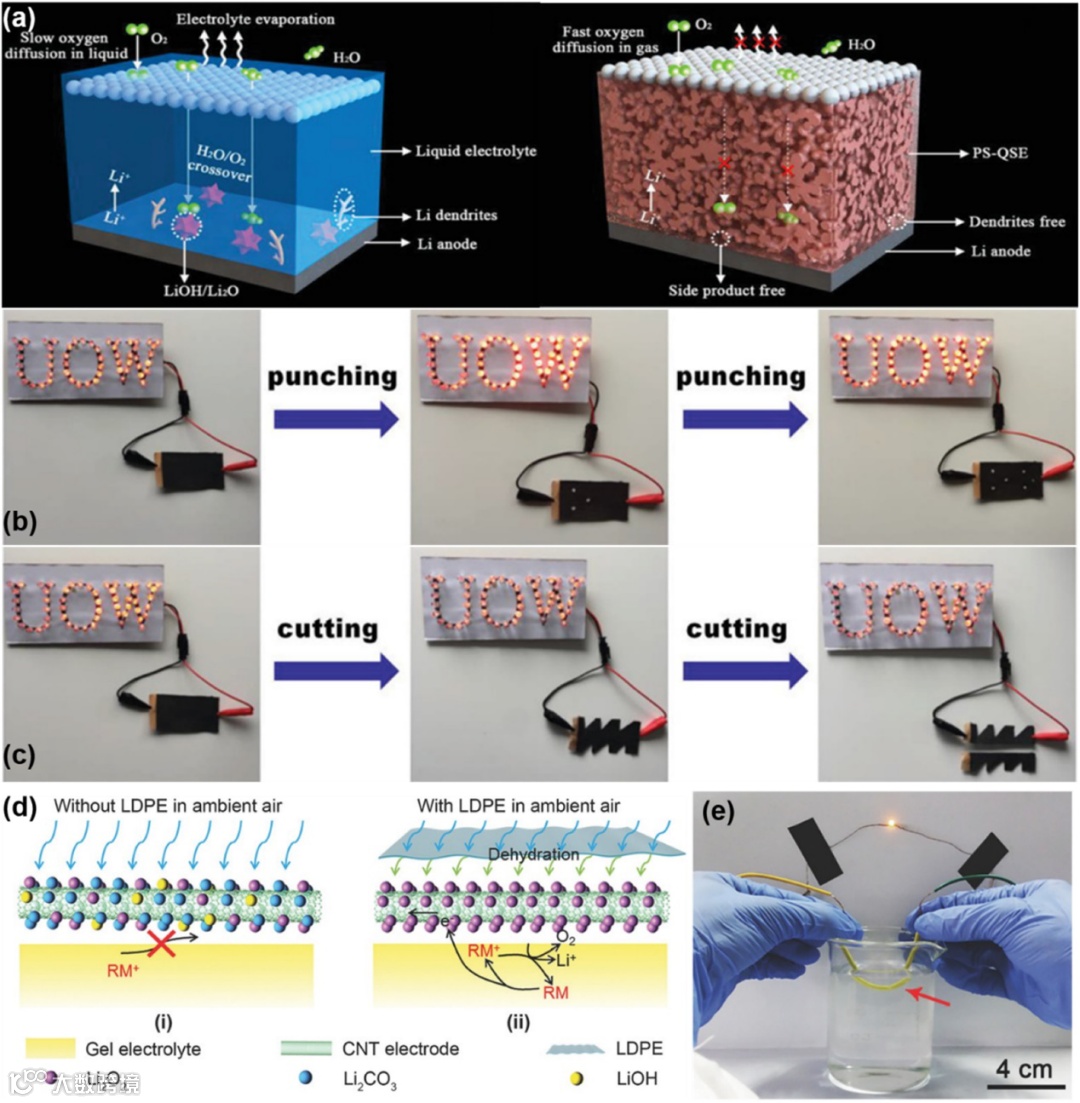
(a-c) Schematic comparison of Li–O2 batteries based on conventional liquid electrolyte and PS-QSE; punching and cutting test of the PS-QSE based flexible Li–O2 battery. Reproduced with permission.
(d-e) Schematic illustration of the working mechanism of the redox mediator (RM) with and without LDPE film in the Li-air battery operated in ambient air, and (e) the bending and waterproof tests of the Li-air battery with LDPE film. Reproduced with permission .
 
文章链接:
https://www.sciencedirect.com/science/article/pii/S2405829720301604#!

导师简介:

汪国秀教授任职悉尼科技大学清洁能源技术中心主任,特聘杰出教授。
汪教授致力于能源材料领域的研发,并在包括材料工程、材料化学、电化学能量储存转换、纳米科技, 先进材料的合成与制造等多个跨学科领域取得了优异的成果。汪教授主持完成二十多项澳大利亚基金委和工业界的项目。迄今为止,汪教授已发表SCI论文超过510篇, 引用超过380000次,h因子107。2018年全球材料和化学双学科高被引科学家(Web of Science/Clarivate Analytics). 英国皇家化学会会士 (FRSC) 和 国际电化学学会会士(ISE fellow)。


版权声明:
1) 本文仅代表原作者观点,不代表本平台立场,请批判性阅读。
2) 本文内容若存在版权问题,请联系我们及时处理。
3) 如作者对该文章有误解误读,请联系我们进行修改,欢迎各位老师进行批评指正。
4) 本文版权归科学材料站公众号所有,翻版必究。
投稿请联系contact@scimaterials.cn
【声明】内容源于网络
0
0
科学材料站
内容 0
粉丝 0
科学材料站
总阅读0
粉丝0
内容0